Myorinji Training Institution
Myorinji Training Institution
The contents of this page include various teachings, from the official
teachings of the Nichiren shu to the secret techniques that have been handed
down from ancient times to Myorinji.
In particular, the content that is not officially taught by the Nichiren
shu is not for shami but for the Nichiren shu priests.
All content on this page is copyrighted.
It is prohibited to take out the contents of the videos and materials on
this page in any way.
It is prohibited to teach the contents of this page to non-members.
Especially the Myorinji's original rituals are absolutely prohibited from being shown to priests other than the members.
Basics for Shami
▼ Educations for Shami
Most of the knowledge here is from "Shutei Hoyoshiki".
Knowledge and skills required before going to the Shingyo dojo.
▼ Before studying
If you are a foreigner Shami who wants to study here, please get permission from your master first.
What is taught here is the official teaching of the Nichiren shu from the
Shutei Hoyoshiki.
Perhaps the official teachings of the Nichiren shu may differ from the
methods of your temples and your masters
It doesn't mean that your temple or your master is doing something wrong.
Each temples and masters has a traditional methods other than a official
methods.
You need to learn the official ways but also respect the traditional ways.
You should not deny the traditional ritual method of your temple or your
master.
The important thing is to be able to distinguish between the official and
traditional methods.
When you are doing a ceremony at your temple under your master, it is ok
to do it in your temple’s traditional way even if it is not officially
correct.
When you are outside of your temple, you should do only the official way
of the Nichiren shu.
▼ Basics of the Shomyo
If you are Shami and want to practice Shomyo, watch this video first.
▼ Dōjō-ge and basic movement
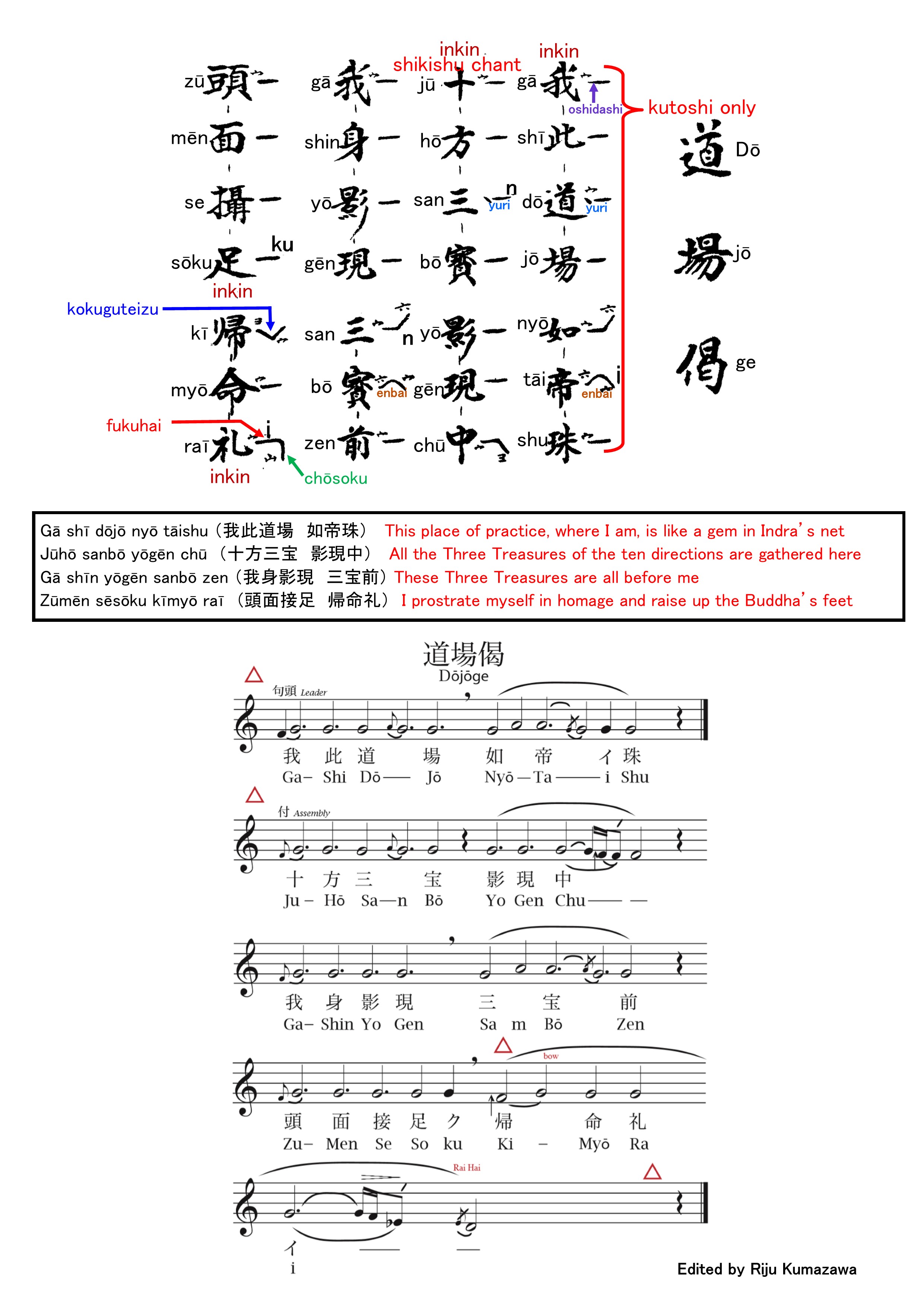
(1) Dōjō-ge (Verse on the Place of Practice)
[Japanese Transliteration]
Gā shī dōjō nyō tāishu 我此道場如帝珠
Jūhō sanbō yōgēn chū 十方三宝影現中
Gā shīn yōgēn sanbō zen 我身影現三宝前
Zūmēn sēsōku kīmyō raī 頭面接足帰命礼
[Translation]
This place of practice, where I am, is like a gem in Indra’s net.
All the Three Treasures of the ten directions are gathered here.
These Three Treasures are all before me
I prostrate myself in homage and raise up the Buddha’s feet.
At the beginning of a ceremony we welcome the many Buddhas and deities
by prostrating ourselves and raising them up by their feet. This is the
verse we use for such reverent prostrations.
The verse is to be chanted in a solemn and stately manner.
Procedures
1. The entire assembly is in jōki with the hands in gasshō.
△ Strike once.
(The triangle indicates to strike the inkin once)
The leader intones “Ga shi dōjō nyo taishū.”
△ Strike once.
The entire assembly chants in unison from “Jūhō sambō” to
“Zumen sessoku.”
△ Strike once.
Between the kyū note at “Ki” and “Myō,” all perform kokugu-teizu.
At “Rai,” they go into fukuhai. Then at the final chi note they perform
chōsoku for a few seconds until the inkin is struck.
△ Strike once.
All quietly raise their heads and return to jōki.
▼ Sanbō-rai
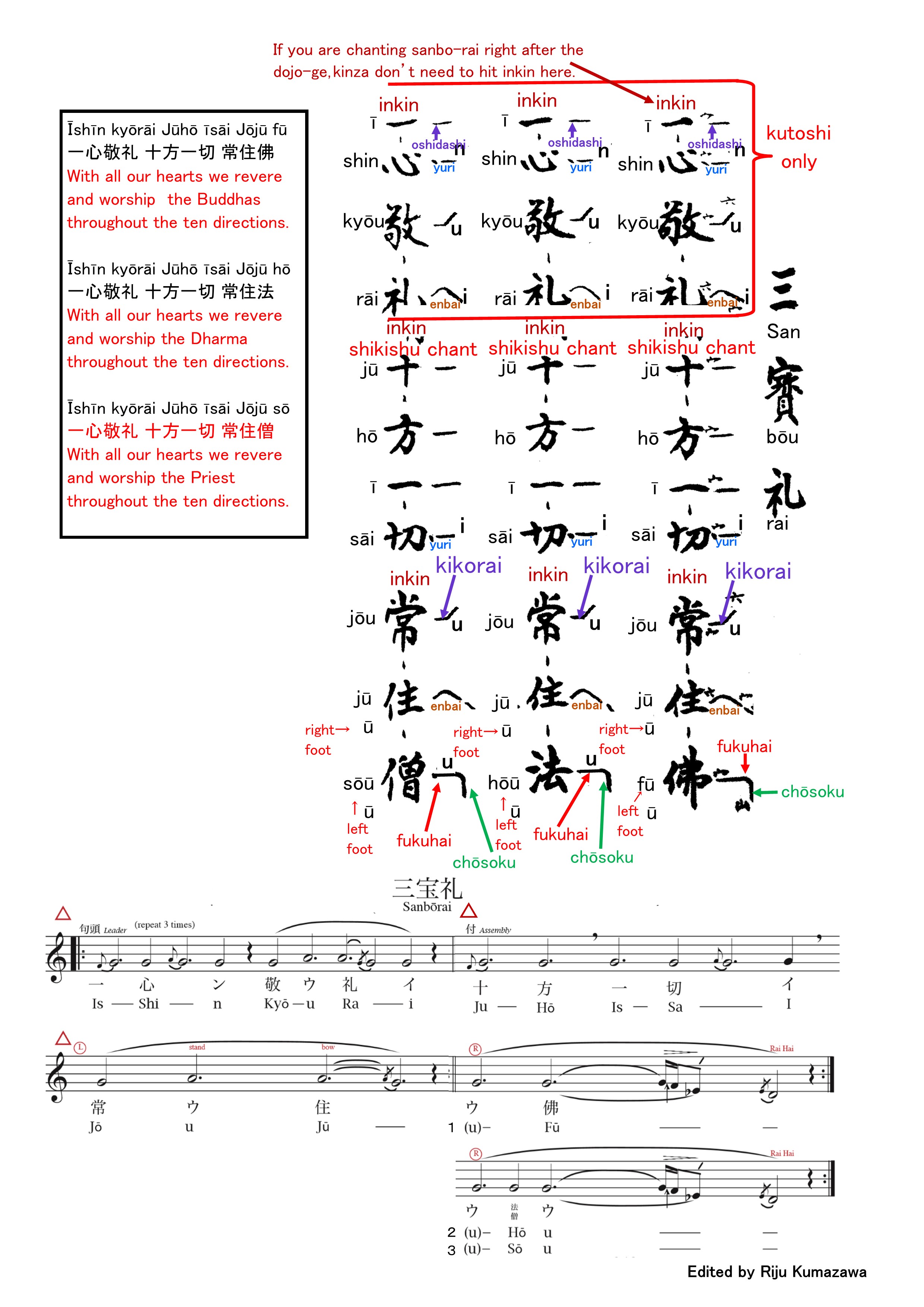
Sanbō-rai
(Worship of the Three Treasures)
Īshīn kyōrāi Jūhō īsāi Jōjū fū
一心敬礼十方一切常住佛
Īshīn kyōrāi Jūhō īsāi Jōjū hō
一心敬礼十方一切常住法
Īshīn kyōrāi Jūhō īsāi Jōjū sō
一心敬礼十方一切常住僧
With all our hearts
we revere and worship the Buddhas throughout the ten directions.
With all our hearts
we revere and worship the Dharma throughout the ten directions.
With all our hearts
we revere and worship the Sangha throughout the ten directions.
● This hymn is performed during reverence for the Three Treasures of Buddhism.
● The worship procedure used with it, and also with Sanki, is kikorai,
that is also properly used by the dōshi in front of the altar after the
incense offering.
● When the dōshi performs it alone, he or she reads the opening and makes
kikorai between the syllables “kyōrai.” If agreement is made beforehand
at the end of “rai,” the chi note may be added.
The chanting accompanying the kikorai should be careful and reverent.
● Procedures:
From jōki with hands in gasshō:
△ Strike once.
(When it is performed immediately following Dōjō-ge, the first striking
of the inkin for the Sanbō-rai may be made as the head is raised at the
conclusion of the Dōjō-ge. The kutōshi then immediately intones the first
syllable of the Sanbō-rai.) The kutōshi intones “Īshīn kyōrāi.”
△ Strike once.
All in unison on “Jūhō īsāi.”
△ Strike once.
At “Jō,” during the transition from the kyū note to the shō note, the right
hand, fingers together, is naturally lowered to the side, as you rise on
your left foot. Take a half step forward. Bringing the right foot in line
with the left, stand upright and bring your palms together in gasshō.
On the first half of “jū,” slowly perform kokugu-teizu.
Then return to the upright standing position with the hands in gasshō.
On the kyū note of the second half of “jū,” take a half step backward on
your right foot.
At “fū,” bring your left foot back to align with your right and, moving
into fukuhai, lightly raise your robe with both hands, kneel and, on the
chi note, perform chōsoku.
△ Strike once
The ministers quietly rise back up to jōki.
As the kutōshi moves into the next phrase, the assembly of ministers once
more brings their hands together in gasshō.
The same worship procedure is performed two more times.
▼ Kiri-sange
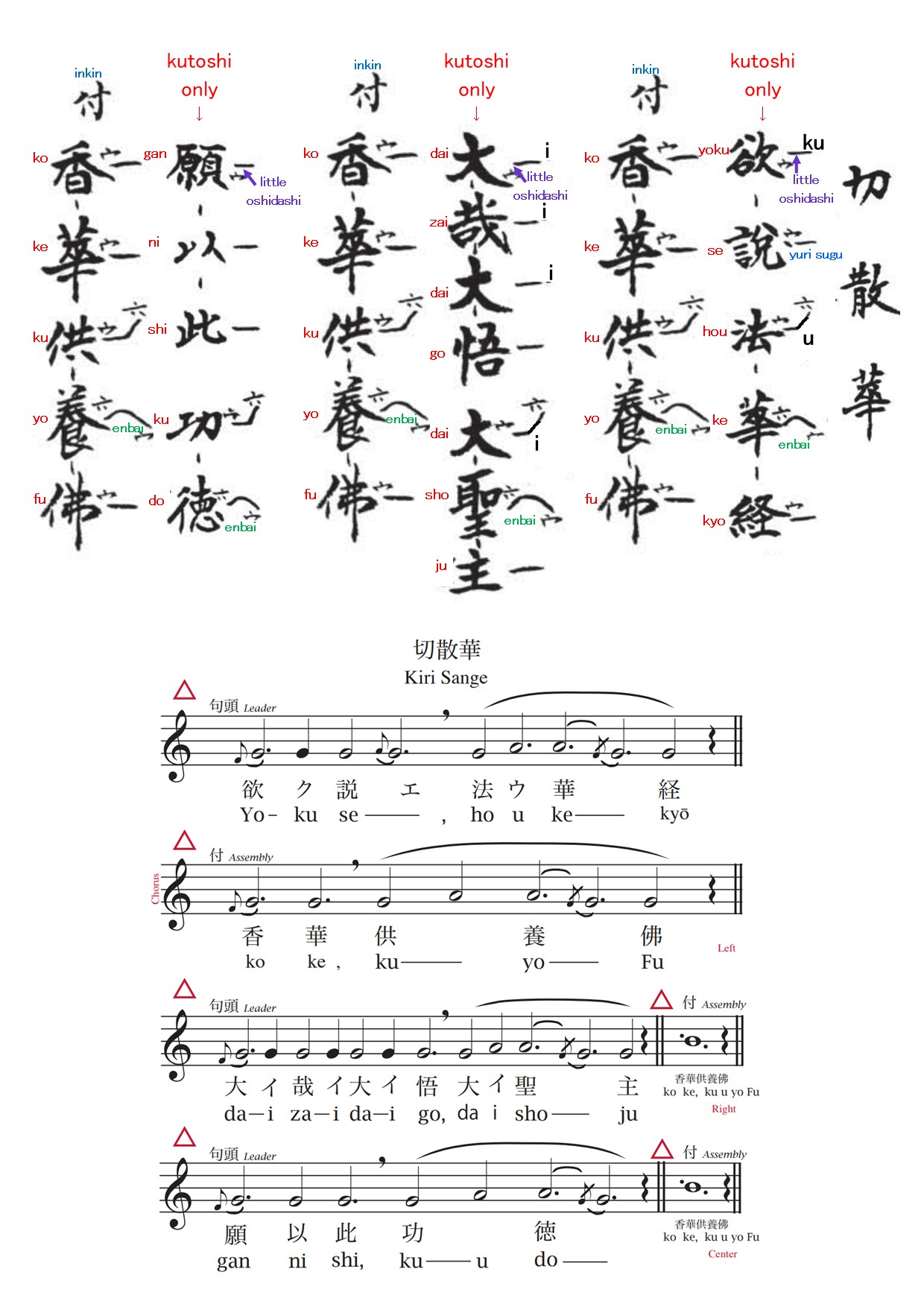
Kiri-sange
(Flower-petal Strewing)
[Japanese Transliteration]
Yōku sē Hōkēkyō Kōkē kūyō fū
欲説法華経 香華供養佛
Dāizāi dāigō daishōjū Kōkē kūyō fū
大哉大悟大聖主 香華供養佛
Gān ni shī kūdō Kōkē kūyō fū
願以此功徳 香華供養佛
[The Buddha] wished to expound the Dharma Flower Sūtra.
With incense and flowers we make offerings to the Buddha.
Great! The Great Enlightened, the Great Holy Lord.
With incense and flowers we worship the Buddha.
May the merits we have accumulated by this offering be distributed among
all living beings.
With incense and flowers we make offerings to the Buddha.
This shōmyō is used when the place of practice is made splendid with the
scattering of flower petals and the setting up of a flower dais to welcome
all the Buddhas and revered beings of the
past.
It should be performed in a bright, pure fashion, livelier than that used
in a gāthā.
Procedures:
△ Strike once.
Pick up the ekoku and chūkei and stand up. Thekutōshi then intones “Yōku
sē Hōkēkyō.”
△ Strike once.
All in unison on “Kōkē kūyō fū.” At “Kōkē” the chūkei is slipped inside
the breast opening of the robe. At “kū,” on the rise from the kyū note
to the shō note, holding a petal by the index and middle fingers of the
right hand, raise it to the level of your forehead.
Throw it on “fū.” At the conclusion of the chanting, the nyō are struck
four times. The same worship procedure is carried out two more times. The
third time, using the hand with which the petals were scattered, take the
chūkei out.
△ Strike once.
Sit down.
The first petal is thrown to the left, the next to the right, and the last
to the center.
You must not seem to be tossing them away.
▼ Shusan
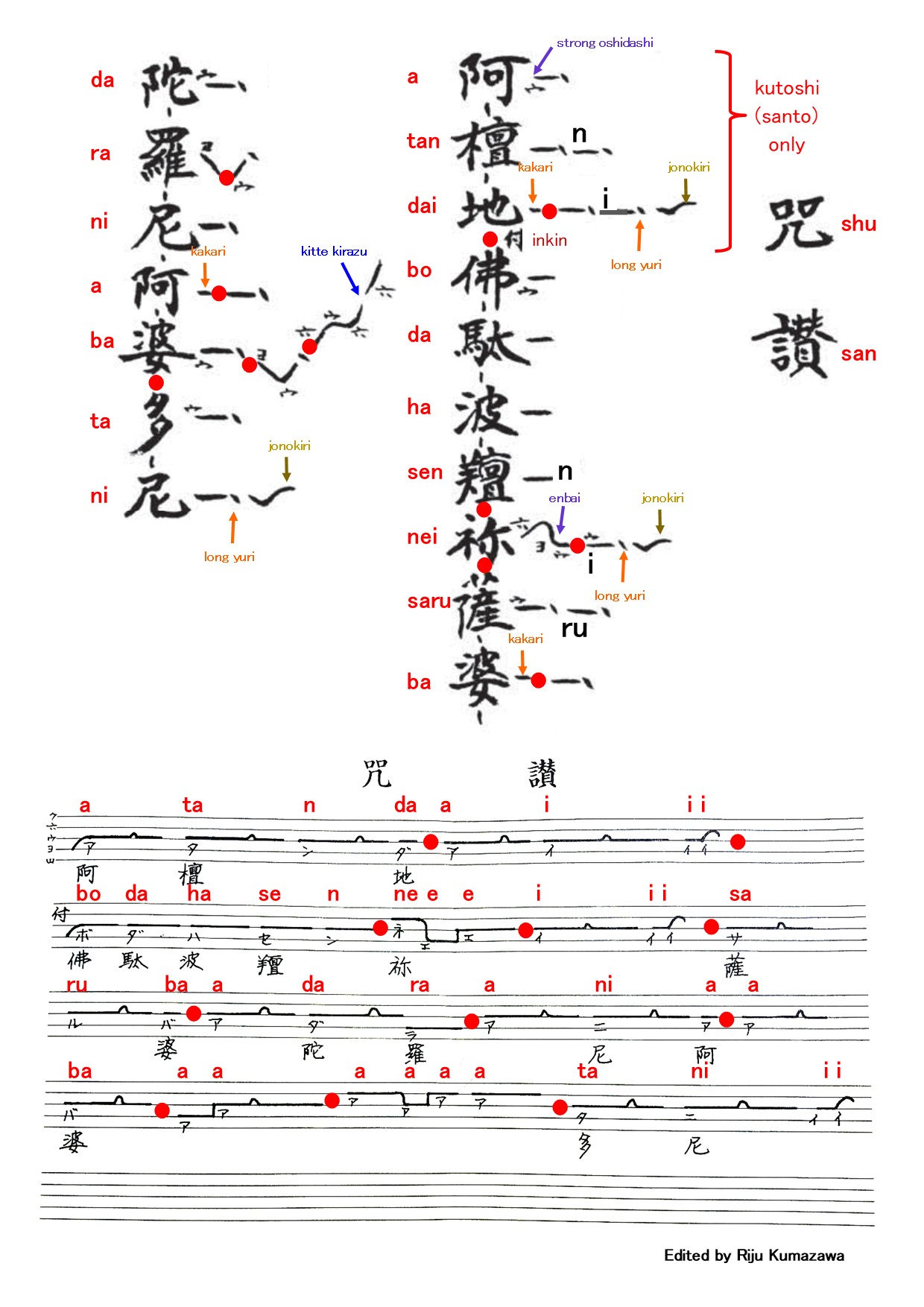
Shusan
(Incantation)
Ā tān dāī
Bō dā hā sēn nēī
Sārū bā dā rā nī
Ā bā tā nī
Shusan is a song to praise the virtues of the Buddha by chanting shu (or
dhāranīs), to express the wish to accomplish all good deeds
and to dedicate the merit to the Buddha. The nyō-hachi accompanies it.
The san of shusan are words for praising the Buddha set to a melody.
There is bonsan (Sanksrit words), kansan (Chinese words), and wasan (Japanese
words).
In Nichiren Shū, the Fugenju (the dhāranī bestowed by Universal Sage Bodhisattva
in chapter 28) with the san melody is called shusan.
We must praise the virtue of the Buddha as highly as possible, so it must
be sung with great devotion like a song.
It features sugu and yuri melodic lines5 and emphasizes the
latter more than the other six shōmyō forms.
At the end of the kyū note at “dāī, nēī, nī,” occurs a jō no kiri, which
gradually drops and fades. The yuri preceding the jō no kiri is protracted
more than other yuri.
The kakari before “dāī,” “bā,” and “Ā” is short and gently chanted.
The voice halts within a single breath at the notation at the end of “Ā
bā” (between shō and shō of shō, kyū, shō, shō) then continues.
Called kitte-kirazu, this occurs only at one place in the seven shōmyō
hymns.
It is of special importance because it is a so-called oral tradition (kuden)
that does not appear in Western notation.
Procedures:
Sit in seiza with hands in gasshō.
In case of debachi (when the nyō-hachi is performed before the altar in
front of the shikishū), the kutōshi assumes the upper seat facing the altar
and strikes the nyō.
In a triangular arrangement, the hachi players are in front of him and
facing each other.
They all are in jōki with hands in gasshō.
△ Strike once.
The kutōshi chants “Ā tān dāī.”
△ Strike once.
All chant in unison from “Bō dā.”
Since the kutōshi has his back turned to the dōshi, he stays in jōki while
the hachi players, picking up their hachi, quietly rise at the end of “Ā
bā.”
At the conclusion of the chant, the nyō is struck once, and the hachi are
played.
Upon hearing the nyō, the shishū change from gasshō to shashu.
In the case of ibachi (when the performers stay at their usual seats),
at the conclusion of “Ā bā,” the players take up their nyō and hachi
and assume jōki.
The nyō-hachi are played at the end of the chanting just as in the procedures
set forth above.
In the old days shusan was chanted using more of the Fugenju, however in
modern times it has been abridged to its current version.
▼ Taiyō
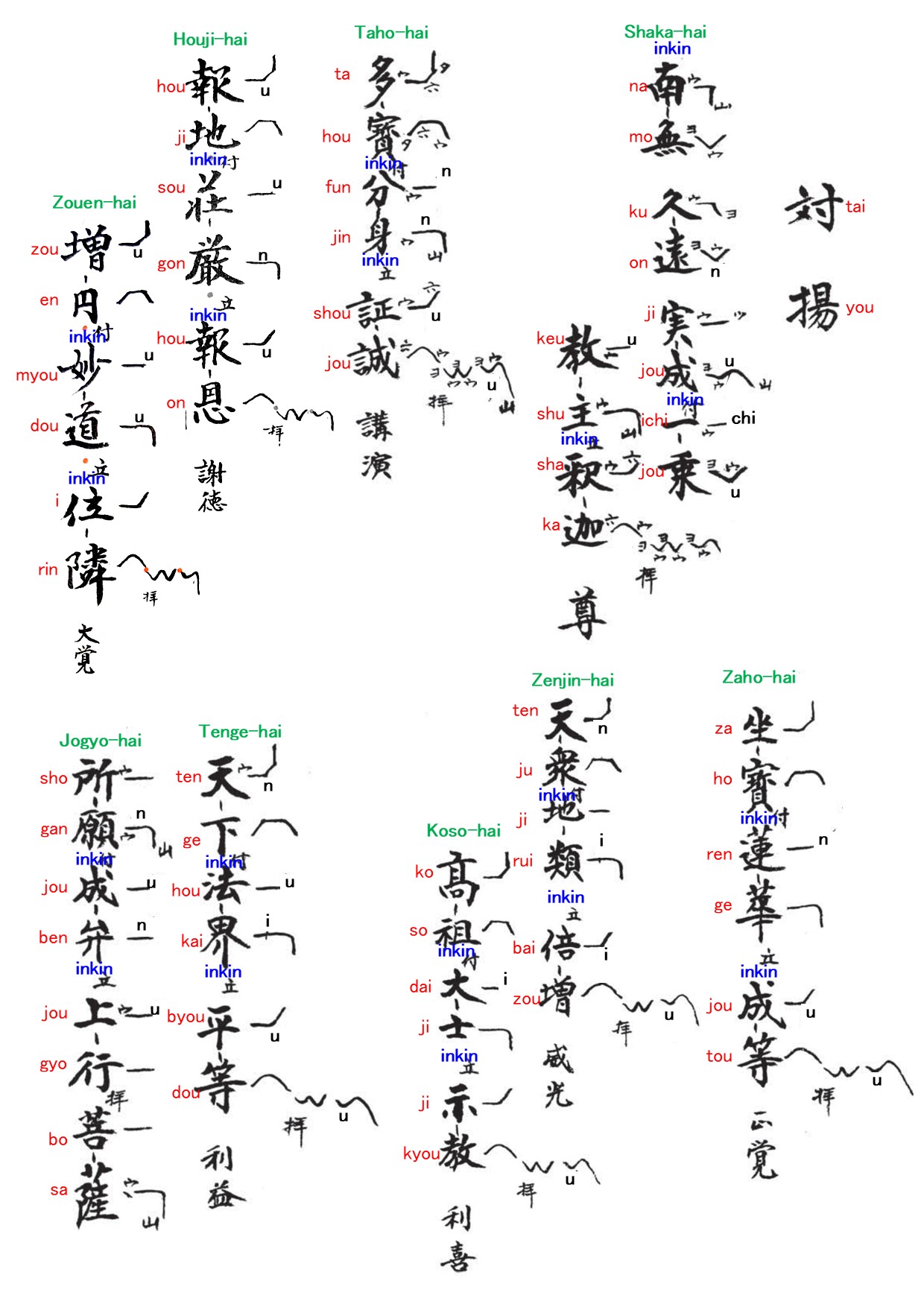
Taiyo Doshi's movement
Taiyō (Reverences)
(a) Shaka-hai (Reverence for Śākyamuni Buddha)
Nāmō Kūōn Jī-jōū Īchijō Kēushū Shākā
Homage to Śākyamuni the World Honored One who attained Buddhahood in the
remote past and is the teacher of the One Vehicle.
(b) Tahō-hai (Reverence for the Many Treasures Tathagata)
Tāhōū Fūnjinn Shōjōū
To Many Treasures Tathagata and the Emanation Buddhas who bear witness,
and verify, and expound [the Lotus Sūtra].
(c) Zenjin-hai (Reverence for the Good Guardian Deities)
Tēnnjū Jīruī Baizōū
To the increasingly majestic illumination of the heavenly and
earthly beings.
(d) Kōso-hai (Reverence for Exalted Founder)
Kōsō Dāijī Jīkyōū
To the exalted founder, the great sage, whose revealed the teachings that
bring great benefit and joy.
(e) Tenge-hai (Reverence for All Things)
Tēnngē Hōukaī Byōdōū
To the equal benefit of all beings in the Dharma world under heaven.
(f) Jōgyō-hai (Reverence for Superior Practice Bodhisattva)
Shōgann Jōbenn Jōgyō Bōsā
To Superior Practice Bodhisattva who accomplishes all vows.
The Taiyō is chanted together with reverent worship to praise the virtue
of the Buddha and to request that our own Buddhist practice proceed successfully
and without obstruction.
In its original form it is performed in Shidaion (antiphonally) between
the taiyōshi and the taishū.
But limitations of time may make it necessary for the taiyōshi to intone
only the opening and then for everyone to join in unison, this is called
tsuketaiyō.
The chanting method, unlike the one employed for gāthā, shortens the recitation
of the opening. It is important that the sounds are flowing and sonorous.
At “Nā,” from the kyū note to the chi note, descent is more than a full
note. The drop should be sharp, not smooth. The same is true at “Kū.”
Atesage occurs between Tahō-hai and Tenge-hai. This means that the chant
rises in this order: kyū, shō, kaku.
In the descent from kaku to shō, chi is hit before the shift to shō.
Then use enbai to return to kyū. This deserves attention because it is
an oral transmission that cannot be represented in Western notation.
Procedures of the tsuketaiyō:
For the first stanza of Shaka-hai, all are in koki.
△ Strike once.
The taiyōshi intones “Nāmō Kūōn Jī-jōū.”
△ Strike once.
All in unison: “Īchījōu Kēushū.”
△ Strike once.
At the shift from the kyū to the shō note at “Shākā,” all rise slowly.
At the final stage of “Shaka,” all make a kokugu-teizu then at the final
chi tone, return to koki.
For the Tahō-hai,
△ Strike once.
The taiyōshi intones “Tāhōū.”
△ Strike once.
All in unison at “Fūnjīn.”
△ Strike once.
All rise at “Shōjō,” make a kokugu-teizu and return to koki.
The same procedure is repeated for the other parts of the Taiyō.
For the Jōgyō-hai,
△ Strike once.
The taiyōshi intones “Shōgān.”
△ Strike once.
All in unison on “Jōu benn.”
△ Strike once.
All rise at “Jōgyō.” On “Bō,” all make a kokugu-teizu. Then on “sā,” all
perform fukuhai. Then on the chi tone, the hands are raised in chōsoku.
△ Strike once.
All quietly raise their heads.
The Taiyōshi carrying an egōro advances to the front of the altar
and begins the shōmyō and then performs raihai.
Composition: The Taiyō is used in combination with an invocation to all
the Buddhas and revered beings of the past (jimbun) and an explanation
of the nature of the ceremony (keibyaku); that is, whether supplication
or dedication.
By its nature, the Taiyō is a supplication, though it is often employed
in memorial services.
It is never, however, used for funerals.
Here are three examples of the explanation (keibyaku) that can be added
to the Taiyō:
At the Dedication Ceremony
With greatest reverence:
We humbly offer this grand truly pure ceremony with music and the building
of this stūpa of treasures. These meritorious words and good practice are
intended to dedicate the establishment of this ○○(hall) to the repaying
of our debt of gratitude to the founder and other ministers in honor of
the ○○th anniversary of the establishment of this temple. We pray for the
prosperity of this temple and the perpetual unfolding of the Dharma.
At the Memorial Service
With greatest reverence:
We humbly offer this grand truly pure ceremony with music and the building
of this stūpa of treasures. These meritorious words and good practice are
intended for ○○-in ○○-shinji on this, their [ordinal number of week or
year] memorial. Sit on the seat of the Lotus Flower of the Wonderful Dharma
and attain the supreme perfect awakening of the Buddha.
At the Grand Memorial Service for Nichiren Shōnin
With greatest reverence:
We humbly offer this grand ceremony with heavenly children and music and
the building of this stūpa of treasures. These meritorious words and good
practice are intended for the Great Bodhisattva Nichiren Shōnin, named
Risshō Daishi by the Emperor, and the First and Foremost Disciple of the
Original Buddha at his ○○th memorial. By this, we illuminate the Buddha
land and show our gratitude for his favors and virtue.
The keibyaku all begin with the phrase “with greatest reverence,” which
is “seikyō” in shindoku.
These keibyaku are all chanted following the Tahō-hai.
When chanting in shindoku, sei is done in the notes of u and kyū, and kyō
is in the note of kyū.
In shindoku, the last eight characters of each keibyaku are chanted with
the same melody as the Tahō-hai.
Time limitations may necessitate the use of a five-part ceremony consisting
of the Shaka-hai and the Tahō-hai, the keibyaku, and then the Tenge-hai
and Jōgyō-hai.
▼ Sanki
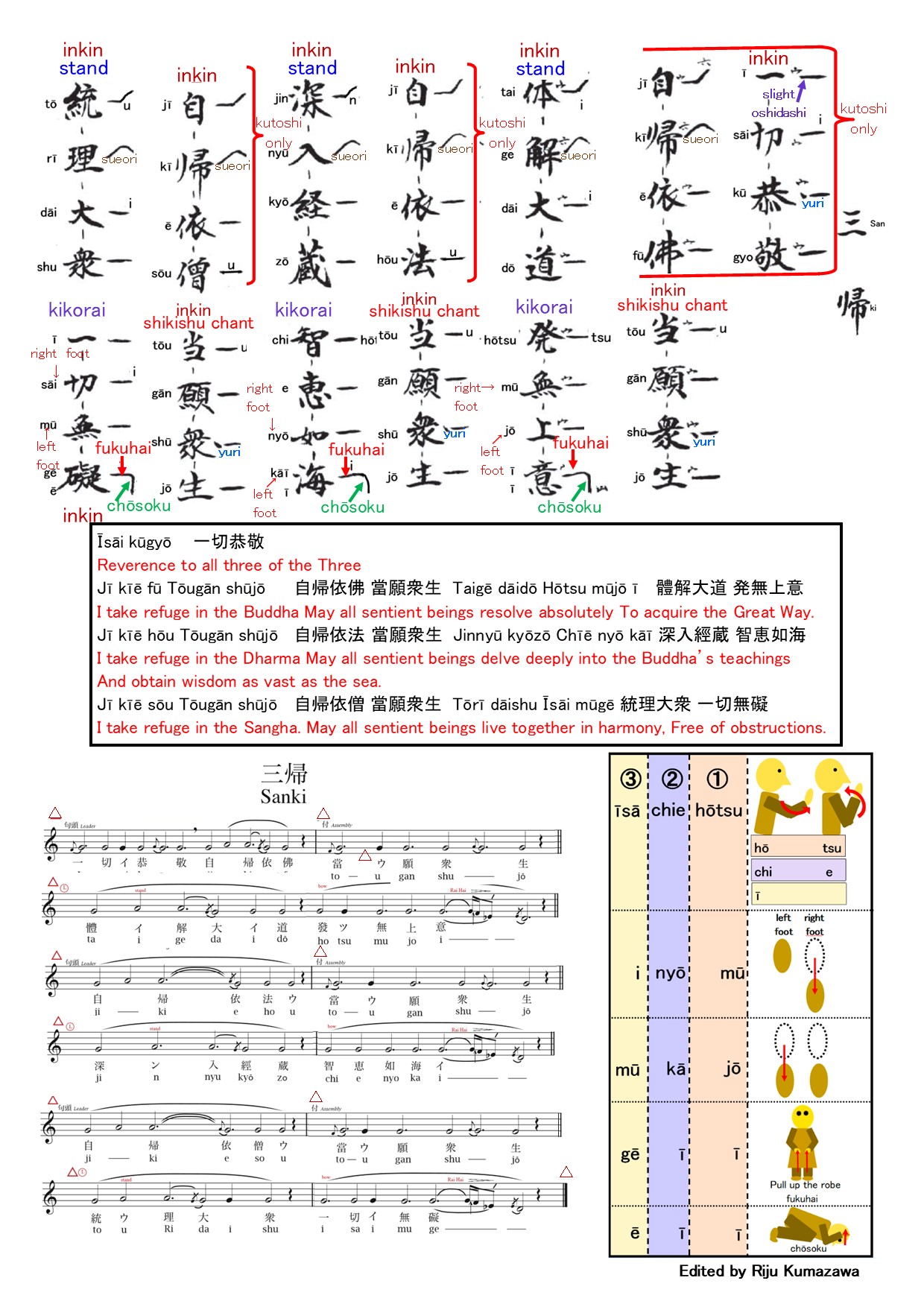
Sanki
(Three Refuges)
Īsāi kūgyō 一切恭敬
Jī kīē fū Tōugān shūjō
自帰依佛 當願衆生
Taigē dāidō Hōtsu mūjō ī
體解大道 発無上意
Jī kīē hōu Tōugān shūjō
自帰依法 當願衆生
Jinnyū kyōzō Chīē nyō kāī
深入經蔵 智恵如海
Jī kīē sōu Tōugān shūjō
自帰依僧 當願衆生
Tōrī dāishu Īsāi mūgē
統理大衆 一切無礙
Reverence to all three of the Three Treasures I take refuge in the Buddha
May all sentient beings resolve absolutely To acquire the Great Way.
I take refuge in the Dharma
May all sentient beings delve deeply into the Buddha’s teachings And obtain
wisdom as vast as the sea.
I take refuge in the Sangha.
May all sentient beings live together in harmony, free of obstructions.
The Three Refuges expresses reliance on the Three Treasures of Buddha,
Dharma, and Sangha and the vow to strive for spiritual diligence.
It must be performed in a reverent yet flowing and lively manner.
This too is performed in conjunction with kikorai. When it is performed
by the dōshi alone, as in the Sambō-rai, he rises at “Jī” during the shift
from the kyū to the shō note and performs kikorai.
It is permissible to add a chi tone at the end.
There is a sueori at “kī” in each verse and at “gē,” “nyū,” and “rī.”
Adding a slight enbai at the end of the shō note, descend to the kyū note
then move immediately to the next kyū note.
This requires special attention.
Procedures:
Kneel in jōki with hands in gasshō.
△ Strike once.
The kutōshi intones “Īsāi kūgyō Jī kīē fū.”
△ Strike once.
All in unison chant together on “Tōugān shūjō.”
△ Strike once.
Slowly rise at the upward shift from kyū to shō at “Tai.”
Perform kokugu-teizu at “Hōtsu.”
Take a step back on the right foot at “mū.”
Take a step back on the left foot at “jō.”
Perform fukuhai at “ī.” Perform chōsoku on the chi tone.
△ Strike once.
All raise their heads as the kutōshi begins the next stanza.
At the end of the second stanza, make a kokugu-teizu at “Chīē.”
Step back on the right foot at “nyō.”
On the “kā” of “kāī,” step back on the left foot. Perform fukuhai on
the “ī” of “kāī.”
At the end of the third stanza, make a kokugu-teizu on the “sā” of
“Īsāi.”
Take a step back on the right foot of the “i” of “sāi.”
Take a step back on the left foot on “mū.”
Perform fukuhai on “gē.”
This is explained diagrammatically as follows.
Hōtsu : Kokugu-teizu
mū : Step back on the right foot
jō : Step back on the left foot
ī : Fukuhai.
Chī ē : Kokugu-teizu
nyō : Step back on right foot
kā : Step back on left foot
ī : Fukuhai
Ī sā : Kokugu-teizu
i : Step back on the right foot
mū : Step back on the left foot
gē : Fukuhai
▼ Busō
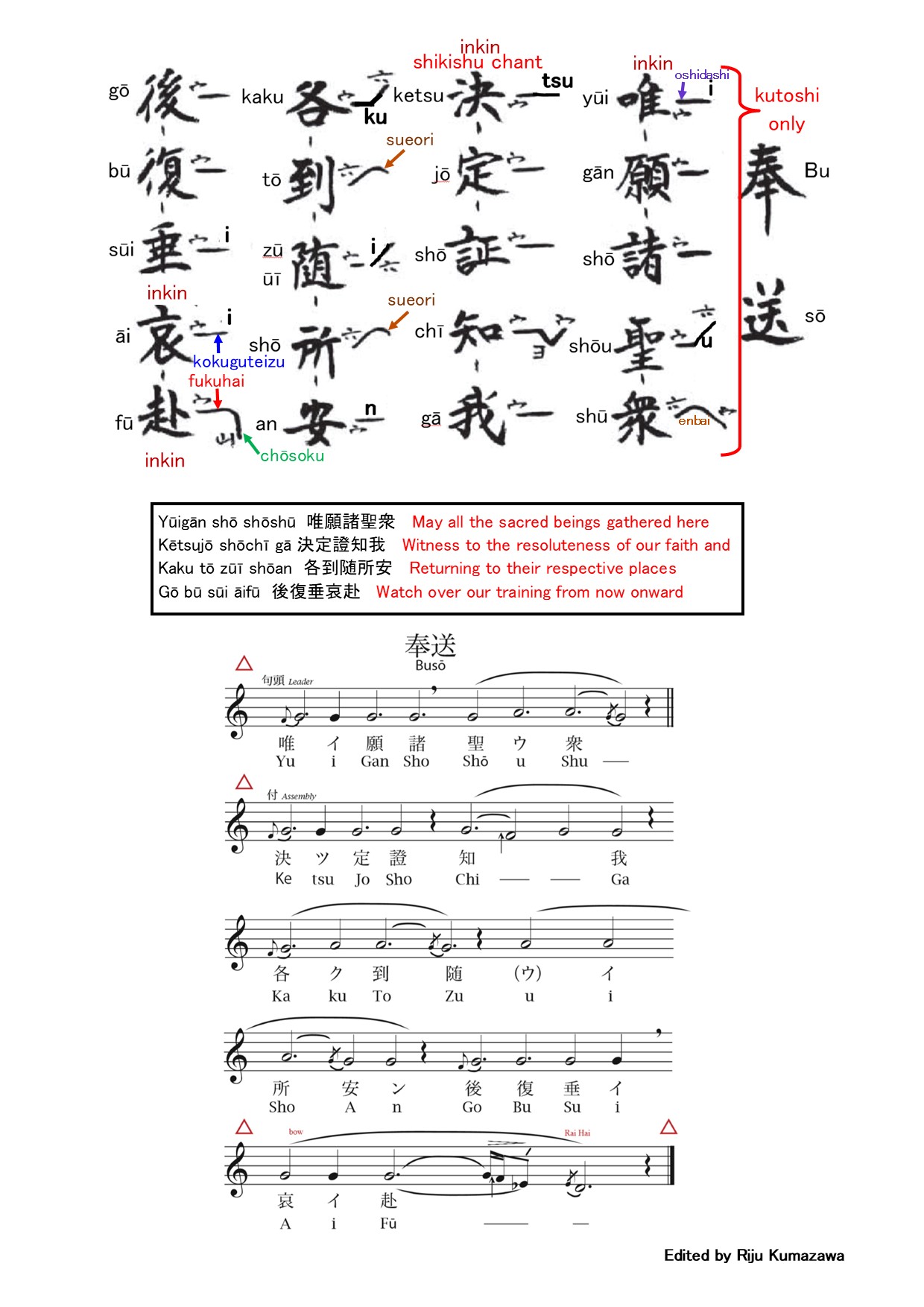
Busō
(Valedictory)
Yūigān shō shōshū
唯願諸聖衆
Kētsujō shōchī gā
決定證知我
Kaku tō zūī shōan
各到随所安
Gō bū sūi āifū
後復垂哀赴
May all the sacred beings gathered here
Witness to the resoluteness of our faith and Returning to their respective
places
Watch over our training from now onward.
This hymn expresses the wish that all the Buddhas, bodhistattvas, and guardian
deities who have assembled in the worship place will return to their own
abodes and always watch over us.
It should be performed solemnly and with a renewed spirit suitable to the
conclusion of the ceremony.
Since there is a sueori at “tō” and “shō,” adding a slight enbai at the
last of the shō note, descend to the kyū note and move on to the next word.
Procedures:
Kneel in jōki with hands in gasshō.
△ Strike once.
The kutōshi intones “Yūigān shō shoshū.”
△ Strike once.
All in unison from “Kētsujō shōchī gā” to the end: “Gō bū sūi.”
△ Strike once.
At “āi,” make a kokugu-teizu.
At “fū,” make a fukuhai. Perform chōsoku at the chi tone.
△ Strike once.
All raise their heads.
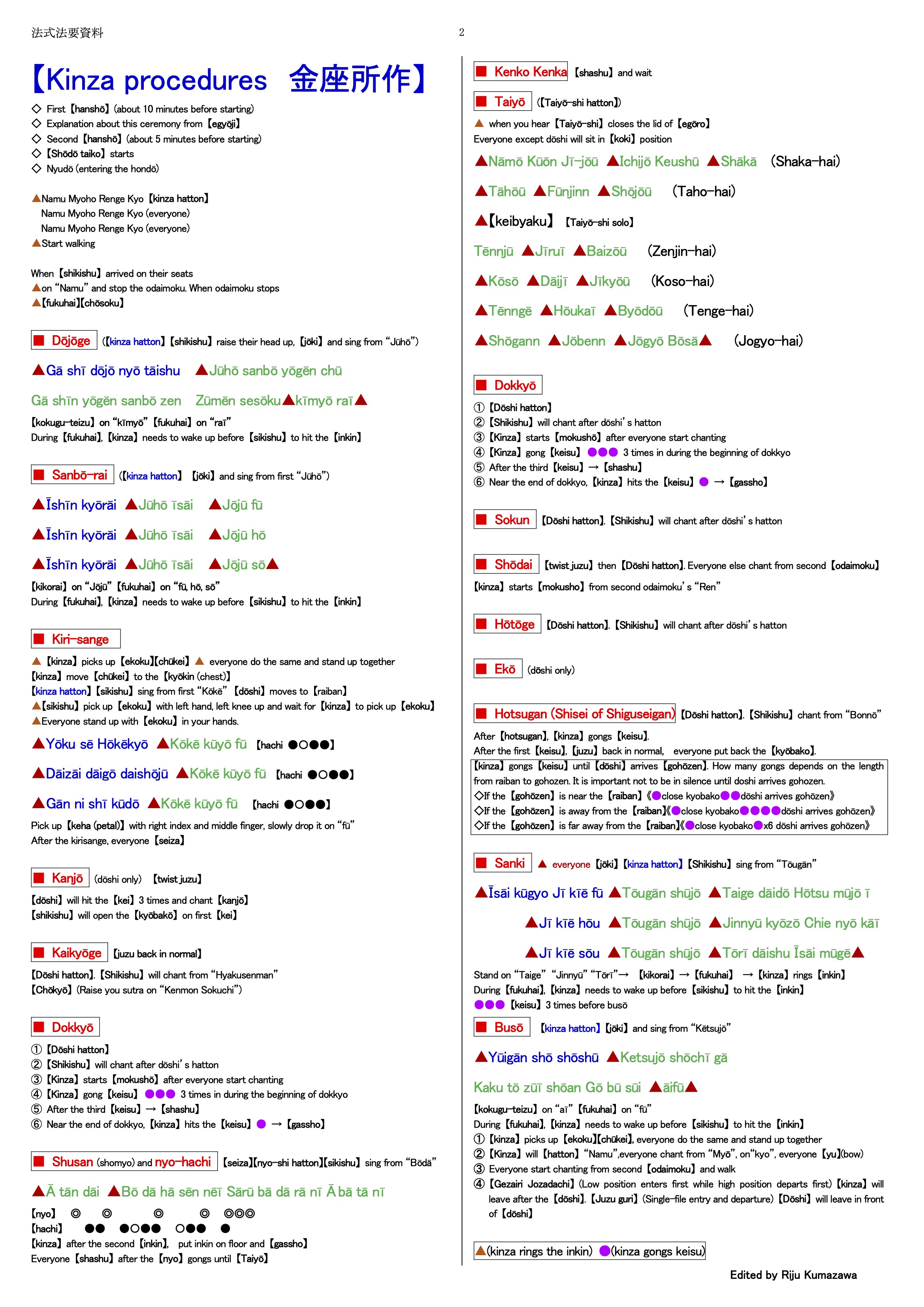
▼ Kinza's procedures
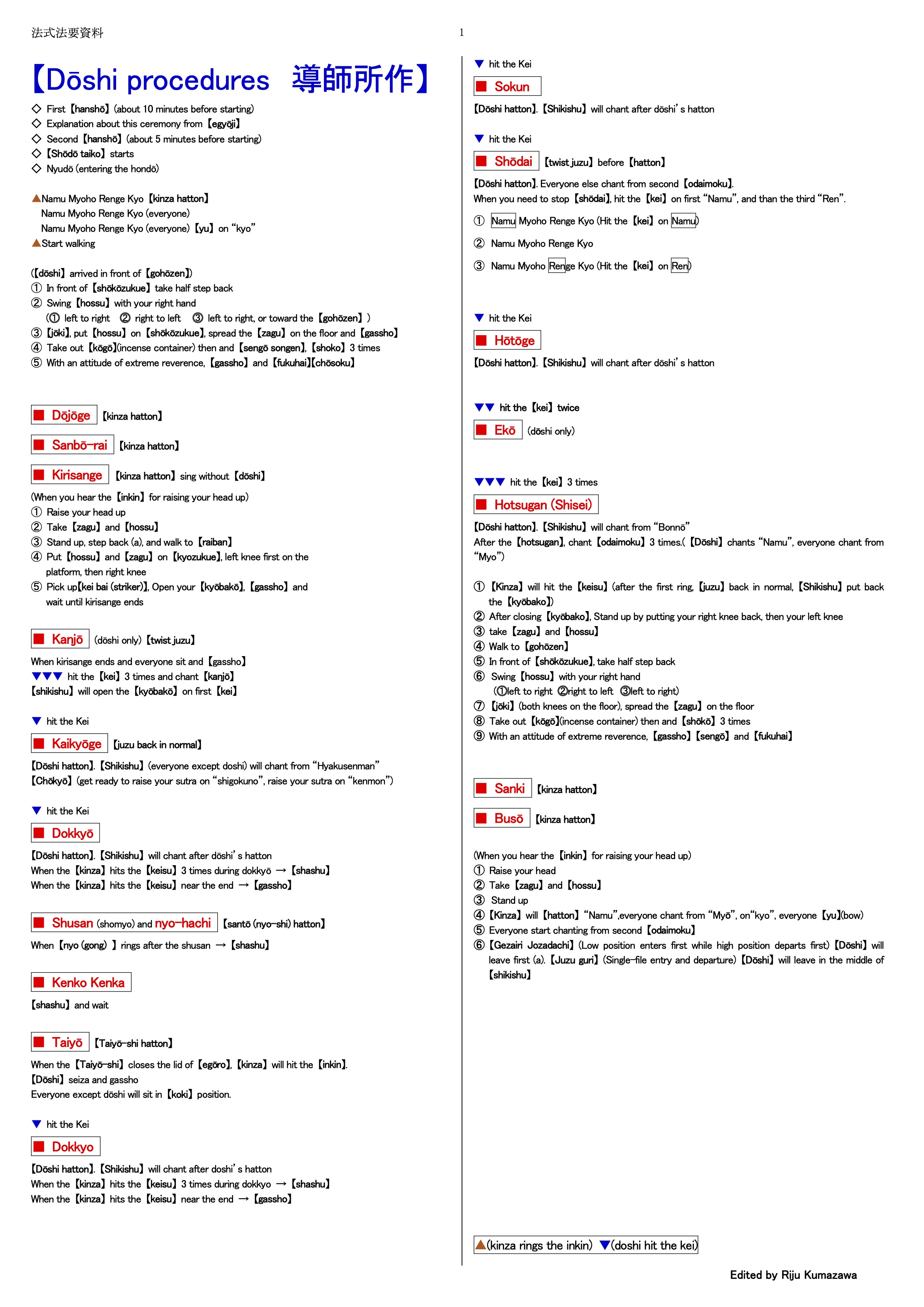
▼ Doshi's procedures
▼ Hanshō & Taikō
Hanshō
(Small Suspended Bell)
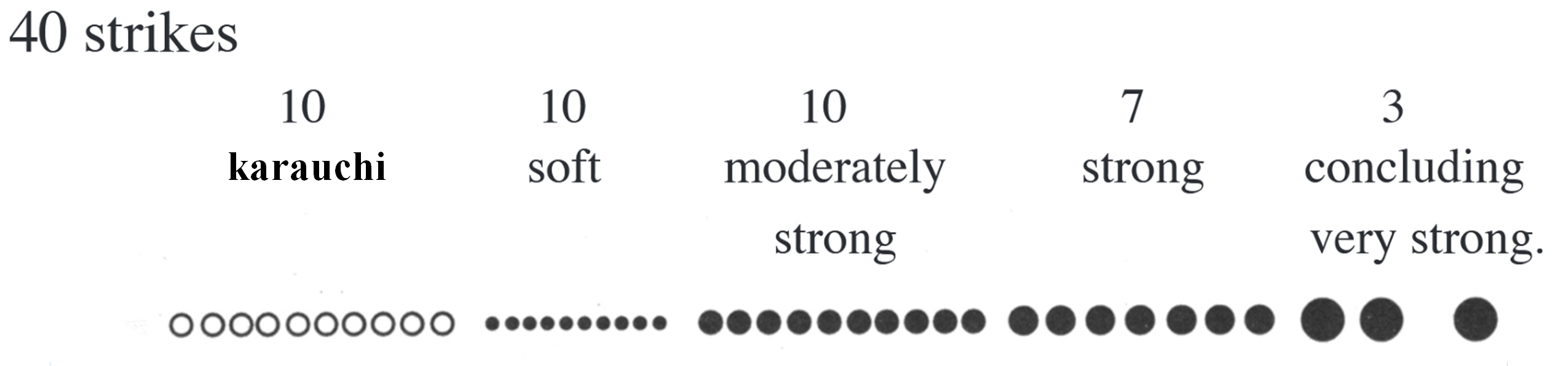
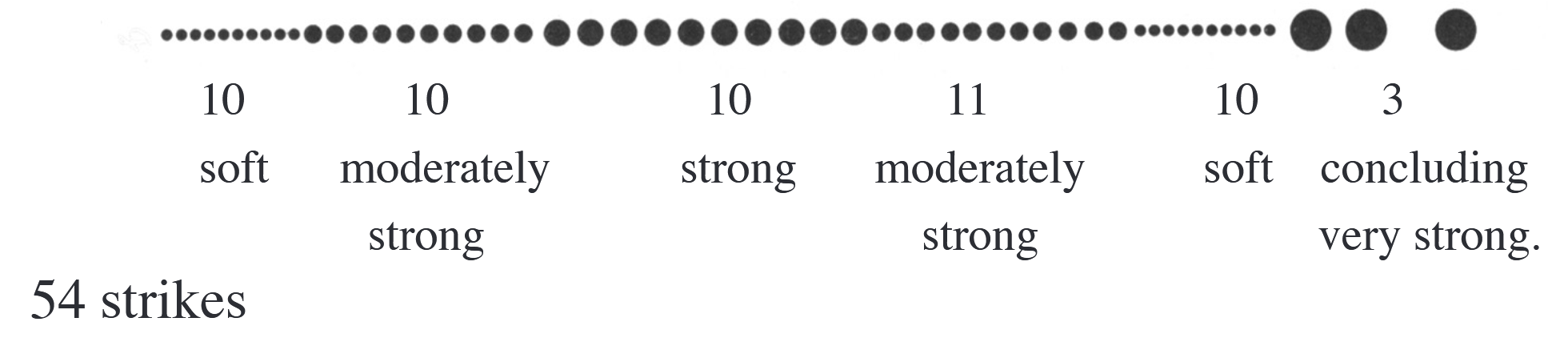
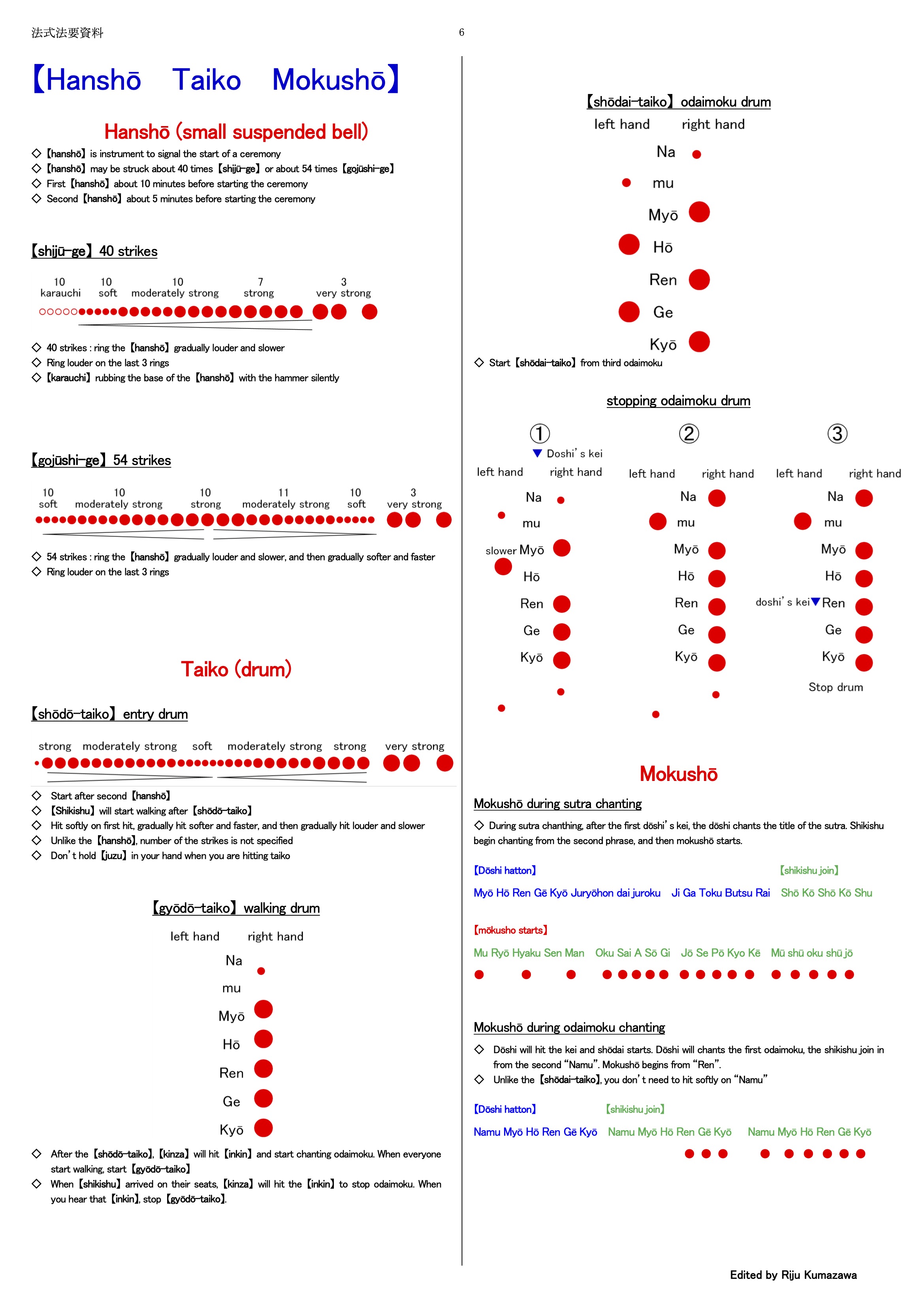
To signal the start of a ceremony, the Hanshō may be struck 40 times or
54 time.
Which one to hit depends on Egyoji's instructions.
Usually hit Hanshō twice before the ceremony.
The first Hanshō signals the priests to dress up.
The second Hanshō signals the priests to line up.
The person in charge of hitting will be Chido.
The timing to hit the Hanshō is usually written in Shiki-shidai.
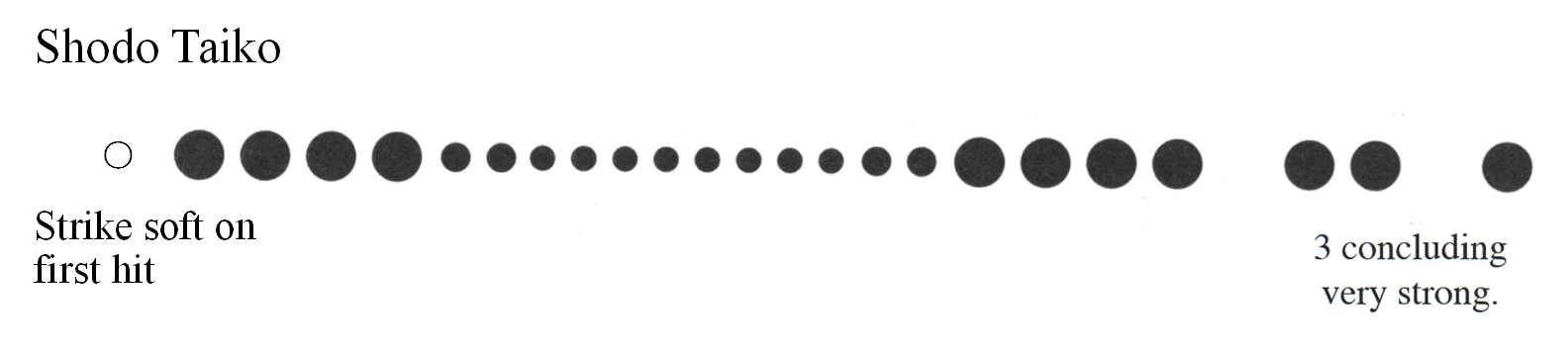
Shōdō Taiko
(Entering Taiko)
Beating the Taiko signals the entry of the Shikishu into the Hondo.
Number of strikes is not specified.
Hit the Taiko with one hand.
Start the Shōdō Taiko after the second Hanshō.
So person in charge of Shōdō Taiko needs to listen carefully for the second
Hanshō.
After the Shōdō Taiko, Kinza will hit the Inkin and the Shikishu will start
walking to the Hondo.
The person in charge of hitting will be Chido.
The timing to hit the Hanshō is usually written in Shiki-shidai.
▼ Shasui Sange
Shasui Sange
(Water Sprinkling and Flower Strewing)
Prior to a ceremony, when the Shikishu has assembled and lined up before
the ceremony, two Chido (assistant priests) perform shasui sange to exorcise
and purify the place.
Shasui Sange will perform it at the four corners of the Hondo.
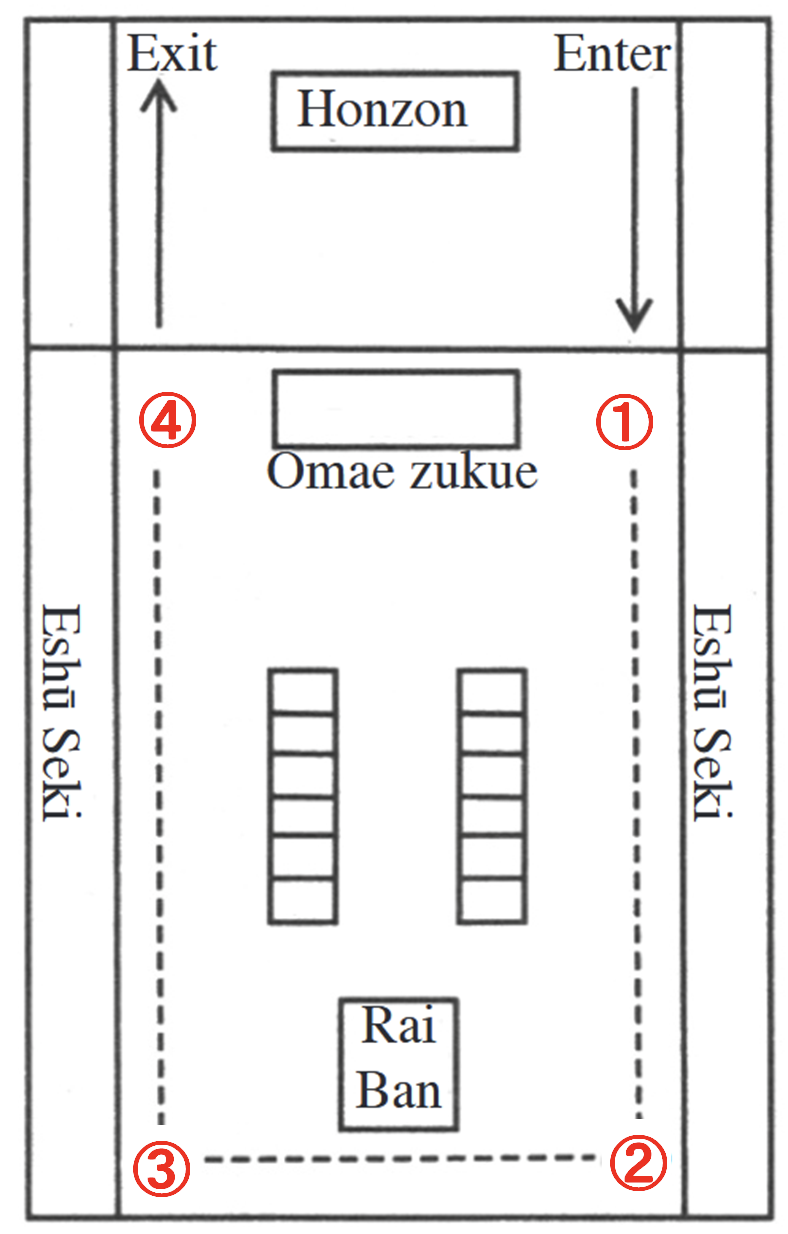
The sange minister carries an ekoku, an inkin, and an egōro with his left
hand only.
He advances to the position marked 2 then turns around to face position
1.
The shasui minister carries a Kebyou (vase) filled with water on the palm
of his left hand, in which are a Sanjo (Shasui wand) and a single seasonal
blossom.
Shasui minister uses Sanjo to sprinkle this scented water to Hondo to purify
Hondo.
He advances to the point marked 1.
The two ministers face each other.
The sange minister strikes the inkin, and both bow.
Picking flower petals from the ekoku with his right hand and scattering
them high, the sange minister throws petals above right, left, and center.
Shasui Sange
(Water Sprinkling and Flower Strewing)
Prior to a ceremony, when the Shikishu has assembled and lined up before
the ceremony, two Chido (assistant priests) perform shasui sange to exorcise
and purify the place.
Shasui Sange will perform it at the four corners of the Hondo.
The sange minister carries an ekoku, an inkin, and an egōro with his left
hand only.
He advances to the position marked 2 then turns around to face position
1.
The shasui minister carries a Kebyou (vase) filled with water on the palm
of his left hand, in which are a Sanjo (Shasui wand) and a single seasonal
blossom.
Shasui minister uses Sanjo to sprinkle this scented water to Hondo to purify
Hondo.
He advances to the point marked 1.
The two ministers face each other.
The sange minister strikes the inkin, and both bow.
Picking flower petals from the ekoku with his right hand and scattering
them high, the sange minister throws petals above right, left, and center.
Simultaneously, the shasui minister takes the Sanjo in his right
hand and, raising it high, writes in the air with its tip the cursive
version of the kanji for water.
Then he returns the Sanjo to the Kebyou.
The inkin is struck again, and the two ministers bow.
They then advance to positions 2 and 3, face each other, and bow
after the inkin is struck once again.
They repeat the flower strewing and water sprinkling.
They then advance to positions 3 and 4 and repeat the procedures
for the third time before retiring.
Should space limitations make adaptation necessary, the two ministers may
enter from behind the altar, the sange minister from the left side as one
faces the altar and the shasui minister from the right side as one faces
the altar.
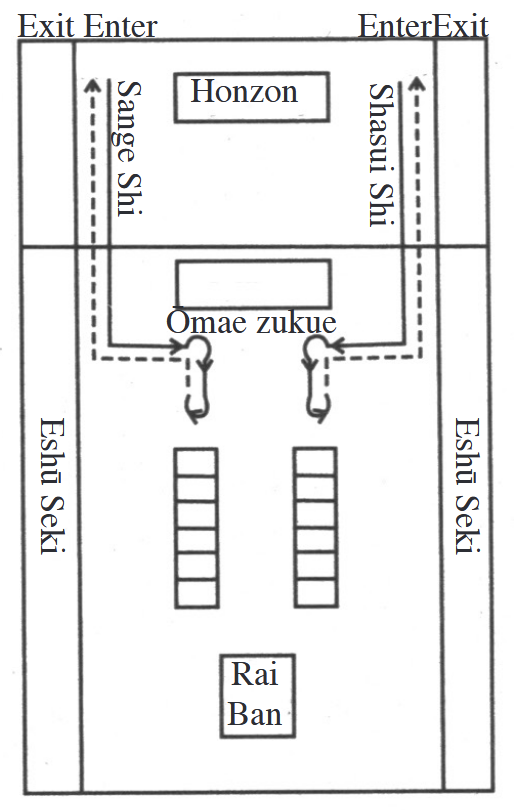
They advance to the front of the altar, face each other and carry out their
procedures.
They then turn away from the altar and walk a few steps towards the entrance
of the worship hall. Then, both facing the entrance they repeat their procedure.
This done, they turn back and retrace their route.
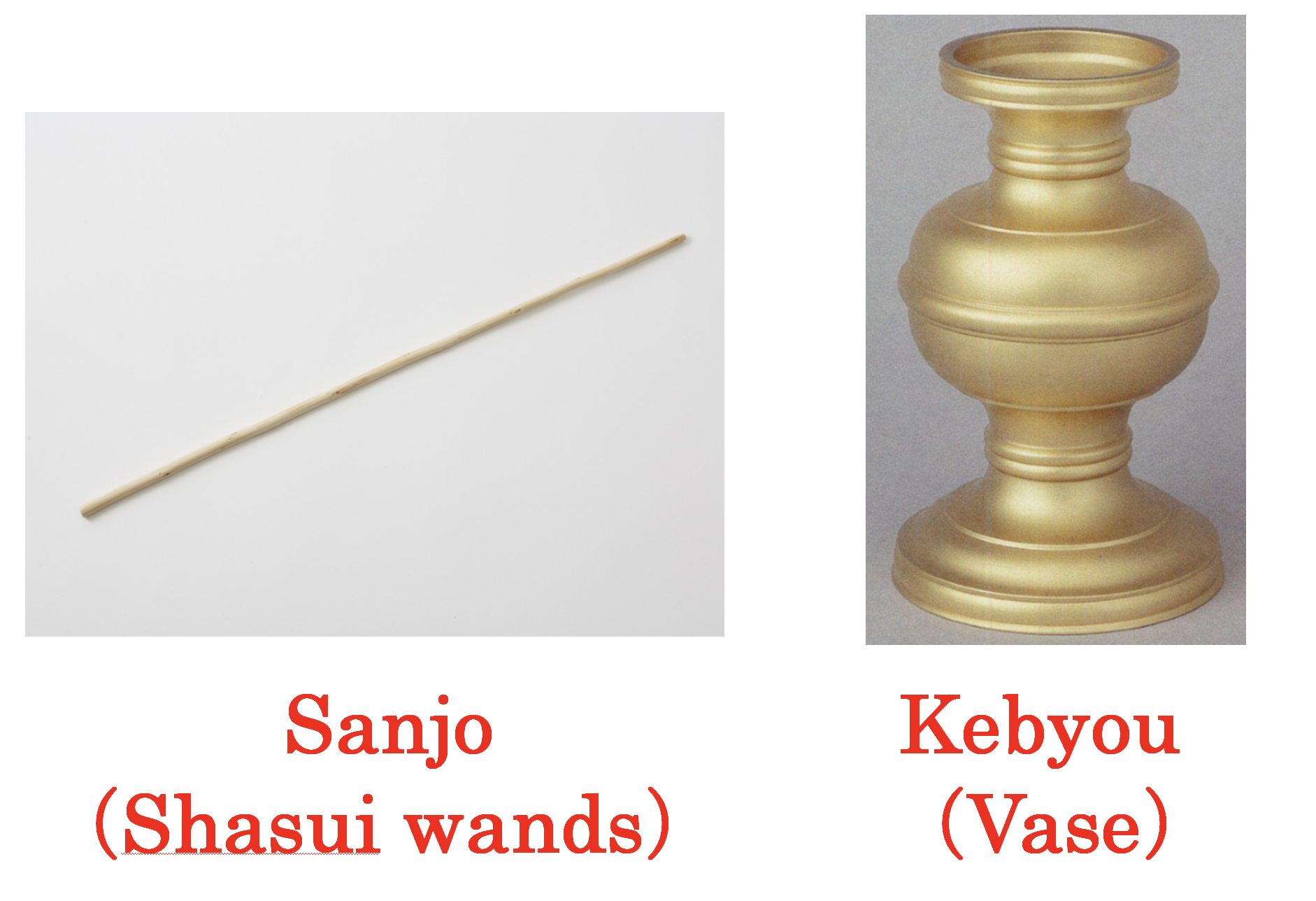
Sanjo, the Shasui wands are made from a branch of plum, peach, or willow
slightly under three centimeters in diameter that has been stripped of
bark, dried, and sandpapered.
One that has grown on the south side of the tree is considered best.
It should be cut to a length equal to the distance between the elbow and
the tip of the middle finger.
White paper is wrapped around about nine centimeters from the lower end.
▼ Kenko Kenka
Kenkō (Incense Offering)
The person making the incense offering first takes up the zagu, then the
egōro, advances to the censer stand, and bows. Then in the position of
jōki, he or she places the egōro in front of and to the right of the right
knee, aligned with the bowl farthest away. Next the minister spreads the
zagu in the appropriate fashion. Repositioning the egōro crosswise directly
in front of his or her knees with the bowl to the left, the minister reverently
burns three pinches of incense. The minister then picks up the egōro, raises
the left knee, stands, and then extends the egōro to the front with both
hands while bowing. This is called jiro-kikorai. The minister then goes
back to jōki, puts the egōro down again as before, and then folds the zagu
and drapes it on his or her left forearm. Then taking up the egōro again,
he or she rises. Elevating the egōro to the height of his or her forehead,
the minister chants the following:
Gedatsu no Myōkō Giten ni Hemman su,
May the wonderful fragrance of liberation pervade everywhere.
Shujō Kaori o Ukete Hōkkai Shōjō nari
May sentient beings receive its aroma and purify the Dharma
realm.
After chanting, the minister bows and returns to his or her place.
Kenka (Flower Petal Offerings)
The person doing kenka takes, in this order, the zagu, the ekoku, and the
chūkei. Advancing to the shōkōzukue, he or she bows. Adjusting the cords
of the ekoku with the chūkei, the minister takes the jōki position. Then
the minister places the chūkei to the right and in front of the right knee,
and the ekoku to the left and in front of the left knee. Spreading the
zagu, the minister offers a pinch of incense, then puts his or her hands
in gasshō, and then does fukuhai. Next, the minister folds and drapes the
zagu over his or her left forearm before taking up the ekoku. Then, adjusting
the ekoku cords with the chūkei, he or she rises. Inserting the chūkei
inside the opening of his or her robe, the minister scatters the petals
left, right, and center three times. Then removes the chūkei and chants
this verse:
Kōfū Shibomeru wo Fuite Shinkō no Mono wo Furasu
Fragrant winds blow away the withered flowers and new flowers
rain down,
Hōkai Jakujō ni Shite Tada Myōshiki Nomi ari
The entire world is tranquil and thus is wondrous form just as it is.
Then the minister bows and returns to his or her place.
When more than one person is performing some action such as kenkō or kenka,
as one is entering and another is leaving, they should bow together from
their respective positions to the dōshi.
Offerings of incense and flowers are not made during funeral service
Learning further for the priests
▼ Learning beyound the Shingyo dojo
Content for Nichiren shu priests who want to study further after finishing Shingyo dojo.
Sharing to non-members is prohibited
▼ About Ho-go (Kaimyo)
戒名 (Kaimyo) is called 法号 (Ho-go) in Nichiren-shu.
Kaimyo is the name given to those who have vowed to keep the commandments in Buddhism.
It is a proof of entering the Buddhist gate and is given as a proof of keeping the commandments.
How to decide Kaimyo differs depending on the Buddhist sect of Japan.
Kaimyo has various ranks, but it may be wrong to rank Buddhist believers.
Kaimyo is not really a rank, but a title that indicates how hard a believer practiced Buddhism and helped his temple in lifetime.
In many cases, the chief priest decides Kaimyo before the funeral after death, but it should be decided while he is alive.
Kaimyo needs to show how the believer lived in his lifetime.
In many cases, the Lotus Sutra characters are used for Kaimyo.
Kaimyo has various parts.
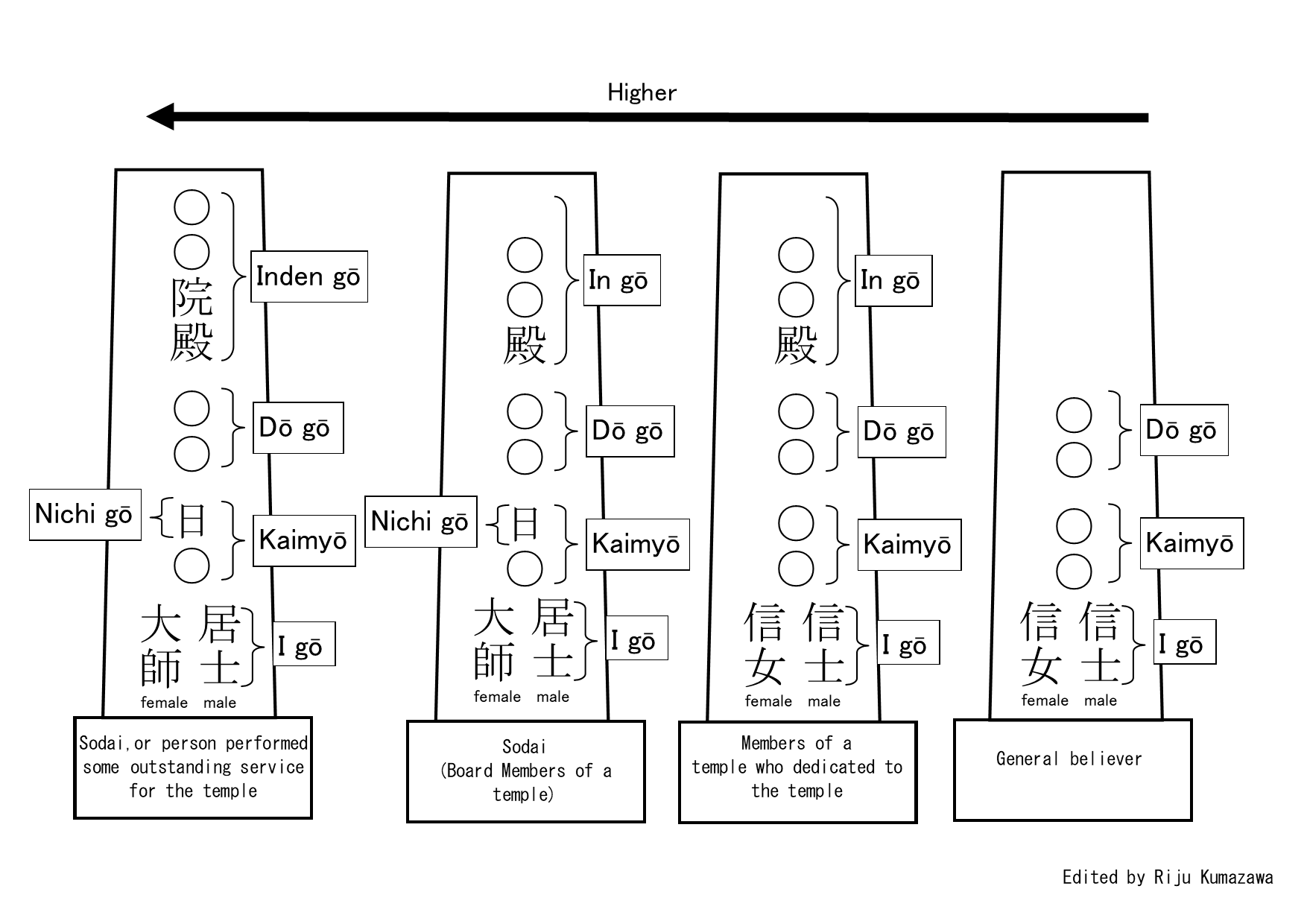
院殿号 (Inden-go)
We add "In den go" for Sodai (board member of a temple) or the believers who performed some outstanding service for the temple, such as donating a large building or land.
It will be ◯◯院殿 (xx In-den)
It is very very rare to give "In den go”, in Myorinji, it is not awarded for decades.
院号 (In-go)
We add "In go" for Sodai (board member of a temple) or the believers who helped the temple alot.
It will be ◯◯院 (xx In)
道号 (Do-go)
Do-go express his work, personality, and his characteristics. You should use the words from Lutus Sutra.
戒名 (Kaimyo)
This will be like a first name for the deceased. If he helped a lot for the temple, you should add 日号 (Nichi-go) in it.
So it will be 日◯. (Nichi x)
This “x” will be from his name. My name is 吏樹 (Riju), so it will be 日吏 (Nichi Ri).
However, you can do it if his name is in Kanji. For foreigners, if the name is not in Kanji, you should name it from the sound of the name.
For example, if his name is John, the sound “Jo” can be written “助”. So it will be “日助 (Nichi Jo)”.
Or you can name it by the meaning of the name. For example, if his name is Mark, “印 (In)” is the Kanji for “mark” so you can name it “日印 (Nichi In)”.
Since you will be giving “Inden-go” to the believers who performed some outstanding service for the temple, “Inden-go” should have “日号 (Nichi-go)”.
So it should be xx Inden xx 日x Koji (or Daishi).
For “In-go”, “日x” or ”法x” “妙x” depends on how hard he practiced Buddhism.
If the deceased is general believers, you should add “法 (Ho)” for male and “妙 (myo)” for female.
So it will be 法◯ (Ho x) or 妙◯ (Myo x).
位号(I-go)
Two kanji to indicate the gender and age of the deceased.
Higher I-go will be 居士 (Koji: for high ranked male), 大姉 (Daishi: for high ranked female).
It is not too common but you can give someone 大居士 (Daikoji) for male, 清大姉 (Seitaishi) for female adult with remarkable achievement and devotion to Nichiren Shū and the temple.
They should have “Inden-go” also.
General I-go will be 信士(Shinji: for general male), 信女 (Shin’nyo: for general female).
Someone with “Inden-go” should ranked “Koji” or ”Daishi”.
If it is “In-go”, you can rank it “Koji Daishi” or "Shinji Shin’nyo” depends on how hard he practiced Buddhism.
So the Kaimyo should be
The most superior ranked Kaimyo
(commonly not given because it is too superior)
xx Inden xx Nichi x Daikoji (or Seitaishi)
〇〇院殿 〇〇 日〇 大居士(清大姉)
Superior ranked Kaimyo
xx Inden xx Nichi x Koji (or Daishi)
〇〇院殿 〇〇 日〇 居士(大姉)
Higher ranked Kaimyo
xx In xx Nichi x Koji (or Daishi)
〇〇院 〇〇 日〇 居士(大姉)
High ranked Kaimyo
xx In xx Ho (or Myo) x Koji (or Daishi)
〇〇院 〇〇 法(妙)〇 居士(or Daishi)
xx In Ho (or Myo)x xx Koji (or Daishi)
〇〇院 法(妙)〇 〇〇 居士(or Daishi)
Moderately high ranked Kaimyo
xx In xx Ho (or Myo) x Shinji (or Shin’nyo)
〇〇院 〇〇 法(妙)〇 信士(信女)
xx In Ho (or Myo)x xx Shinji (or Shin’nyo)
〇〇院 法(妙)〇 〇〇 信士(信女)
General ranked Kaimyo
xx Ho (or Myo) x Shinji (or Shin’nyo)
〇〇 法(妙)〇 〇〇 信士(信女)
Ho (or Myo) x xx Shinji (or Shin’nyo)
法(妙)〇 〇〇 信士(信女)
This is just an example, and there are various ways to decide Kaimyo.
Priests should get Kaimyo from the master or create it by yourself.
Especially if you are giong to Aragyo, it could lead to death so you need
Kaimyo before entering Aragyo.
Priest’s Kaimyo will be
xx In Nichi x
◯◯院 日◯
I-go for the male priest will be Shonin(上人), for the female priest will
be Honi(法尼).
However, never call yourself Shonin or Honi because it is for calling other
priests with respect.
If you call yourself “Shonin”, it is like you are calling yourself “sir”.
▼ Kanji that match with the Kaimyo
院号(In-go) is a title given to the deceased who is considered to have made a great contribution to temples and society, and is considered to be the highest rank in Kaimyo.
Therefore, the two letters of In-go should be words that describe his achievement.
Do-go is a name given to those who have mastered Buddhism.
In modern times, Do-go is a two-letter reminiscent of the deceased's personality, character, and jobs.
Kaimyo is the two letters that are attached under Do-go.
Originally, only this part is called "Kaimyo”.
In Nichiren-shu, you should add “日(Nichi)” or ”法 (ho)” or “妙 (Myo)” and one letter from the original name.
Kaimyo should be given before death, and the Kaimyo given before death is called the “逆修戒名 (Gyakushu Kaimyo : reverse Kaimyo" or “生前戒名 (Seizen Kaimyo : pre-life Kaimyo”.
You should use the two letters written in the Lotus Sutra as much as possible for creating Kaimyo.
For example, if the deceased has a personality that makes others happy, you can name it “福聚 (Fuku Ju)” from chapter 25's "福聚海無量 (Fuku ju Kai Mu Ryo)" because it means that the amount of power that brings happiness is as vast as the sea.
If you can't find the two letters that match the deceased from the Lotus Sutra, combine the letter that represents the deceased.
For example, if the deceased was a brave fisherman, take “勇 (Yu: brave)" from “勇猛精進 (Yu Mo Sho Jin: Brave devotion)" in Chapter 1 and “海 (Kai: Sea)" from "福聚海無量 (Fuku Ju Kai Mu Ryo)" in Chapter 25 to make “勇海 (Yu Kai: Brave Sea)".
The kanji Kanji letters commonly used in Kaimyo
慈 (Ji) Charity
優 (Yu) Nice
華 (Ke, Ge) Flower
英 (Ei) Glory
勇 (Yu) Brave
光 (Ko) Light
泉 (Sen) Spring water
天 (Ten) Heaven
蓮 (Ren) Lotus
海 (Kai) Sea
宝 (Ho, Po, Bo) Treasure
安 (An) Safe, Relief
円 (En) Circle
温 (On) Warm
観 (Kan) Watch, View
勤 (Gon) Work
教 (Kyo) Teach
行 (Gyo, Ko) Go
空 (Ku) Sky
香 (Ko) Scent
乗 (Jo) Ride
真 (Shin) Real, Truth
心 (Shin, Jin) Heart, Mind
純 (Jun) Pure
長 (Cho, Jo) Long
知 (Chi) Knowledge
雲 (Un) Cloud
福 (Fuku) Happy
寿 (Ju) Long life
聚 (Ju) Gather
風 (Fu) Wind
陽 (Yo) Sun
輪 (Rin) Round, Ring
龍 (Ryu) Dragon
良 (Ryo) Good
和 (Wa) Peace
愛 (Ai) Love
意 (I) Will
志 (Shi) Aspiration
永 (Ei) Forever
慧 (E) Wisdom
恵 (E) Enlightenment
学 (Gaku) Learning
喜 (Ki) Joy
眼 (Gan, Gen) Eye
健 (Ken) Health
讃 (San) Praise
進 (Shin) Moving forward
信 (Shin) Believe
正 (Sei, Sho) Right way
浄 (Jo) To cleanse
守 (Shu) Protect
静 (Sei) Silent, Quiet
清 (Sei) Clean
白 (Haku, Byaku) White
For example, if the deceased was a very warm and nice person, it can be 慈温 (Ji On; Charity and warm).
If the deceased lived a long life, it can be 寿良 (Ju Ryo: Long life and Good).
If the deceased was a nice teacher, it can be 優教 (Yu Kyo: Nice and teach).
When you are creating Kaimyo, you should always consult with someone who can understand Japanases very well.
It is because depending on the combination of the Kanji, the meaning might change or the pronunciation may not be suitable for Kaimyo.
For example, 雲知 (Un Chi: Cloud knowledge) might sound nice but in Japanese, Unchi means “Poop”.
You don’t wan to name some “Poop” right? So always consult with someone who can understand Japanese if you are creating Kaimyo.
▼ About Kishimojin
As you should know, Kishimojin was the mother of hundreds of childrens.
Since she is Oni (ogre or demon), she always ate many of other mother's
children so mothers ask Buddha for help.
So Buddha hid her youngest and favorite child to let her know other mothers'
suffering to lose a child and made her believe Buddhism.
After that she promised to protect childrens and mothers and became Shoten-zenjin
of Buddhism.
She chanted “ Ideibi Ideibin Ideibi Adeibi.......” (from chapter 26), and
promised to protect the believers of Lotus Sutra.
In Kanji, the way you write Kishimojin is “鬼子母神”.
鬼: Ogre or demon
子: Children
母: Mother
神: God
There are horns in ogre, but since the horns of Kishimojin have been removed
because her mind was purified by Buddha, the horns of Kishimojin's Kanji
may not be written in Nichiren-shu.
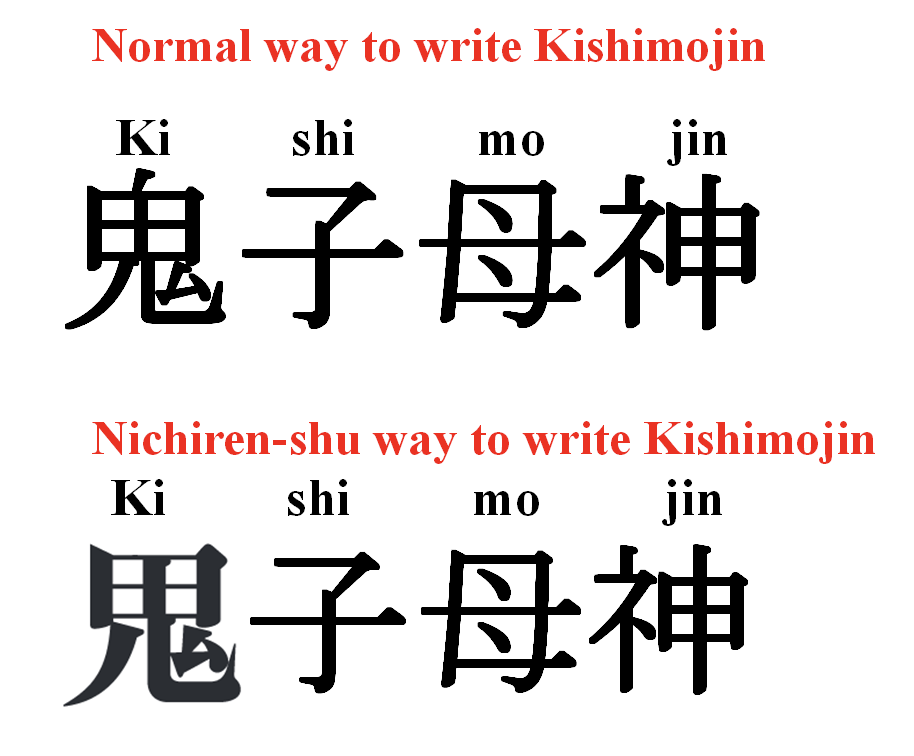
This Nichiren-shu way of writing 鬼 is called “Taku”.
The reason why we call it “Taku” is because the upper part of the kanji
is “Ta” and lower part of the kanji is “Kyu”, so in Nichiren-shu (especially
in Aragyo), we call this kanji “Taku”.
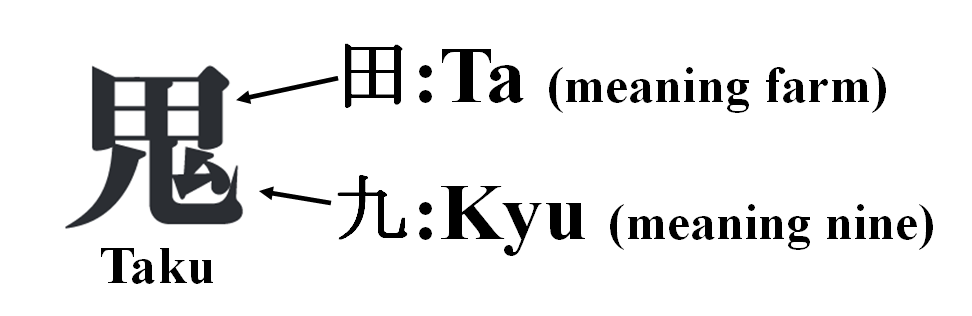
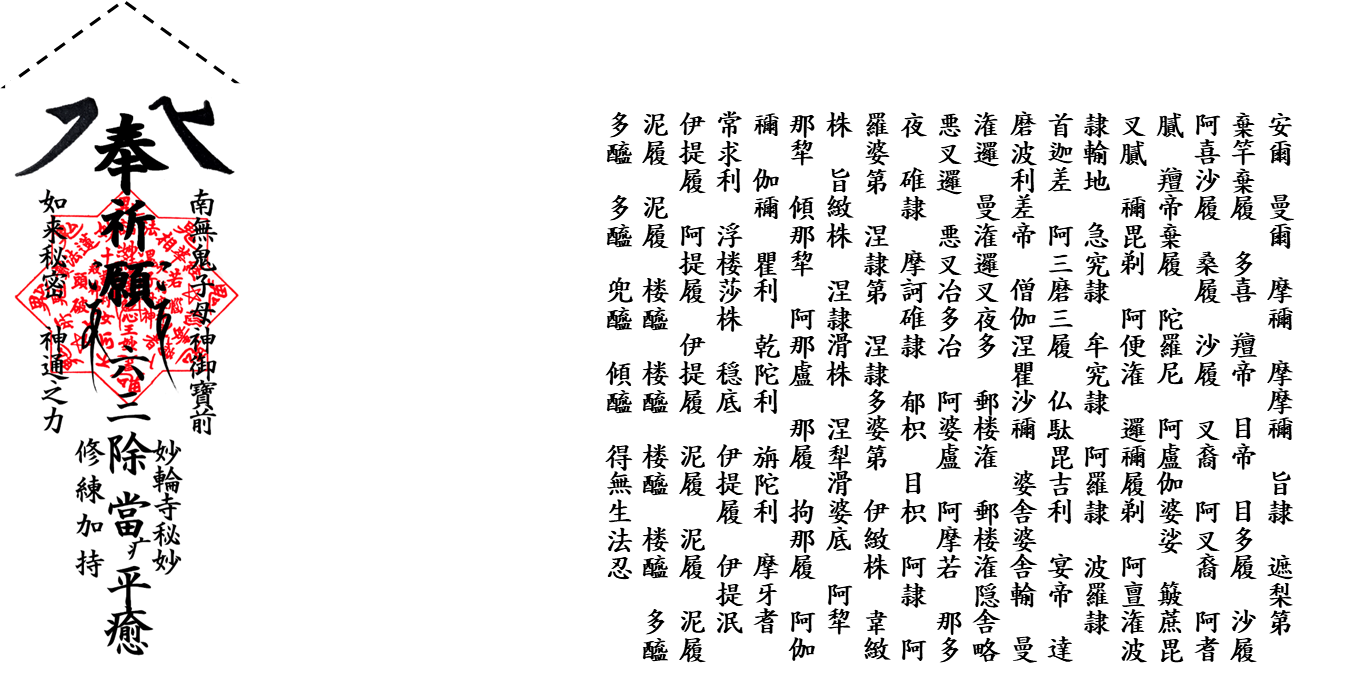
When you see this “Taku” kanji in the Ofuda, you will know that this Ofuda is powered by Kishimojin.
~Method of writing~
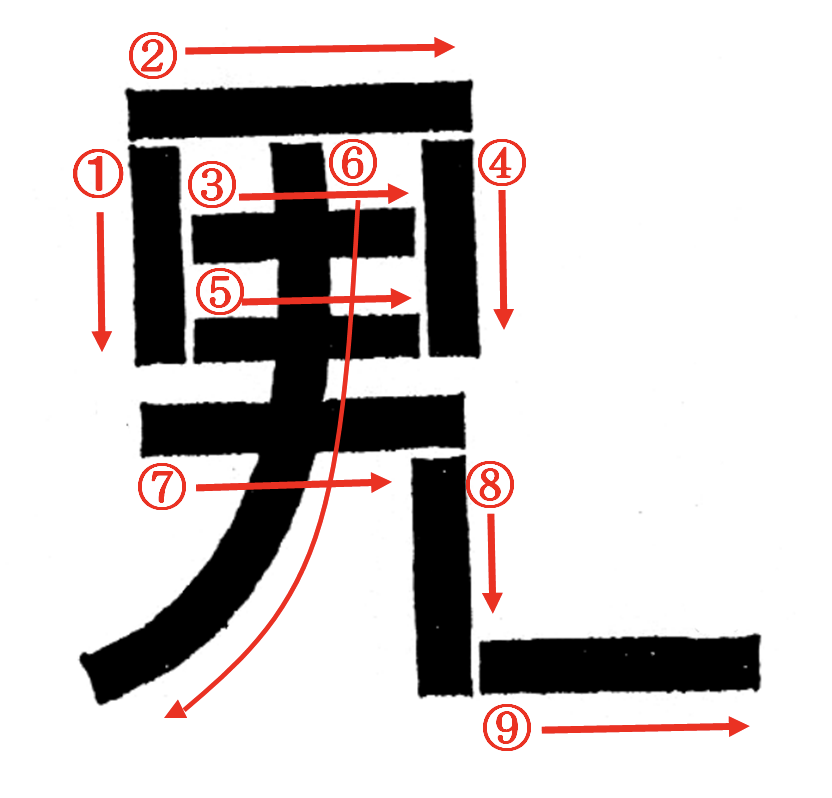
You can write it on the Ofuda, or if you are blessing someone, you can
write it on their body using Juzu (use Juzu's boju to write it), or to
gain Kishimojin’s power, you can write it on your left palm with your right
index finger or Juzu.
Shuhosshi uses bokken to write it on their left palm.
Furthermore, by writing various words next to this Taku's Kanji, the meaning
of it will change.
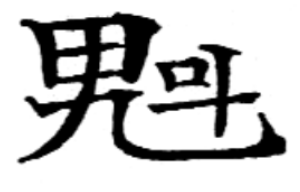
Writing 叶 (wish come true) represents “fulfillment of wishes”.
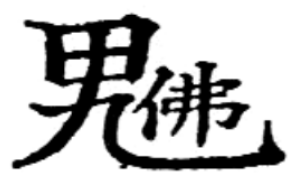
Writing 佛 (Buddha) represents “overcoming illness”.
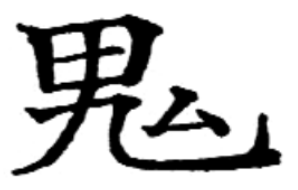
Writing ム (this is the normal “Ki” kanji) represents “get rid of evil”.
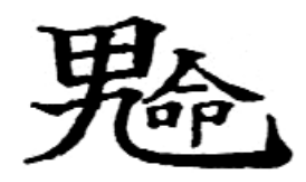
Writing 命 (life) represents “live long”.
When you are doing blessing for overcoming illness, you should write 叶
or 佛 next to “Taku” on your left palm before blessing.
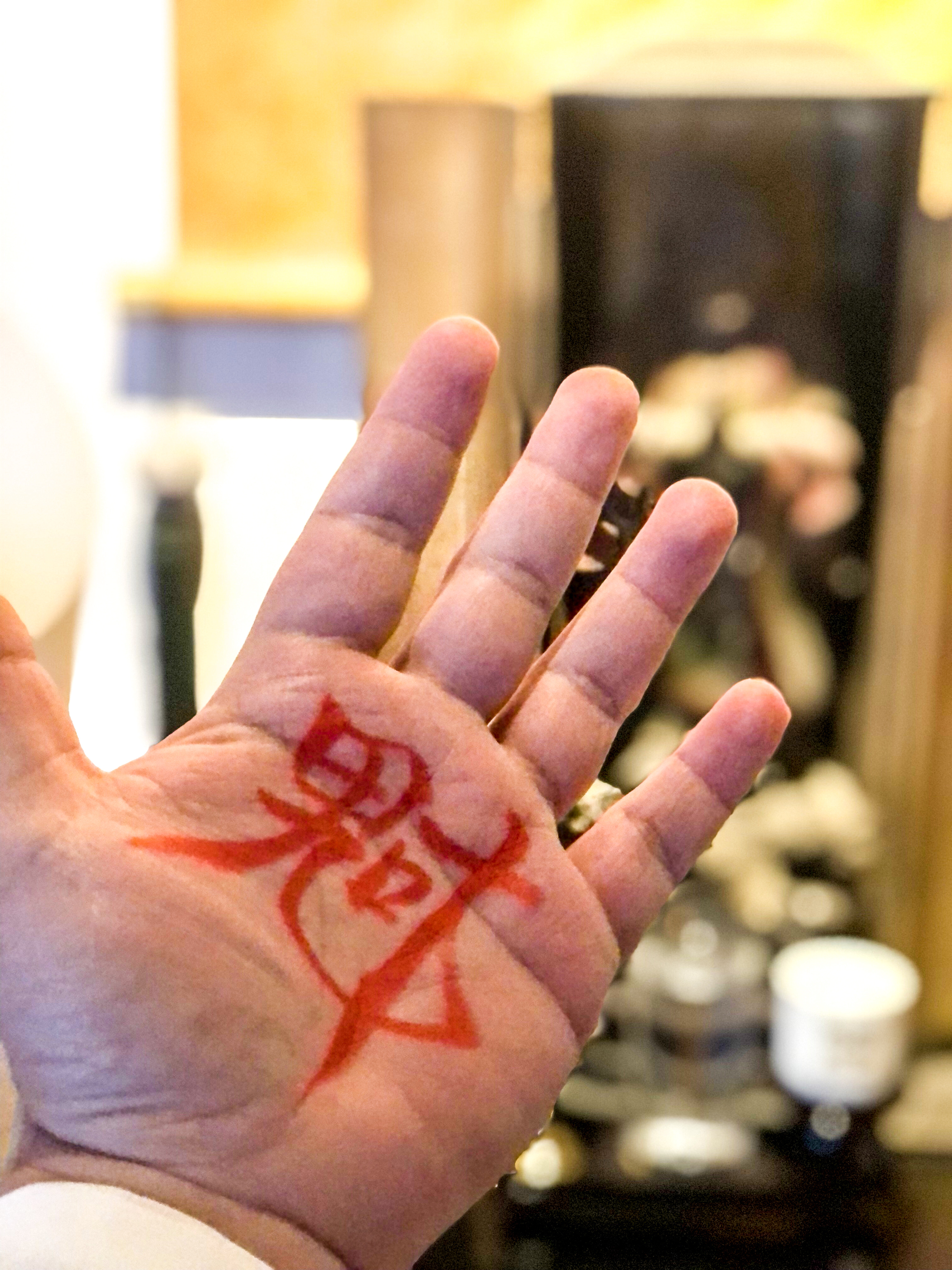
Myorinji’s special blessing by Kishimojin, you actually write the letter
on your palm before blessing.
There are many version of it and if you want learn more about it, you should
learn it in Aragyo.
▼ Roku-San-Yoke
There is Yakudoshi (Unlucky year) in age, but Yakudoshi is also in the
body.
Roku-San (Six Three) is an unlucky part of the body due to body's Yakudoshi
caused by the circulation of Kyu-sei (Nine stars).
According to Kyu-sei, people's fortunes change every year.
Roku-San is a Kyu-sei of the body, and by examining it, you can find out
the illnesses that you should be aware of in that year.
Since ancient times in Japan, when medicines are ineffective and the cause
of the disease is unknown, it is said that Roku-San may be the cause.
Roku-San is also read as Mu-san in Japanese, and Mu-san means "nothing
is born" or "not productive”.
To avoid Roku-San, you can do Roku-San-Yoke (Avoiding Six Three) blessing.
Finding out Roku-San is very easy.
Roku-San refers to 9 parts of the body from the head to the feet of a person,
and the places differ depending on the age and gender.
First, let's understand Kazoe doshi (counting year).
In the Western way of counting age, the year of birth is 0 years old, but
Kazoe doshi is the old-fashioned way of counting the year of birth as 1
year old.
In kazoe doshi, you start your age from 1 on the day you birth, and after
that, every new year day you add your age.
To find out your Roku-San, divide Kazoe doshi by "9" and the
remaining number will be your Roku-San number.
If divisible, your Roku-San is "9".
Kazoe doshi will be your Roku-San number for those under 9 years old.
For example, if the person's Kazoe doshi is 40, first divide 40 by 9. It
is 36 because it is not divisible (you don’t divide it exactly so it won’t
be 4.444….), but by subtracting 36 from 40, you can see that Roku-San for
that year is 4.
When you divide it, the answer need to be lesser number than your age.
That is why if you are 40, it will be 36, not 45 because 45 will be larger
number than your age
If that person's Kazoe doshi is 45, it's divisible by 9, so that year's
Roku-San is 9. If it is divisible, the Roku-San will always be "9".
For children under 9 years old, if Kazoe doshi is 5, that number will be
his or her Roku-San.
Look at the Roku-San table to find that person's Roku-San of the year.
Please note that the table you see depends on your gender.
If your Roku-San for the year is "9", it means to be aware of
head injuries and head illnesses for the year.
Therefore, when doing Roku-San Blessing, do Blessing for head problems.
You should make Ofuda for avoiding Roku-San.
See "Myorinji's original rituals" for Roku-San Ofuda.

There are many ways to do Roku-San-Yoke (Avoiding Roku-San blessing).
The method differs depending on the sect, and there are also methods that
are handed down to the temple according to the tradition of each temple.
See "Myorinji's original rituals" for a very effective Roku-San-Yoke
blessing.
▼ About Juzu
Juzu has been used as the most familiar Buddhist ritual tool since ancient
times.
Juzu is also called "zuzu (Nichiren shonin used to call it like that)"
or nenju (praying beads), and the types of Juzu currently differ depending
on each sect of Japanese Buddhism, and there are more than 70 types.
Each beads has a meaning.
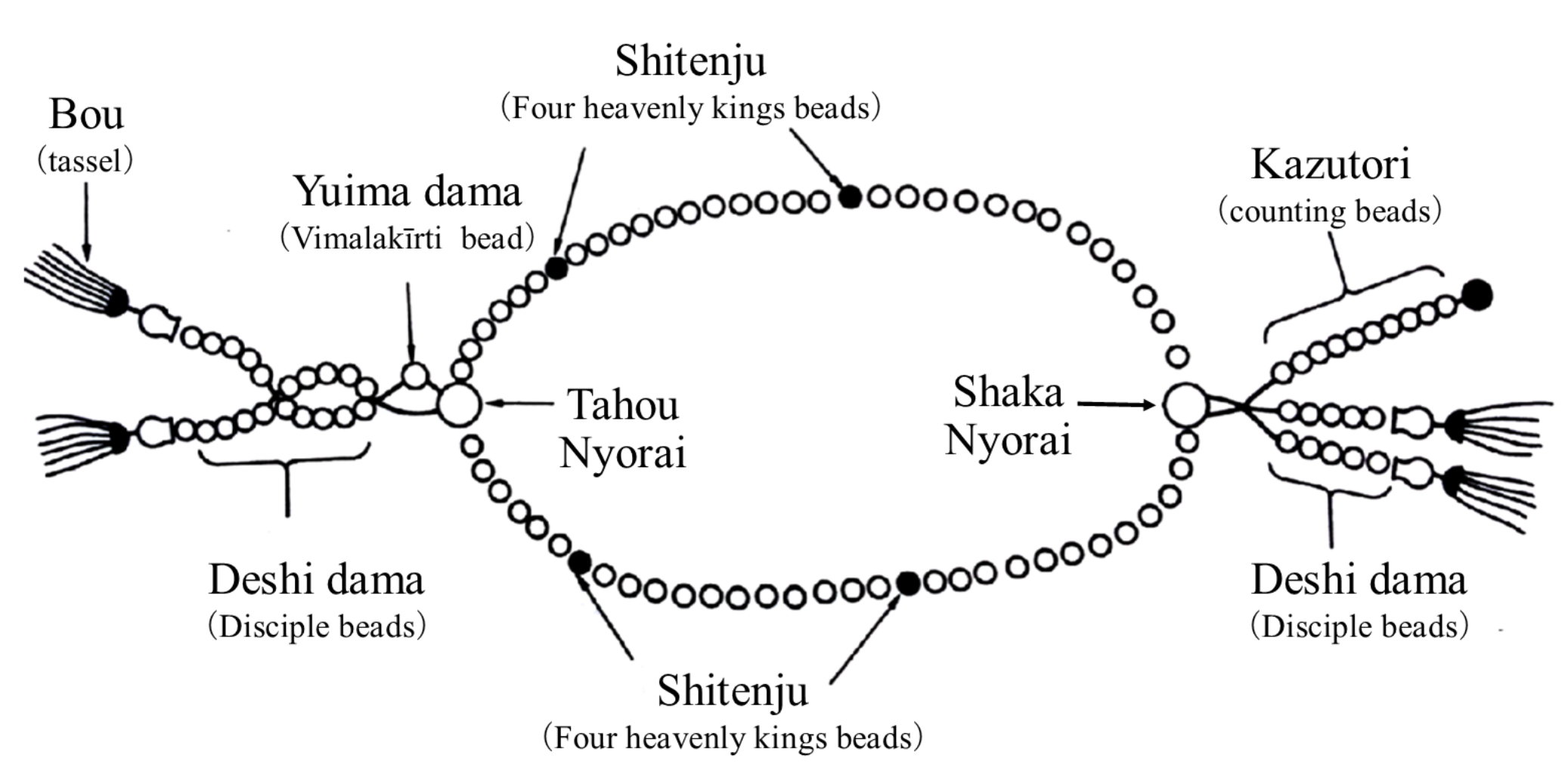
Deshi dama: It is said to represent the ten great disciples of the Buddha and the ten bodhisattvas.
Yuima dama: Yuima, or Jomyo, is one of Buddha's disciples. He is also a famous disciple from Yuima sutra. He is a disciple who didn’t Shukke (become a priest) unlike the other ten disciples. It is said that Yuima bead is separated from other disciple beads because he didn’t Shukke.
Tahou and Shaka beads: Tahou and Shaka beads is also called Boju (mother beads). When you twist the Juzu during the Invocation, Odaimoku, and Eko, these Boju will be located in the first joint of the middle finger. Gassho represents the treasure tower, and the position of Boju is the position where Tahou and Shaka Nyorai are sitting in the treasure tower. It represents the treasure tower of Chapter 11.
Shitenju: It represent Four heavenly kings, or Four Bodhisattvas.
Kazutori beads: Kazutori consists of 10 beads. This is a bead for counting accurately when chanting Odaimoku. Since in Nichiren shu, we chant Odaimoku a lot so the Doshi uses Kazutori to count it accurately. Kazutori's beads can be moved because there is a gap between the beads. The reason why Kazutori should be in the left hand when chanting Odaimoku is to use the right finger to move the Kazutori beades. Kazutori is only attached to Juzu of Nichiren shu. This shows how important Odaimoku is to the Nichiren shu.
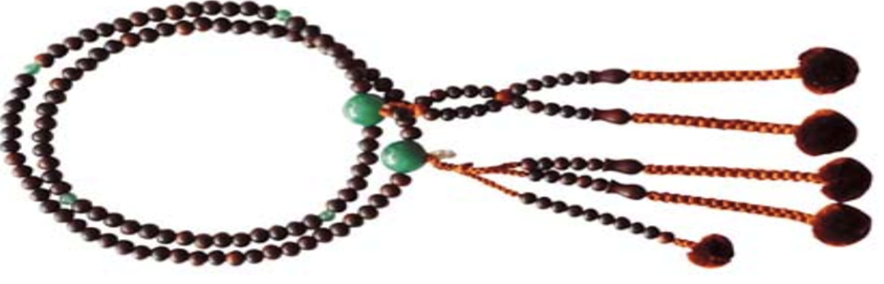
Gongyo Juzu: For priests wearing Dofuku, Soken with 5 jou Kesa or for the non priests.
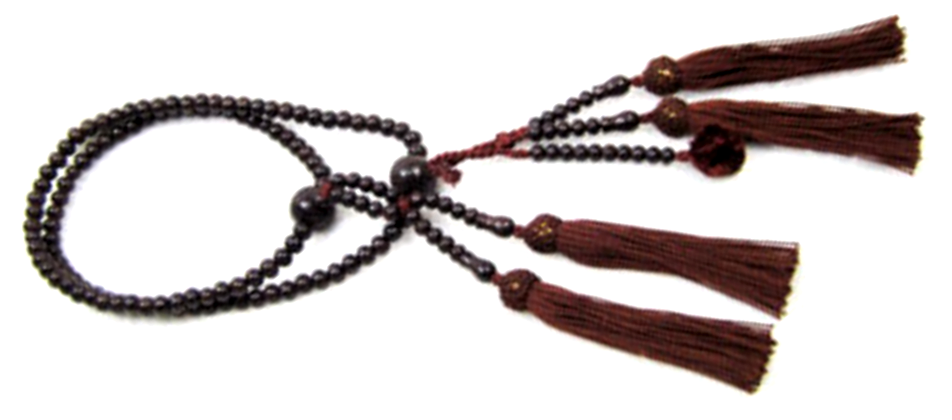
Shozoku Juzu: For the priests with colored Hon-ne with 5 jou Kesa. The crystal Shozoku Juzu is called Hon Shozoku Juzu and it is for Doshi. Doshi should use Hon Shozoku Juzu during solemn ceremonies.

Hikitori Juzu: Hikitori means to take over. This Juzu is only use in Kito
blessing so if you are not a Shuhosshi, you should never use it. Some people
are obsessed with evil spirits and can't keep the Gashho hands still while
Kito blessing. In such a case, Shuhosshi tie up the Gassho hands with the
strings of Hikitori juzu and do the Kito blessing.
▼ Special Shomyos
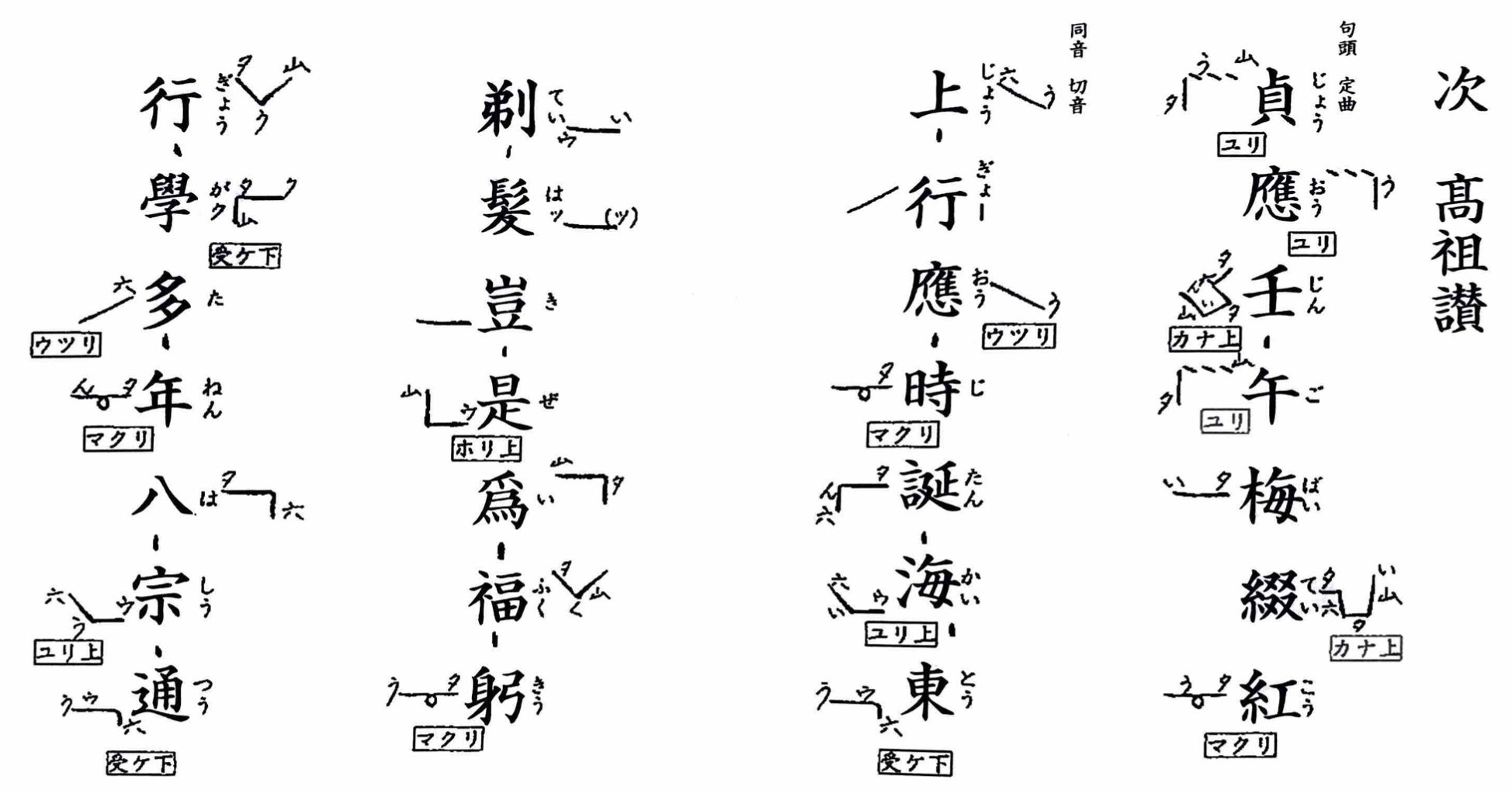
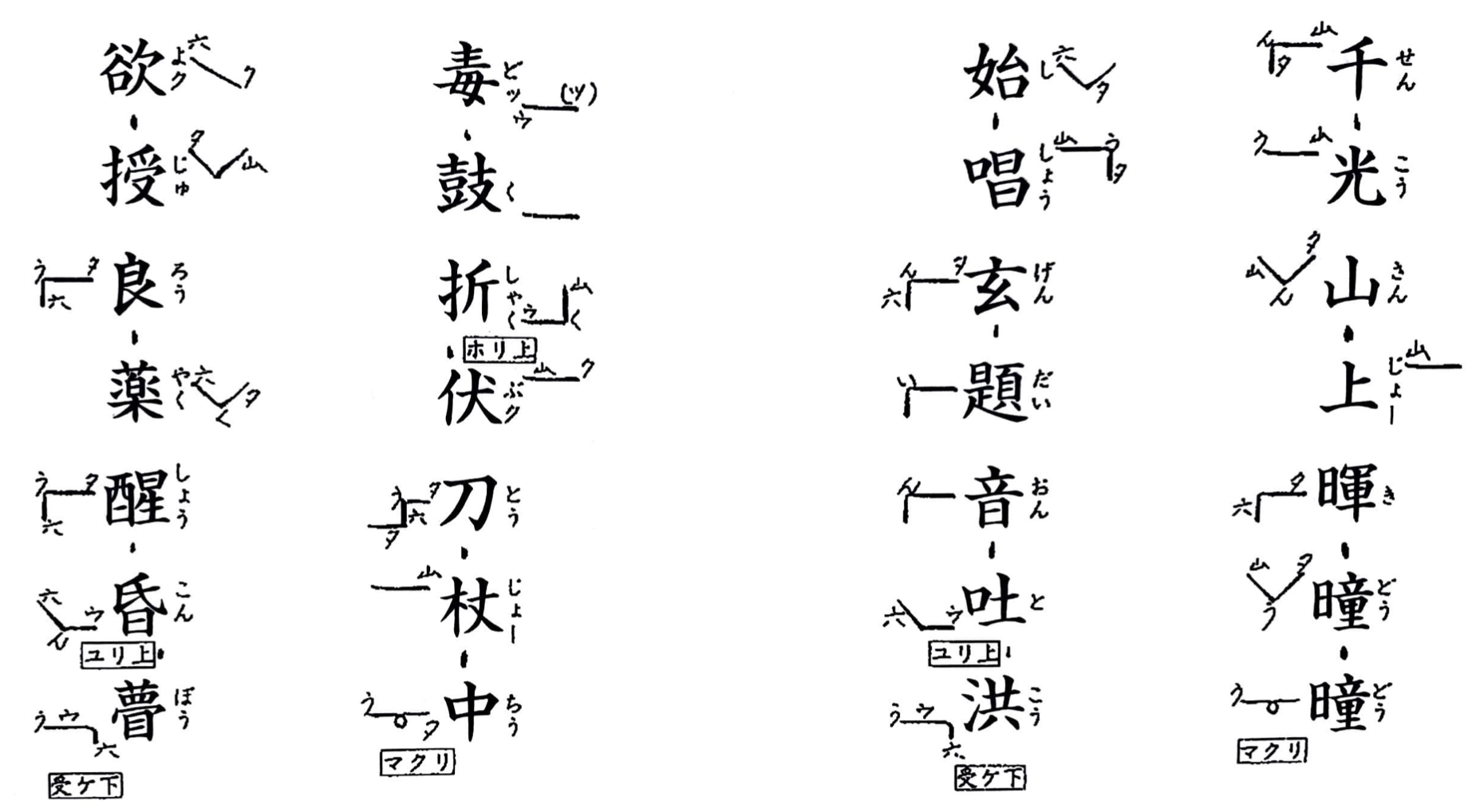
Koso san (Shomyo for Nichiren shonin)
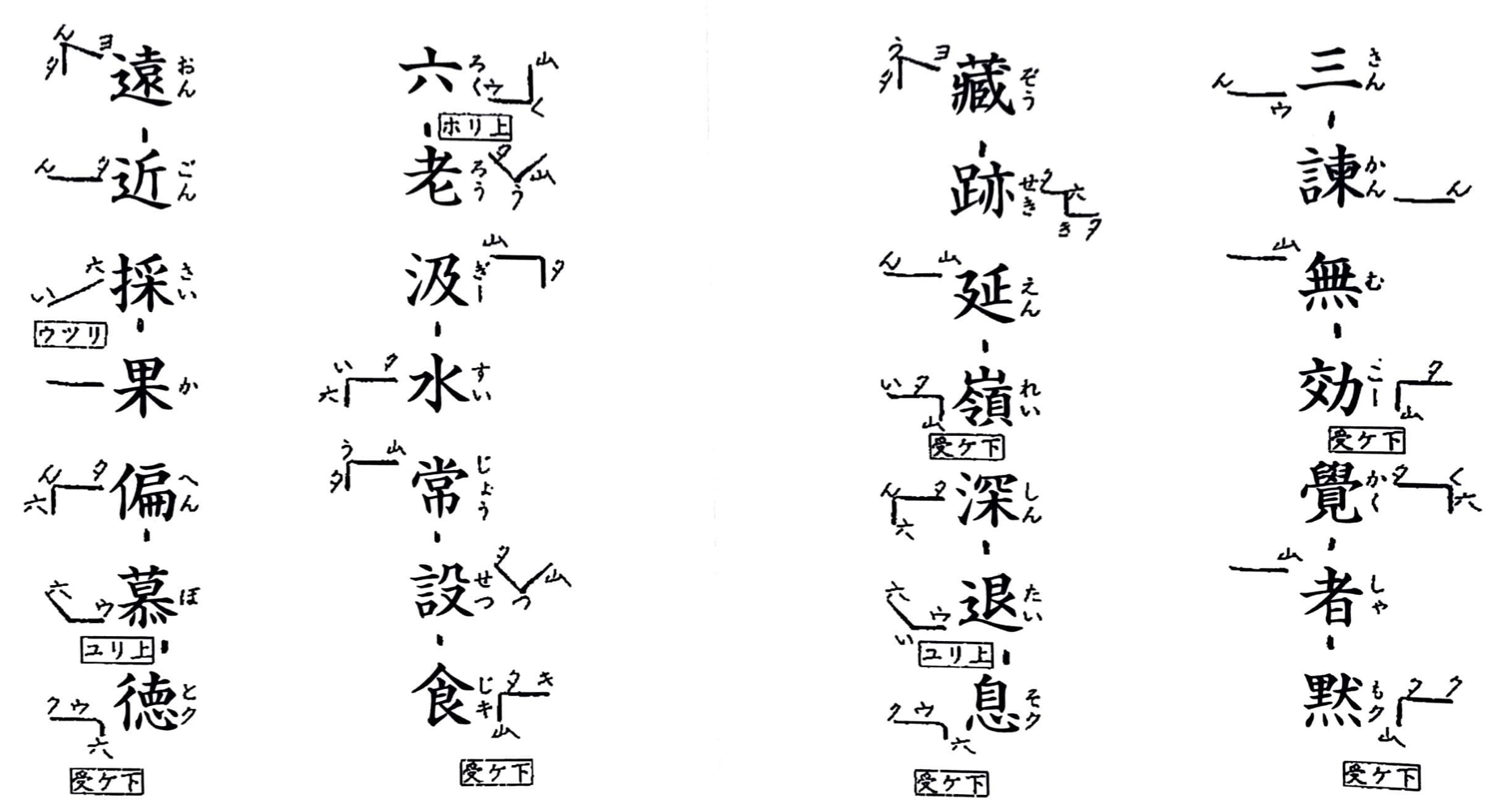
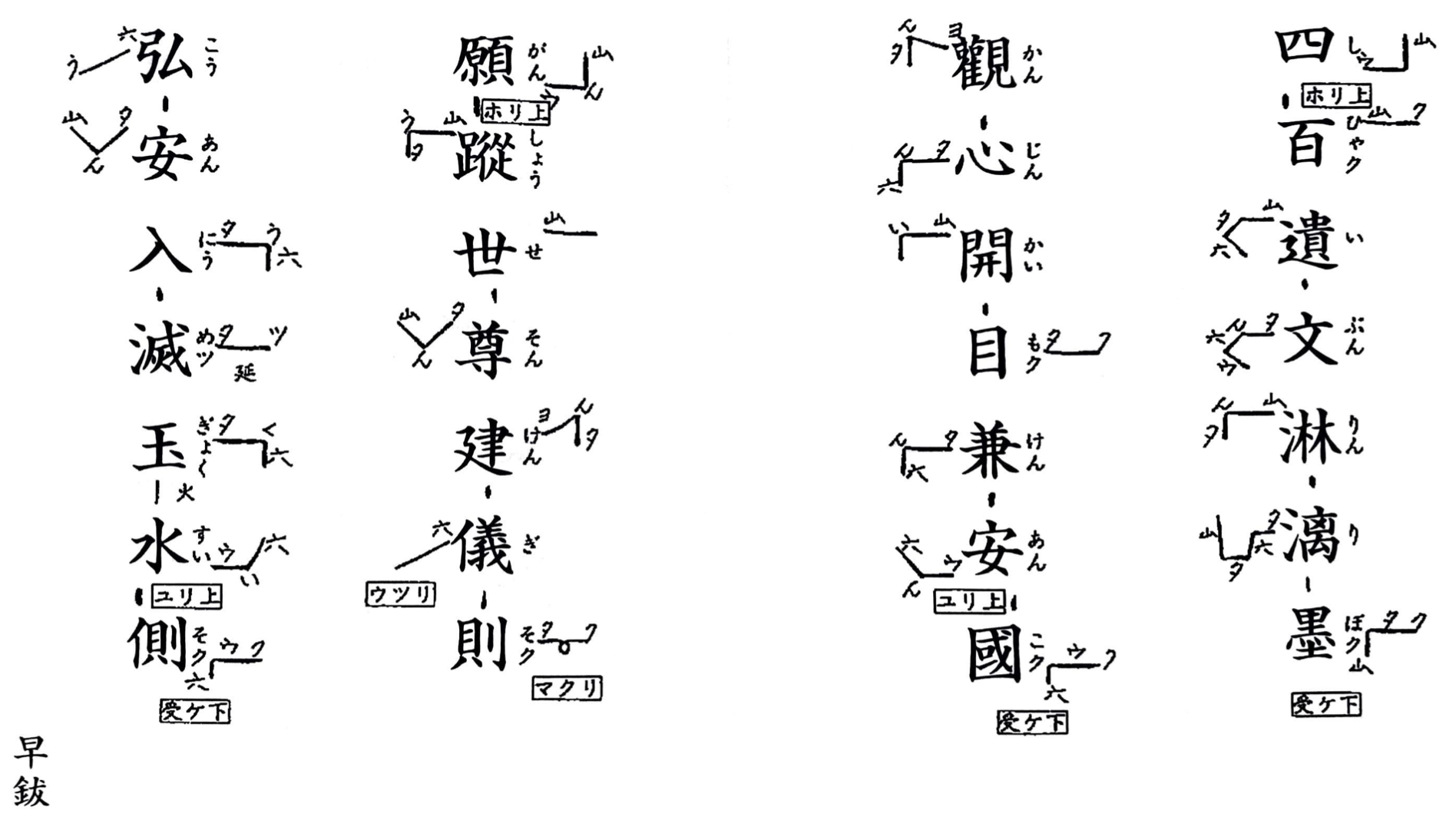
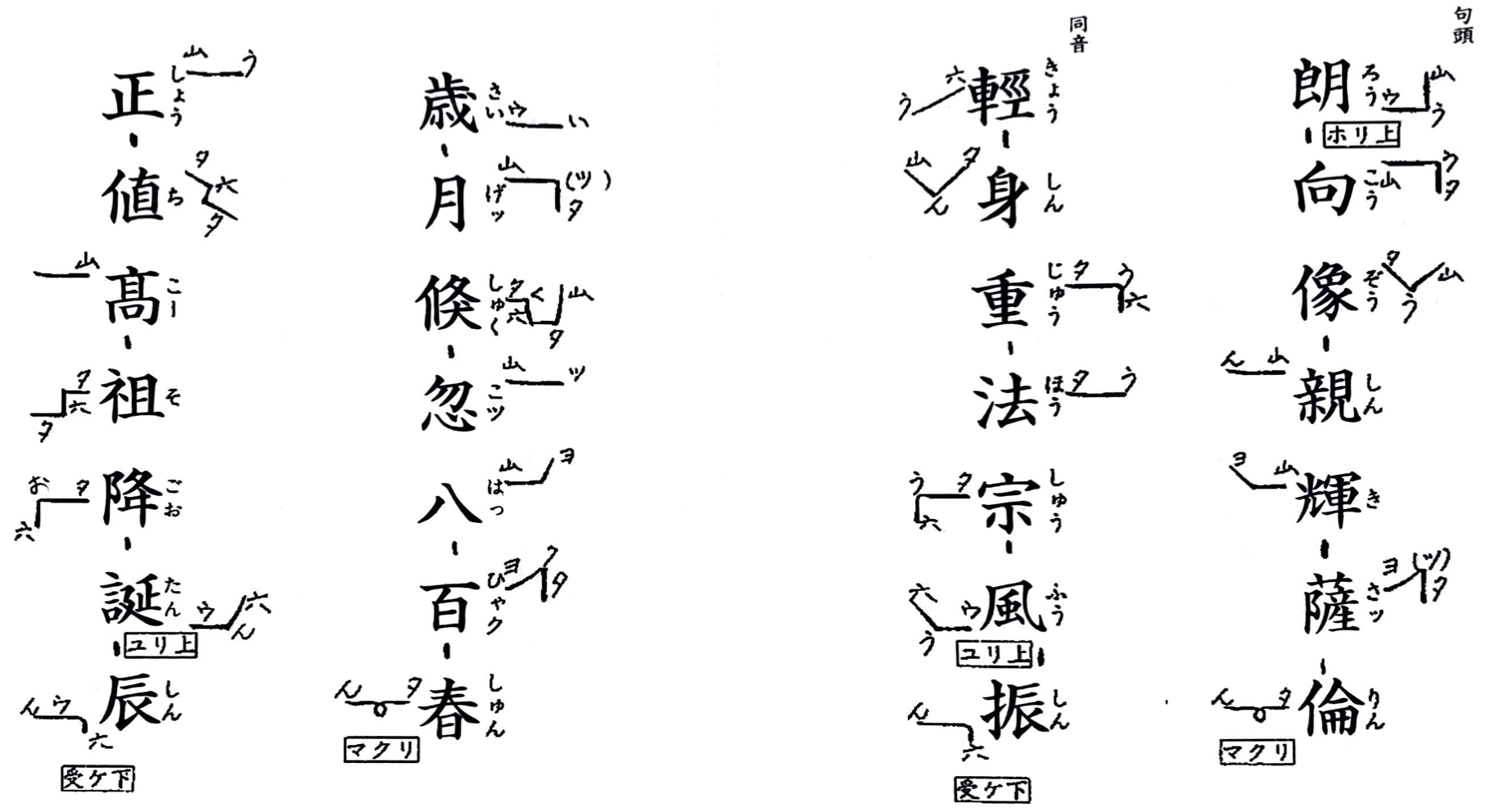
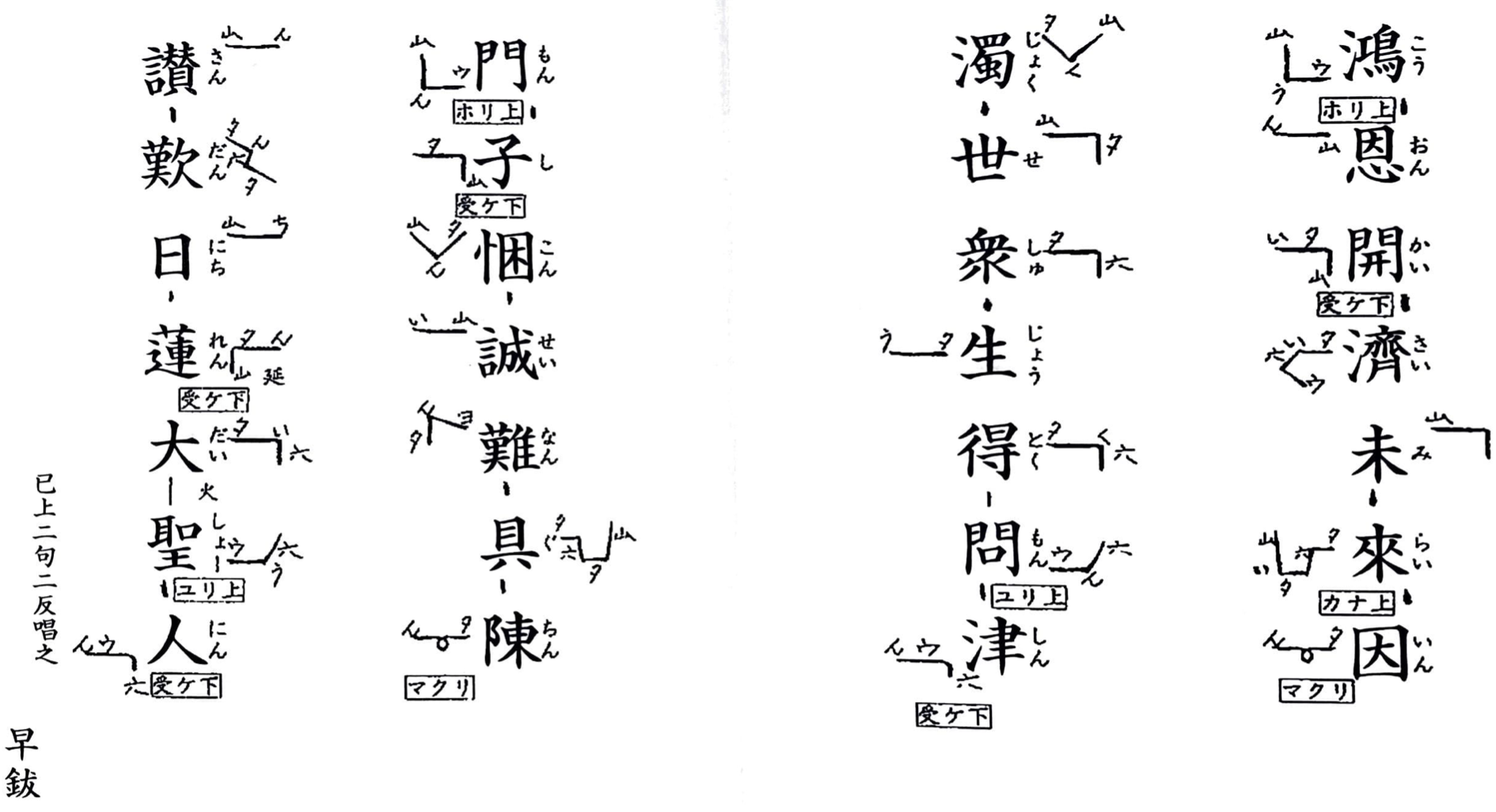
▼ Hokke Senbo video by Shomyoshi Federation
▼ Mokusho techniques
▼ Aragyo in Saijo Inari
To be able to do the Kito blessings, you will need to go to the Aragyo training.
There are several Aragyo-do (Aragyo Institution) in Japan such as Hokekyoji, Onjuin, Myogyoji, and Saijo Inari.
As you know, Hokekyoji is the only Nichiren shu official Aragyo-do so if you want to become a official Shuhosshi (Kito blesser), you will need to go to Hokekyoji Aragyo-do for 100 days.
Onjuin and Myogyoji located in Chiba is also 100 days Aragyo training.
However, Myogyoji aragyo-do held only once every few years.
Since the Aragyo training is very strict and some priests die during the training, women are prohibited to attend the Aragyo training.
The condition to enter the training is male priest younger than 60.
You will need to take a chanting test and pass the physical examination.
In Aragyo, you will wake up at 3 am, and do the suigyo every 3 hours until
11 pm.
All you do is chant in seiza all day and do suigyo every 3 hours.
Aragyo is very difficult to attend for foreign priests because of the long
stay in Japan.
However,Saijo Inari’s Aragyois only 21 days, It is a Aragyo training that even foreigners can easily
participate in.
There is no doubt that it will be more difficult than other Aragyo trainings
because you will need to do everything in 21 days which would normally
take 100 days.
Therefore, if you want to go to the Saijo Inari Aragyo-do, you have to
be able to do everything, such as Kito with Bokken (wooden sword) and chanting
before entering Aragyo.
This is why when you are going to Saijo Inari's Aragyo, you will need someone
who can teach you about Saijo Inari's Kito blessing before entering.
Saijo Inari’s Kito blessing has a history of 1400 years, which is longer
than any of the Nichiren shu Kito blessing.
The beginning of Saijo Inari's Kito blessing was when a priest named Houon
Daishi started Kito blessing for the emperor with the power of the Lotus
Sutra and Inari 1400 years ago.
Since the priest of Onjuin became the chief priest of Saijo Inari 400 years
ago, the Kito blessing of Saijo Inari and Onjuin were combined, and it
became the current Kito method.
Like the other Kito blessing, Saijo Inari’s kito blessing uses Bokken (wooden
sword) .
However, the Kito Kanmon (Kito sutra) is different from the others.
Saijo Inari’s Kito Kanmon is called Saijo Yoku (Superior verce) created
by Houon Daishi.
It is a sutra that extracts important words from the Lotus Sutra.
The unique thing about Saijo Inari's Aragyo is that unlike other Aragyo
trainings, women can also participate.
Men’s Aragyo is from November 3 to 23, women’s Aragyo is from April 3 to
23.
Furthermore, in the case of other Aragyo training, the condition is that
you need to be younger than 60, but in Saijo Inari, you can enter even
if you are 60 years old or older if you can meet several conditions.
As you know, you need to be a Nichiren shu priest to go to the Aragyo.
However in Saijo Inari, Shamis can enter it if he or she can pass the written
test about Nichiren shu.
Obviously, only Japanese can be used in any Aragyo training, so foreigners
who can not speak Japanese can not enter.
However, Rev. Kumazawa is also a teacher of Saijo Inari’s Aragyo, so even
foreigners can enter Saijo Inari.
So if you are interested in training in Saijo Inari, please consultRev. Kumazawa first.
Saijo Yoku (Superior verce)
Daiji daihi joumuge kengo
Guzen jiriyaku issai nyorai
Himitsu jintu shi riki waku jiko
Shin wakujita shinzui shujo yoku
Shuju seppou ninno ninge kaku
Tokujou jitsu go ke daifu zaihou
Muryou kongonn chinbou souko you
Itsu shinnni tainen ketoku annon
Dai I jinriki tasho nyoyaku ten
Sho douji i i kyuji toujou
Fuka doku Funo gai zeko rou
Yaku konru zaishi myouren houyaku
Zenji shubyou ri issai ku issai
Byoutsu tokumon shikyou rokkon
Shoujou jintsu riki ko zou yaku ju
Myou kaidai kangi henman goshin
Saison saijou kenzoku i nyo toku
Daijinzu shinsui koumyou higyou
Jizai shogan pu koyaku o gen
Zetoku gofuku hou juumon kourou
Kakunannyo kaijuumanbutsu myoumon
Jippou kounyoyaku shujou o ku
Nou shi yaku nou i sa e ko gu
Issai kudoku jigen ji shujou
Fukujukai muryou ze ko ouchou
Rainenpi kyououriki shuon shittaisan
Nyorai himitsu jintsu shi riki
Zekou rouyaku konru zaishi
Konshidaijou Nyoraiissai
Shou’ushihou Jizaijinriki
Hiyoushizou Jinjinshiji
Nyaku’ushinju Shinjiogo
Nyoantokutou Nouhaissai
Fuzenshian Hashomazoku
Eshojigun Kafunoshou
Suifunouhyou Ryoutokuannon
Rishosuigen Mubushoge
Goshintaine Sokutokugedatsu
Jouyashugo Gotokusaishou
Nyokyakukenyaku Kaidaijoumon
Ryourigige Joubukugoshin
Shidairouyaku Nyotoukabuku
Sokujoukunou Mubushugen
Dai’itoku kyououbusshou gonen
Ize kudoku isshin gasshou ku
Gyou kuyou ietsu shujouko gen
Muryou jinriki muku shoujoukou
Enichi hasho an non bukusaifu’u
Kafumyoushou seken hitaikai
Raishinjii myoudai unshinkai
Daikangi kaijouannnon soui
Daiji hiriki noukusekenku
Gusoku jinzuuriki shouroubyoushi
Kui zenshitu ryoumetudan shouhou
Chuu aku gashitsu joujaken anju
Jicchi chuwakuchi onzoku nyoukaku
Shittou kagai ishi sae go
Noukugo issai gashido an
Non ten nin joujuu mann gajuku
Onraichuya joushoujinn ga sen
Daijoukyou do dakku shujoukon
Buten saimyou mujou daihourin
Zehou juhou iseken soujou
Joutoushudai shinriki gasshou ku
Gyou shin zenin shi kudoku muhen
Mu uguu shoujou shika houfu
Zen sekenhou nyorengezaisui
Mubusho giwaku nyofuo ku
Chu issai mushouge konbuttoku
Saijouannon muro hozeko
Genkei shuhou kimyou saijouson
▼ About Chukei (fan)
Fan is a tool that reveals dignity.There are three types of fan.
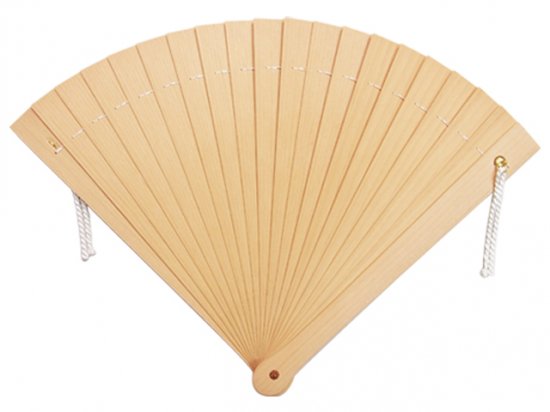
"Hiougi" meaning cypress fan. Used to use in in Japanese Imperial court. We don't use it in Nichiren shu.
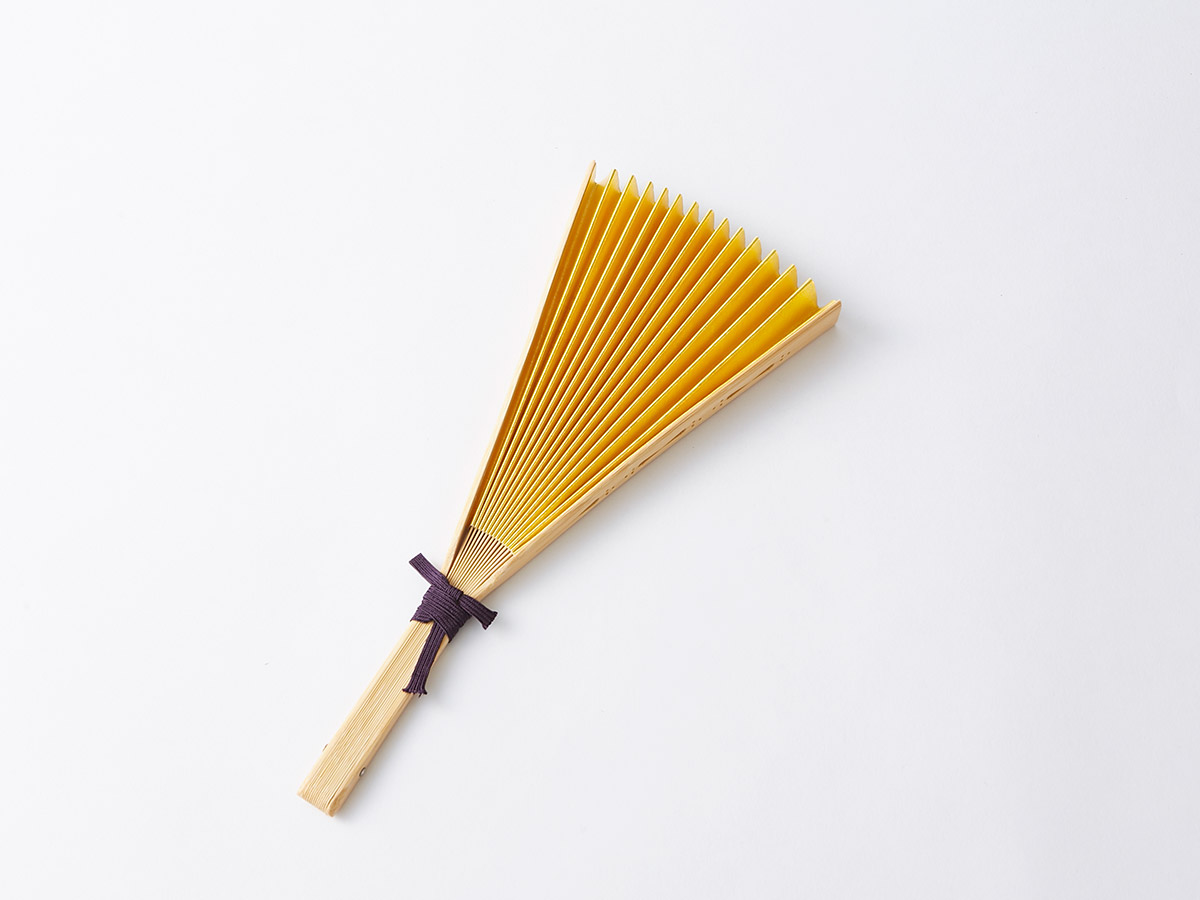 "Chukei" meaning half opened. Frequently used in the Nichiren
shu ceremonies.Use it when you are using shōzoku-juzu. Many priests (even in Japan) use
it in ceremony with the purple knot attached to the handle of Chukei, but
this is proof that it is new fan, so you should remove it when using it.
"Chukei" meaning half opened. Frequently used in the Nichiren
shu ceremonies.Use it when you are using shōzoku-juzu. Many priests (even in Japan) use
it in ceremony with the purple knot attached to the handle of Chukei, but
this is proof that it is new fan, so you should remove it when using it.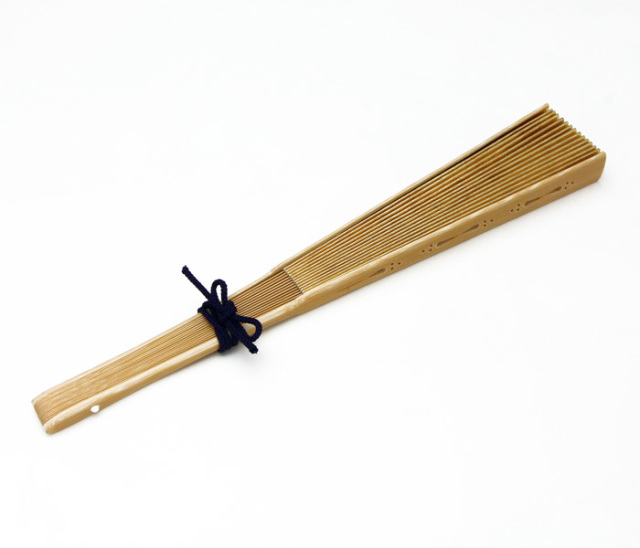 "Bonbori" literally means "snow cave". Since you don't
need a fan to cool yourself in the snow cave, you use this closed fan.
That is why it is call "snow cave fan". Use it when you are using
gongyō-juzu. Since you are using shōzoku-juzu mainly during the ceremonies,
we don't use Bonbori alot in the ceremonies.
"Bonbori" literally means "snow cave". Since you don't
need a fan to cool yourself in the snow cave, you use this closed fan.
That is why it is call "snow cave fan". Use it when you are using
gongyō-juzu. Since you are using shōzoku-juzu mainly during the ceremonies,
we don't use Bonbori alot in the ceremonies.
Types and when to use
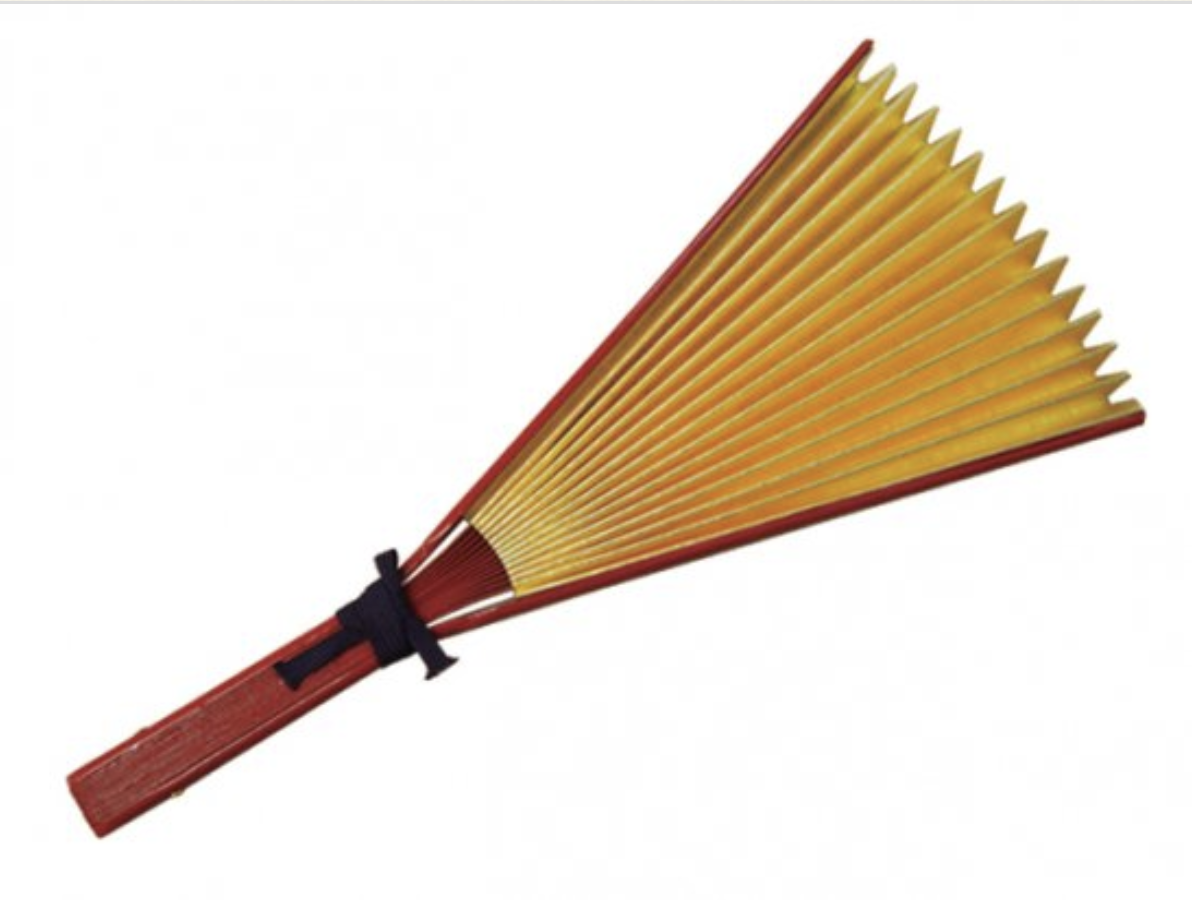
[Red bone gold & silver Chukei]
Can be used in any ceremonies
[Who should use]
Doshi, Fuku-Doshi, Fugin&Zuiki (guests), priests with the role
[Robes and Kesa to wear]
Purple or white hon-e robes & hon shōzoku-juzu with 5 or 7 jou Kesa
Black soken robe & Han shōzoku-juzu with 5 jou Kesa
Not to use when you are wearing Brown Kesa, Gensei 7 jou Kesa, Shojo-e
5 or 7 jou Kesa
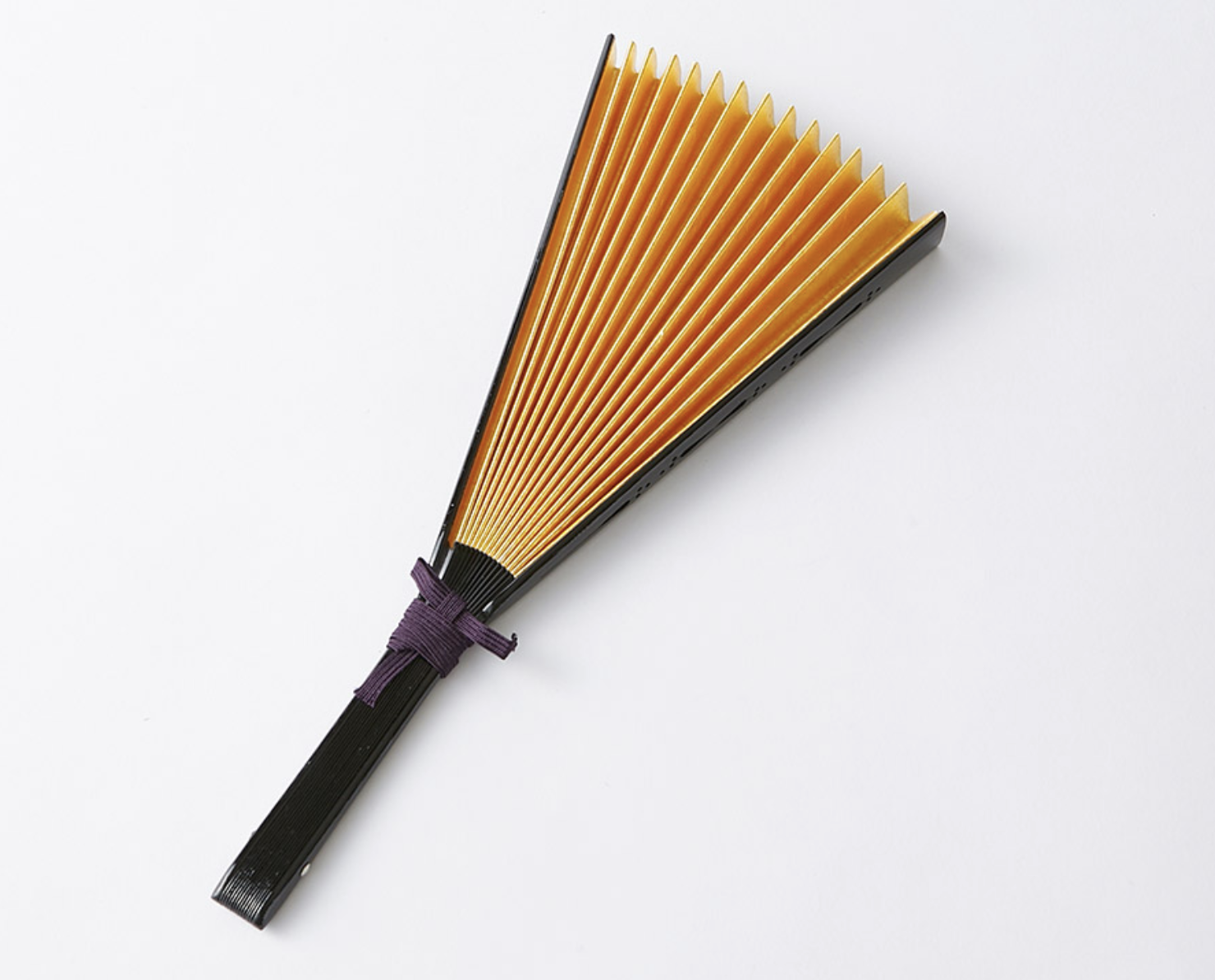
[Black bone gold & silver Chukei]
Can be used in any ceremonies
[Who should use]
Egyoji, Chido, etc
[Robes and Kesa to wear]
Black soken robe & hon shōzoku-juzu or han shōzoku-juzu with 5 jou
Kesa
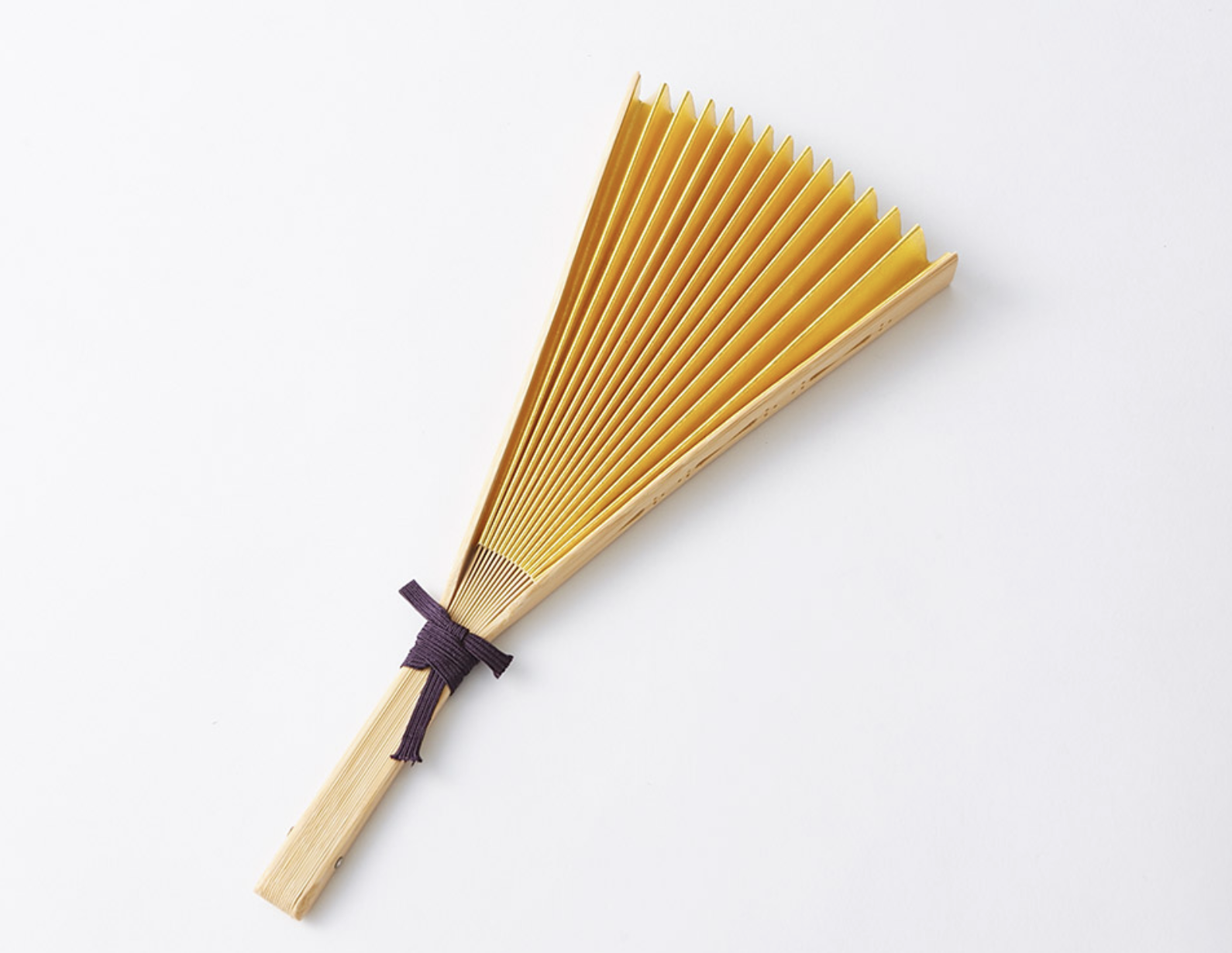
[White bone gold & silver Chukei]
Can be used in any ceremonies
[Who should use]
Zuiki (guest), shikishū, etc
[Robes and Kesa to wear]
White or blue hon-e robes & hon shōzoku-juzu or an shōzoku-juzu with
5 or 7 jou Kesa
Black hon-e robes & han shōzoku-juzu with brown 5 jou Kesa or Gensei
7 jou Kesa
Black soken robe & han shōzoku-juzu with 5 jou Kesa
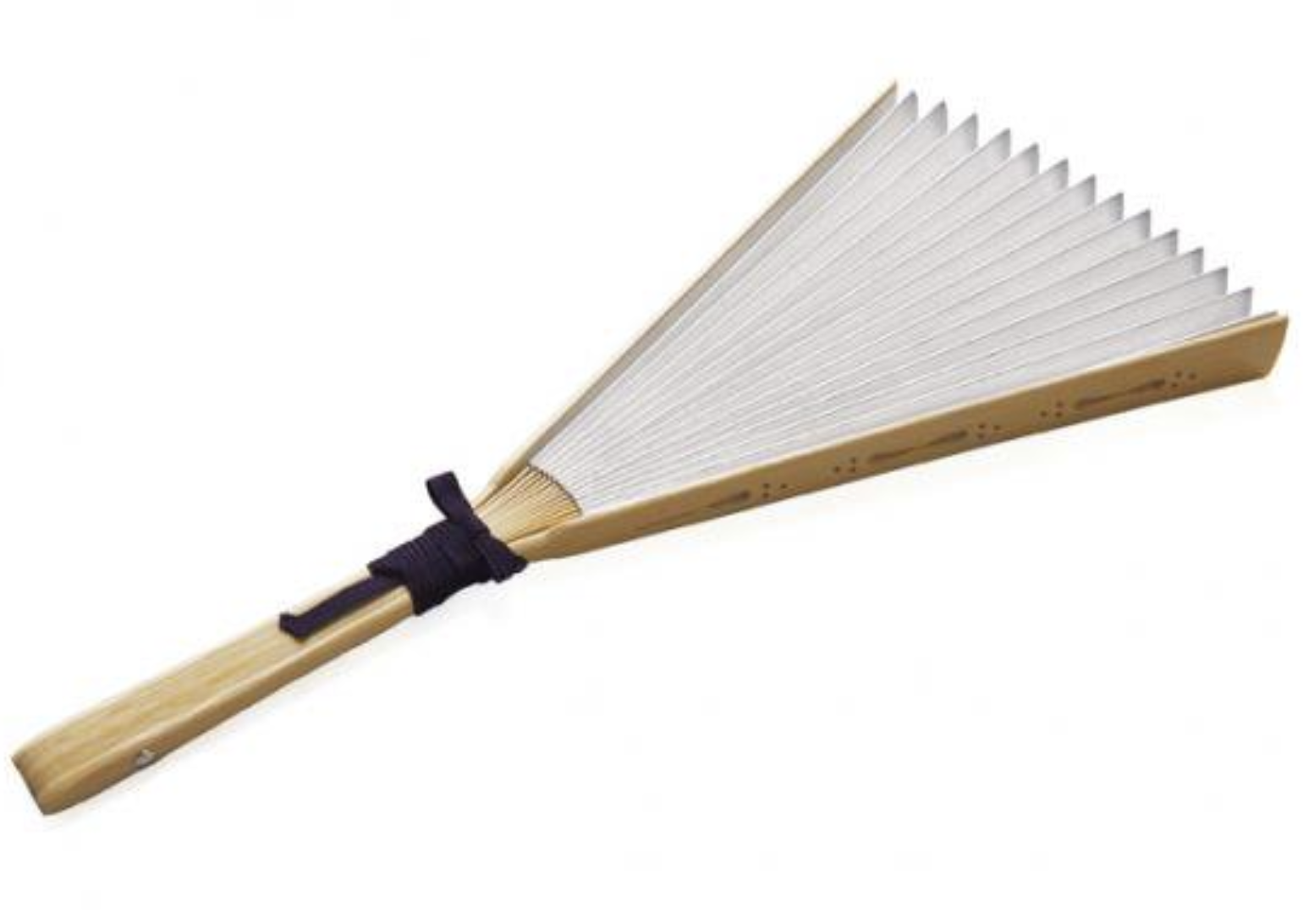
[White bone white Chukei]
For the funerals
[Who should use]
Priests attending their master's funeral
[Robes and Kesa to wear]
Shōjōe hon-e and Shōjōe 7 jou with han shōzoku-juzu
(Shōjōe meaning “pure robe” is a linen jikitotsu worn by ministers inaragyō or by deceased ministers and their surviving disciples)
▼ Nichiren shu crest
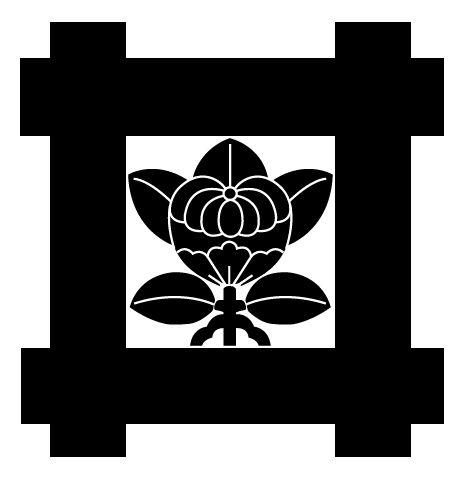
This crest is called "Igeta ni Tachibana", literally means "Well
shape and Tachibana tree".
In the middle of the crest, you'll see flower like crest and that is Tachibana tree.
Tachibana is a tangerine tree peculiar to Japan.
Outer part of this crest is call Igeta" meaning "well shaped".
The shape of it looks like the well in the past Japan.
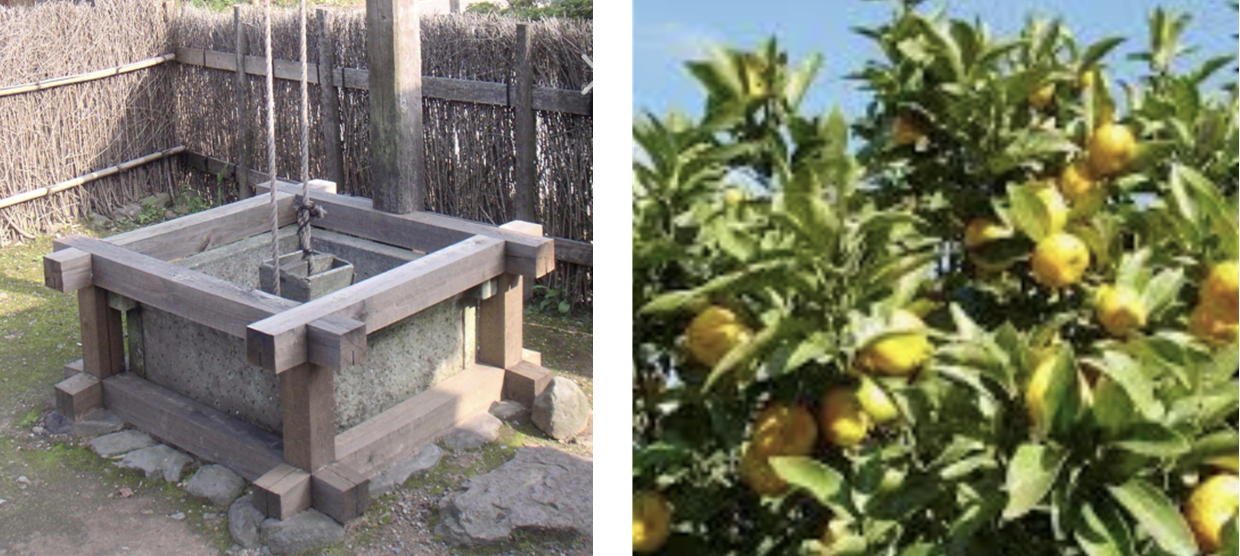
Japanese old well and Tachibana tree
There are various reasons why Nichiren-shu came to use this crest.
If you are familiar with Japanese samurai clan, you may have seen a crest
similar to this.
The Nichiren sect crest is very similar to the I'i Clan crest.
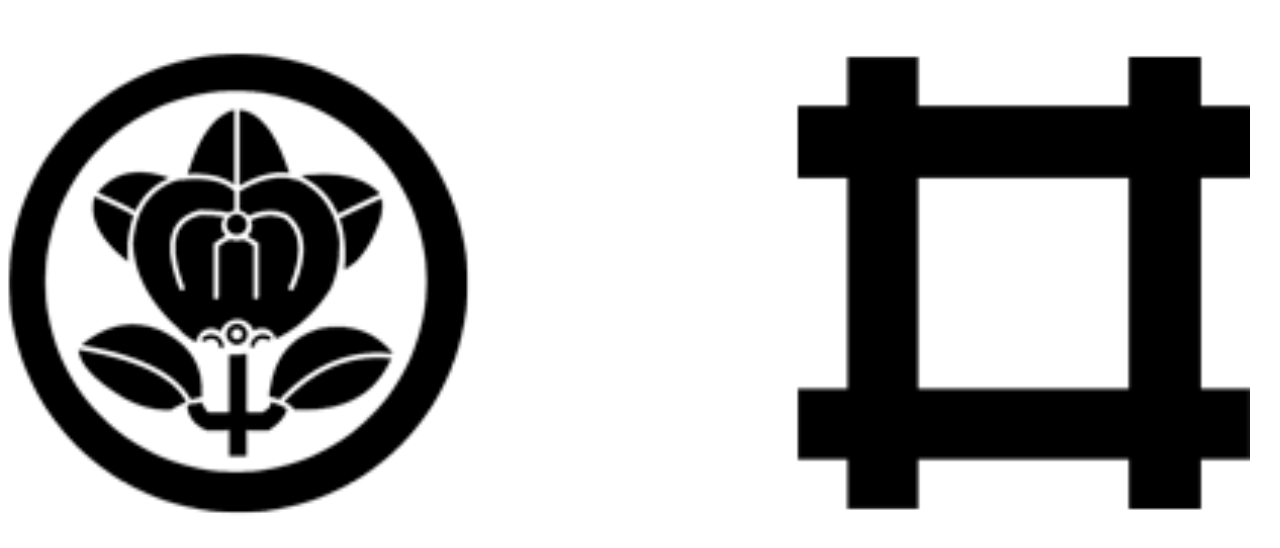
I'i clan crest
There is a theory that Nichiren Shonin is from I'i clan.
There are various mysteries about the birth of Nichiren shonin, but there
seems to be such a theory.
Hokekyo-ji,one of the Nichiren shu Honzan seems to have a different reason.
It is said that this crest came from the fact that the water in the well
blew out when the Nichiren shonin was born and that the tangerine of Tachibana
was a favorite of the Nichiren shonin.
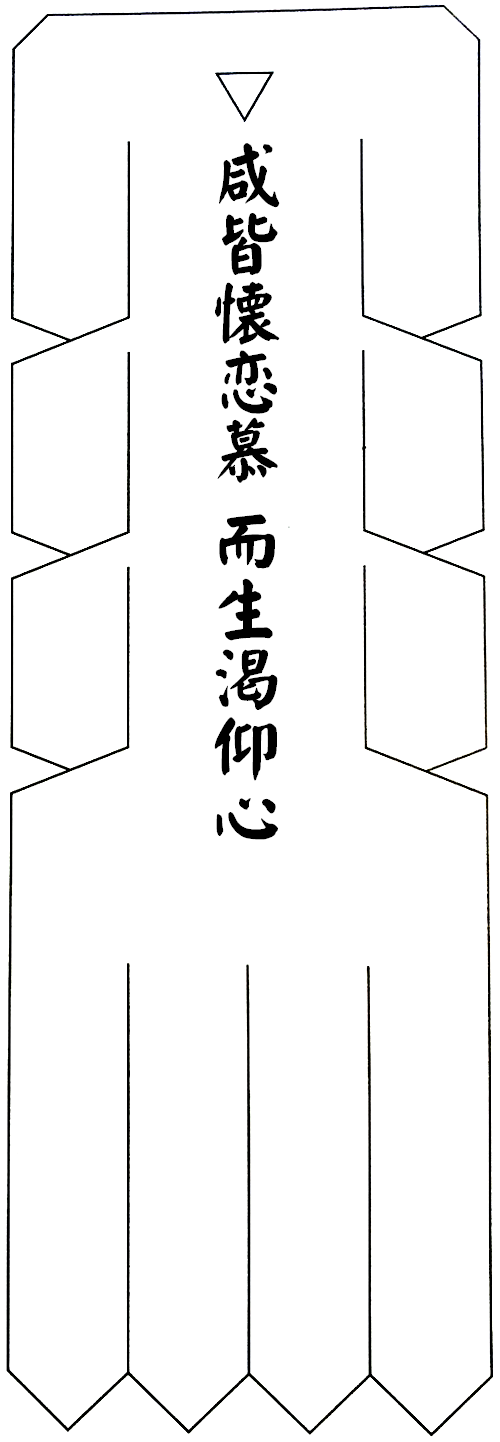
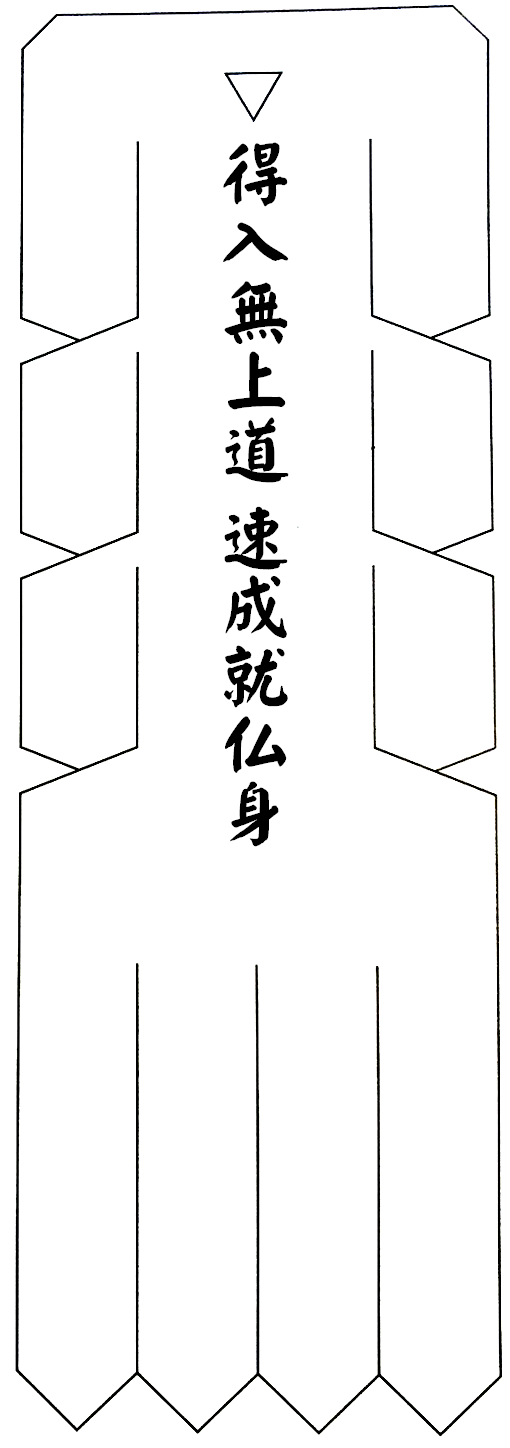
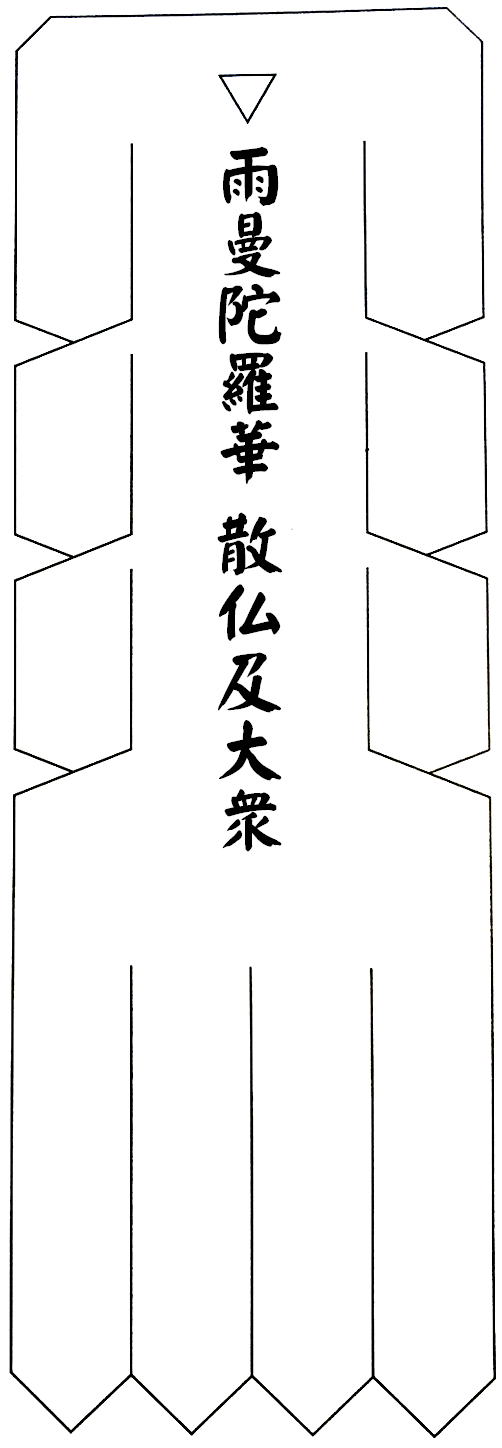
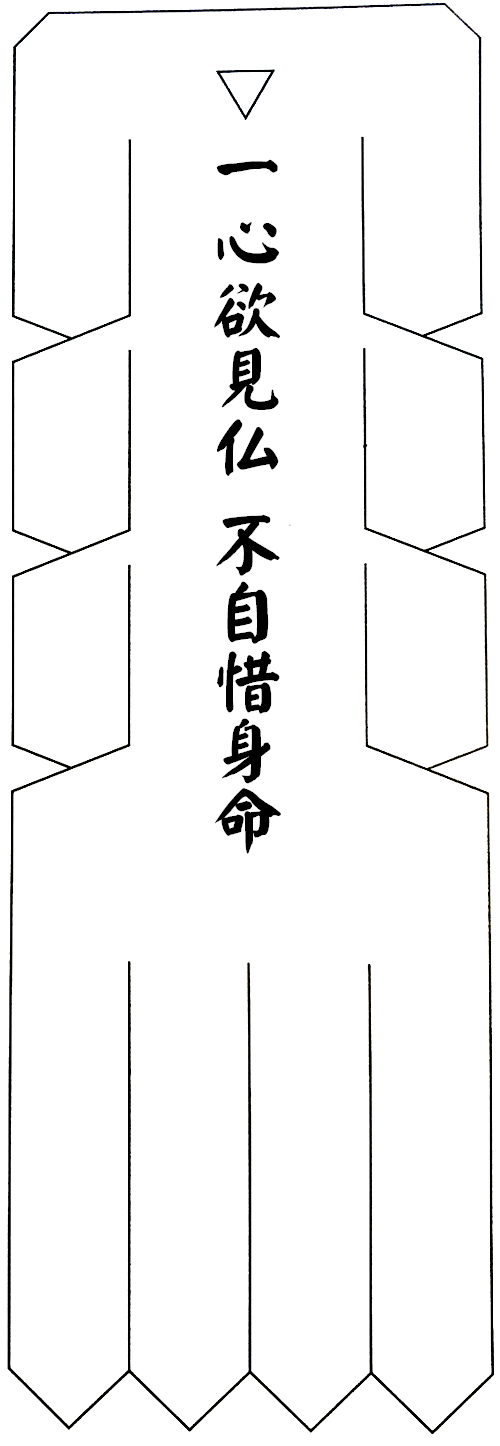
▼ Segaki banner
Gaki refers to the soul that was dropped into the world of Gaki because
of the greedy life during his lifetime, and is always suffering from hunger.
In English, Gaki translated as “Hungry ghost”, but actually Gaki is not
like a ghost. It is more like a ghoul than a ghost, and he is not just
hungry, he is starving. Well this is my personal opinion.
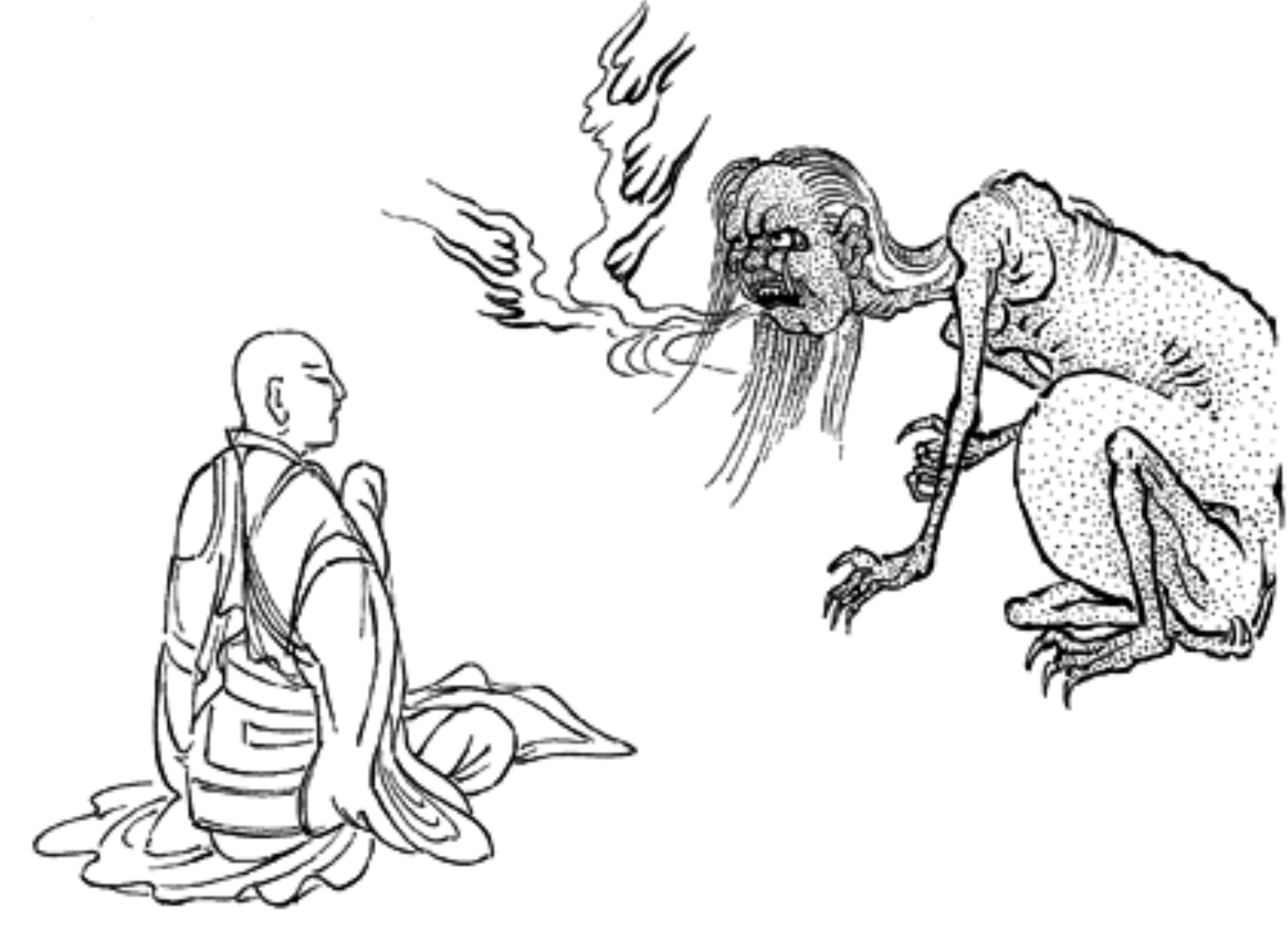
priest and Gaki
Gaki translates literally as Starving Demon (oni).
Segaki, literally means “offering to the Starving Demon” is a ceremony
to offer food and drinks to Gaki.
When you're doing Segaki service, you and your members insert the five
colors Segaki banner in to a bowl of rice (usually raw rice).
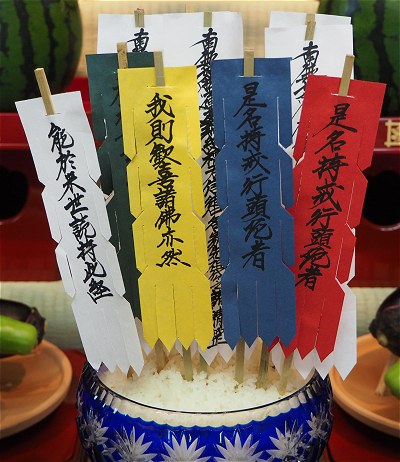
Gaki is attracted to the five colors so we insert the banners in to a rice
to tell them where they can get the foods.
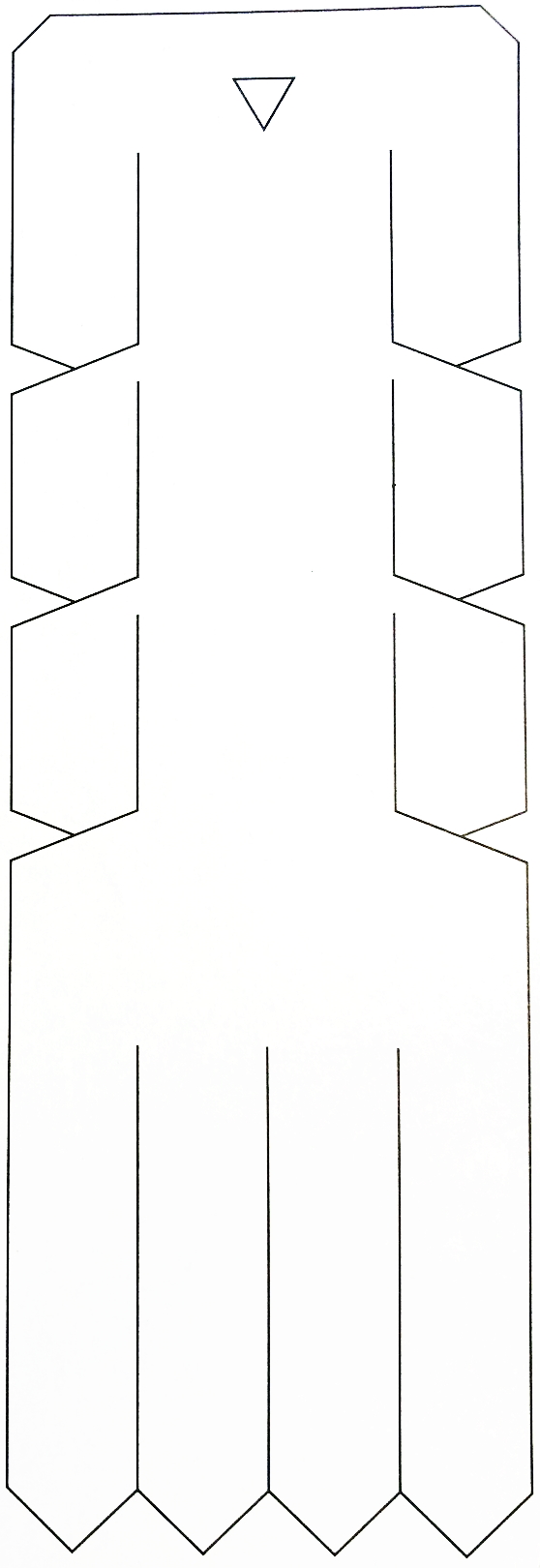
We create these five colors Segaki banners with papers and chop sticks.
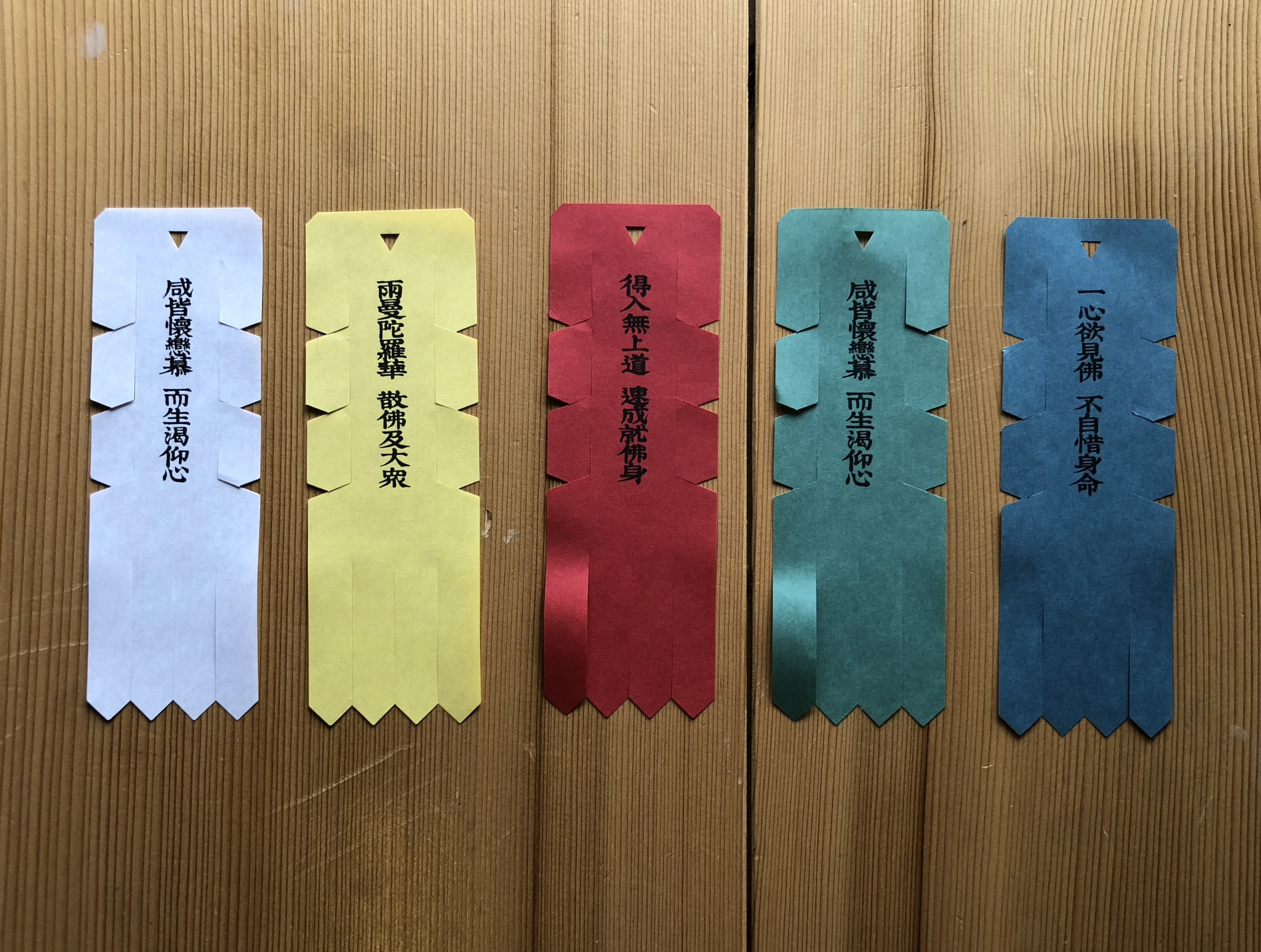
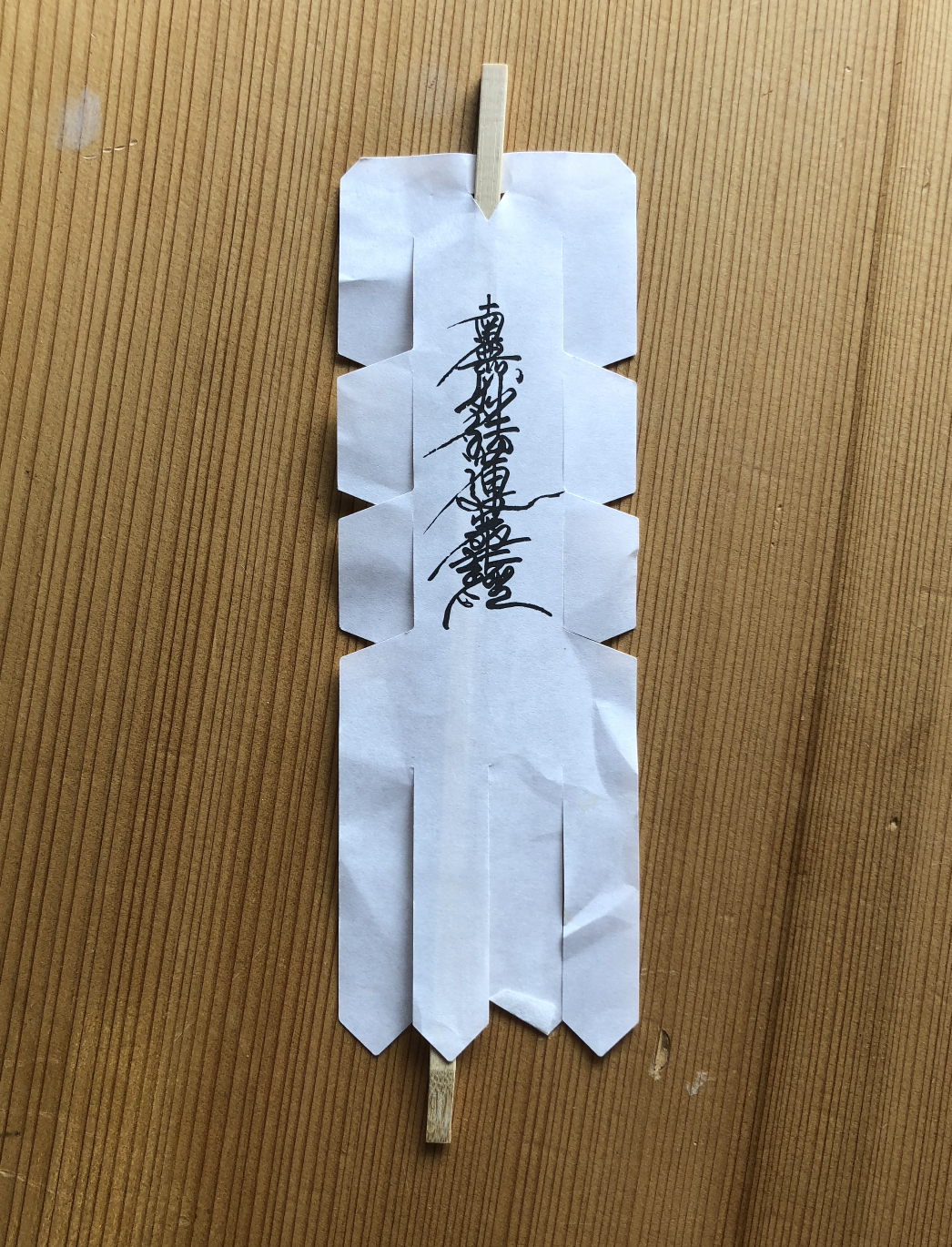
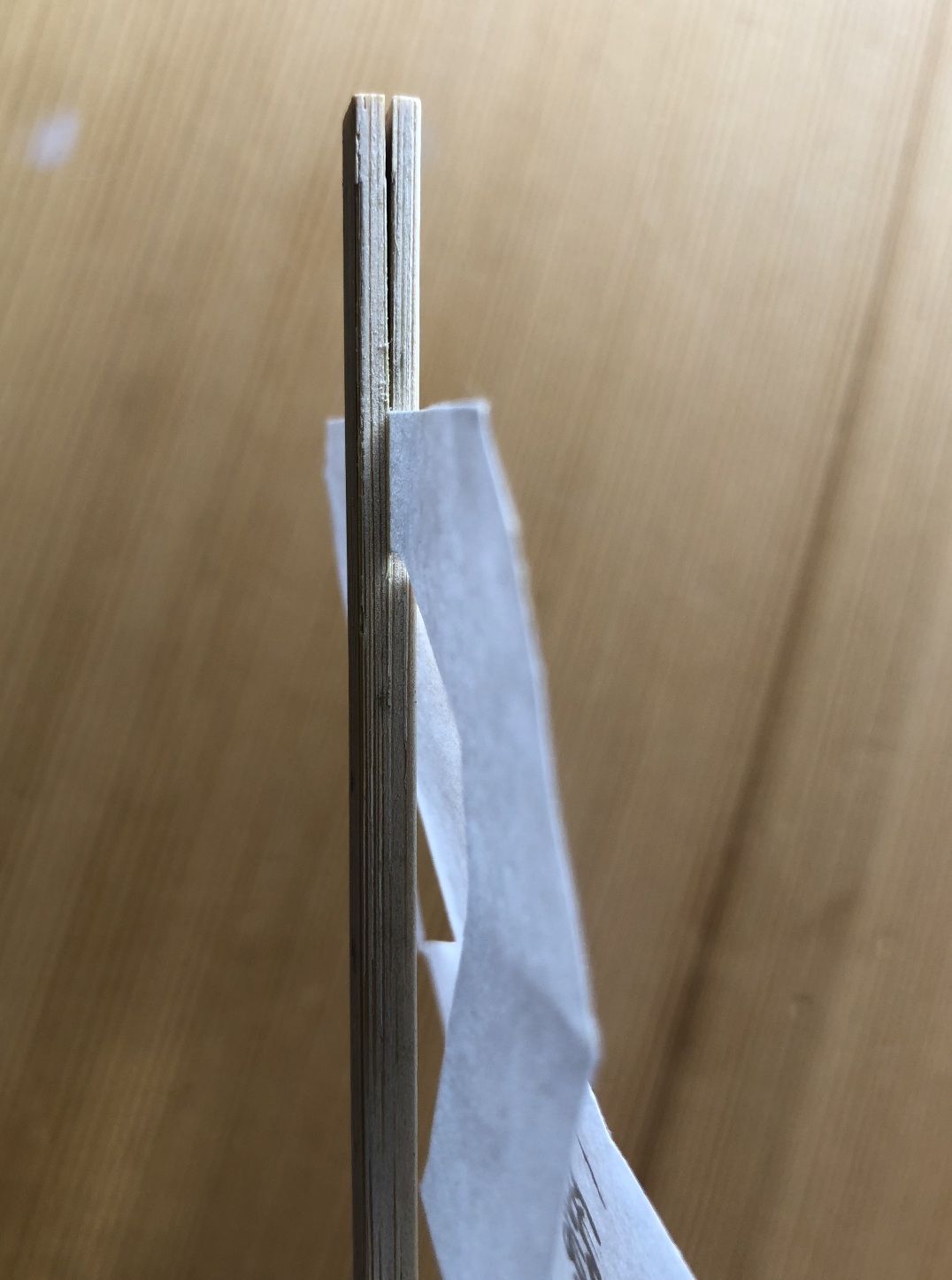
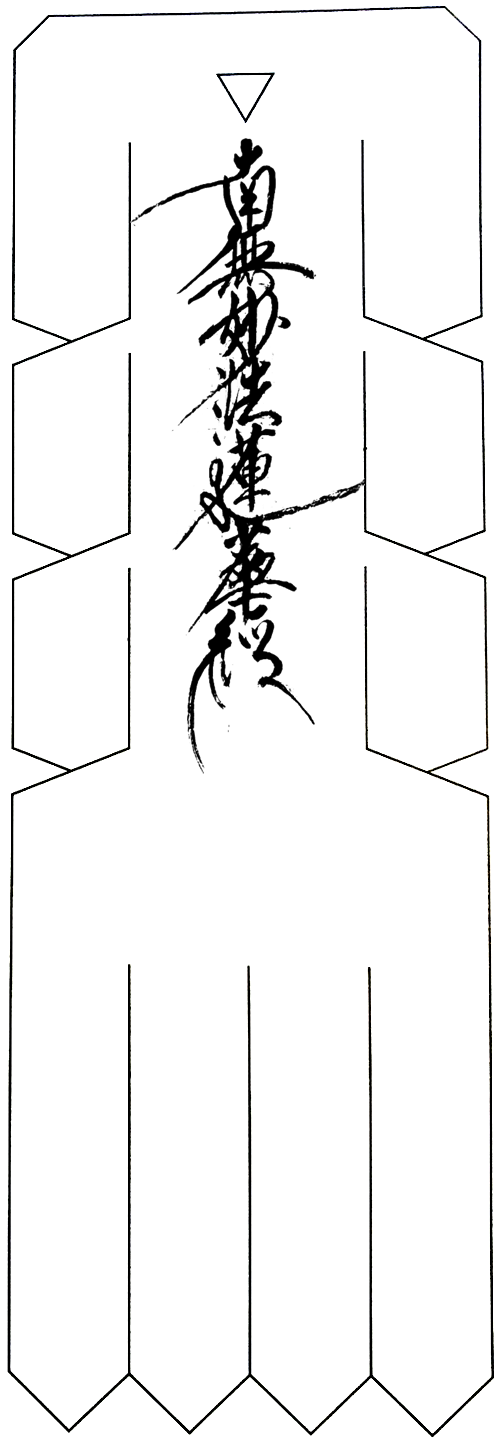
You can print it out the sutra written Segaki banners and cut it, or you
can print out the banners with no writing and write it yourself.
The sutra written in the Segaki banners are usually Odaimoku or phrases
from Chapter 16.
When you download and print out from here, don't forget to use the colored
papers.
▼ How to call yourself
Some foreign priests of the Nichiren shu call themselves "Shonin",
which is quite a mistake.
For example, if I say "Hello, I am Kumazawa shonin" about myself,
or to introduce myself as "Shonin" on the temple's homepage,
it's completely wrong.
Because the word "Shonin" is used to call priests other than
yourself with respect.
It is like a"sir".
You don't call yourself "sir" right?
The literal translation of the word "Shonin" is "higher
person".
So if you call yourself "Shonin", it's like saying "I'm
a very great priest so please respect me."
This is very embarrassing and Japanese priests would say, "Foreign
priests think they are great.".
Therefore, be careful of foreign priests who call themselves "Shonin".
▼ Proof of Kaigen (Eye-opening)
When you are doing Kaigen for the Gohonzon, Sutra book, and statues, you
should always write the proof of Kaigen on it.
There are many ways to write it..
This is the basic way to write written in Shutei Hoyo shiki.
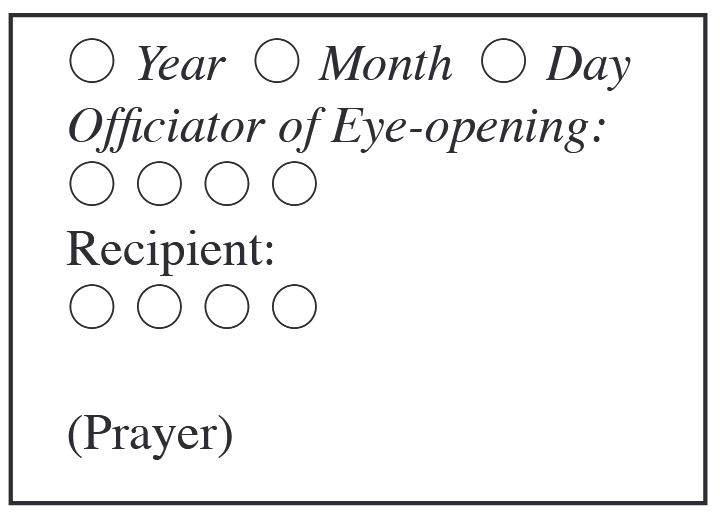
You'll need to be a priest to do the Kaigen ceremony, so if you are still a shami need to Kaigen something, ask your master to Kaigen it for you.
Everything you Kaigen should write the proof of the Kaigen.
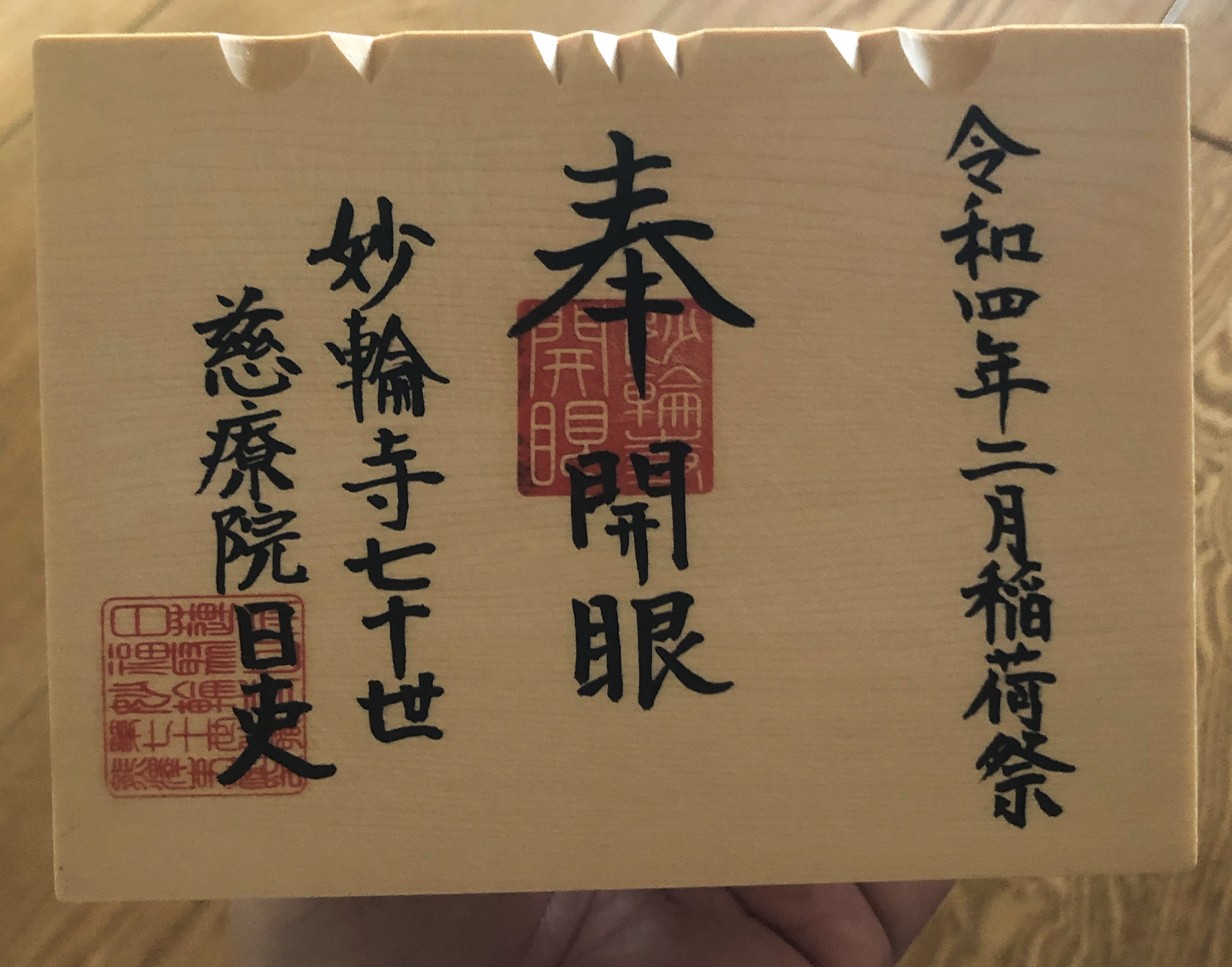
This is the Myorinji way to write the proof of the Kaigen.
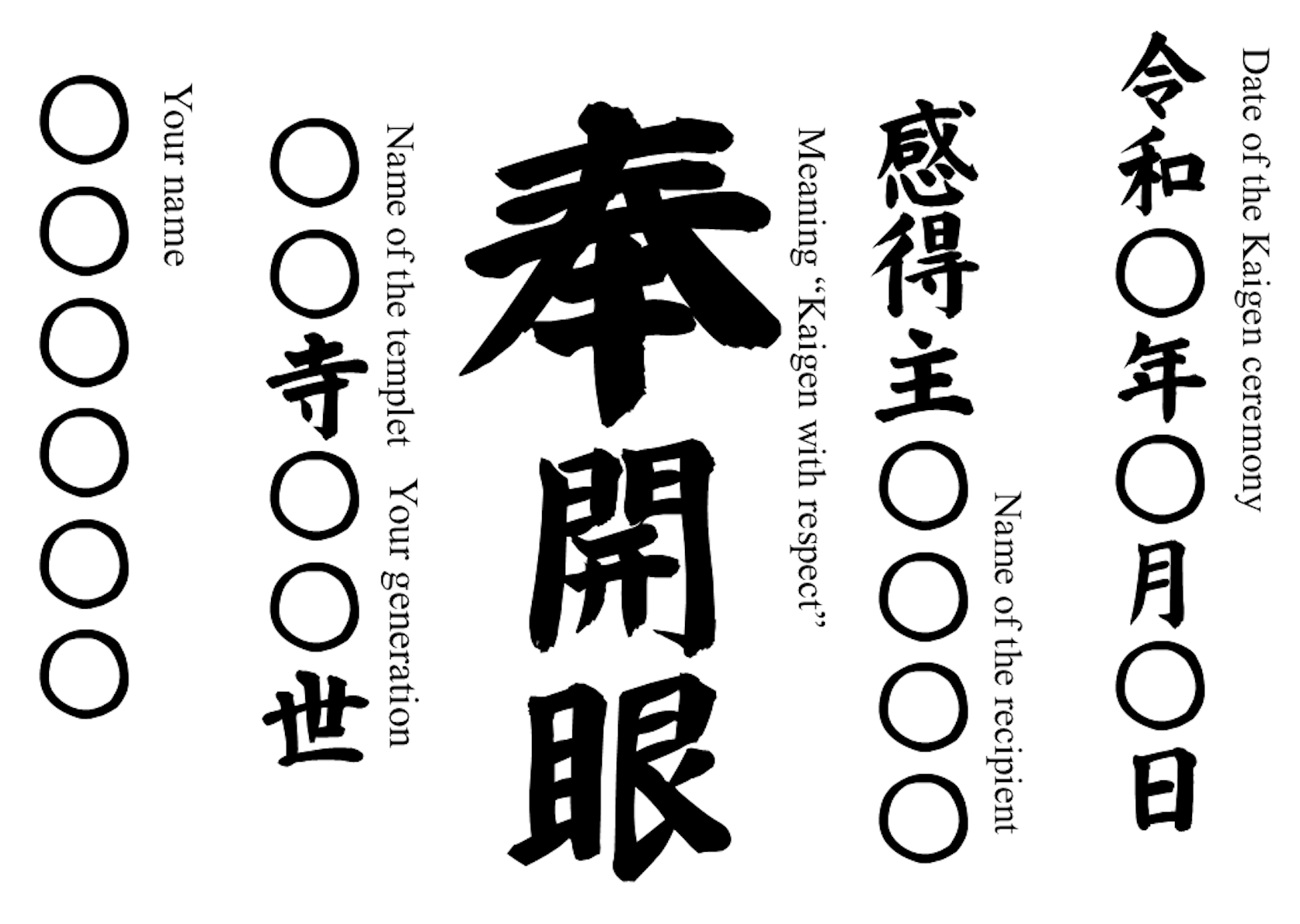
If you are doing Kaigen for something for your temple, you don't need to write the recipient's name.
If the recipient wishing for something, you should write it next to recipient's name and do the blessing for it.
When you are writing the proof of Kaigen, you should have 2 kinds of stamps.
One is "Kaigen stamp" with your temple's name on it.
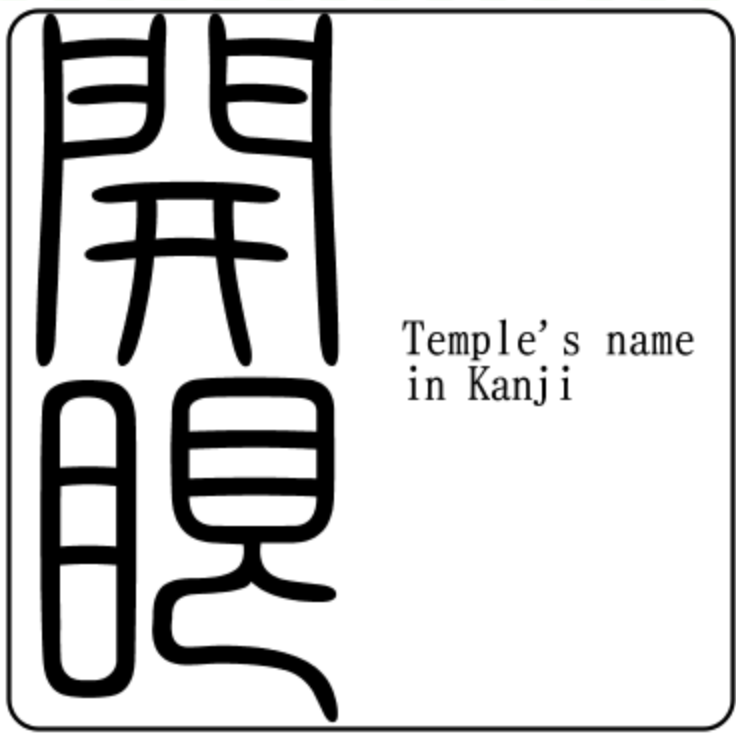
You should stamp it in the middle.
Other one is stamp with your Dharma name on it.
You should stamp it on you name.
▼ About the robes
Correct way to tie Shukin for Hon'ne
Correct way to wear Gensei 7 jou
Myorinji's original rituals
▼ Myorinji's secret techniques
Myorinji was a temple of the Shingon shu until 700 years ago, so unlike
other Nichiren shu temples, there is a unique blessing method that mixes
Shingon and Nichiren shu rituals.
These secret ritual techniques of Myorinji, which has continued for more
than 700 years, has been passed down to the chief priest of Myorinji for
generations.
Rev.Kumazawa will teach some of them for priests living abroad.
The content taught here is extremely confidential, so it is strictly prohibited to teach or show it to other Nichiren shu priest.
▼ Myorinji's Roku-San-Yoke blessing
For more information on Roku-San, see "Roku-San-Yoke" in "Learning further for the priests."
There are many ways to do Roku-San-Yoke (Avoiding Roku-San blessing).
The method differs depending on the sect, and there are also methods that
are handed down to the temple according to the tradition of each temple.
Myorinji’s Roku-San-Yoke blessing has a history of over 700 years.
Myorinji's Roku-San-Yoke blessing is very powerful so please study it here
to help those having problem with Roku-San.
Myorinji’s Roku-San-Yoke blessing
Shiki-Shidai
1. Invocation
2. Kaikyo-ge
3. Hoben-pon
4. Jiga-ge
5. Dhāranī from chapter 26
6. Sokun (Kito-sho)
7. Shodai
8. Hoto-ge
9. Eko
10. Shisei
When chanting invocation, be sure to invocate “Kishimojin” because we use
the power of Kishimojin to get rid of the Roku-San.
When chanting Dhāranī from chapter 26, chant it 9 times while you gyodo
(walk) around the person who is recieving the blessing clockwise.
Since you are walking while you are chanting it, you should memorize the
Dhāranī so you don’t have to carry your sutra with you while walking.
If you haven't memorized it yet, you should carry Ekoku and put your sutra
on it and read it while walking.
While you are chanting Shodai, use your sutra and rub off his or her Roku-San
part to get rid of Roku-San.
If the Roku-San is the head, rub his or her head with Sutra while chanting
Odaimoku.
When rubbing, you should write “Taku” on the Roku-San area with your sutra
(see “About Kishimojin” for details).
Sutra should be full Lotus Sutra, but since it is difficult to use Hakkan-bon
(8 books sutra) to rub it, you should use Nikan-bon (2 books sutra) for
rubbing.
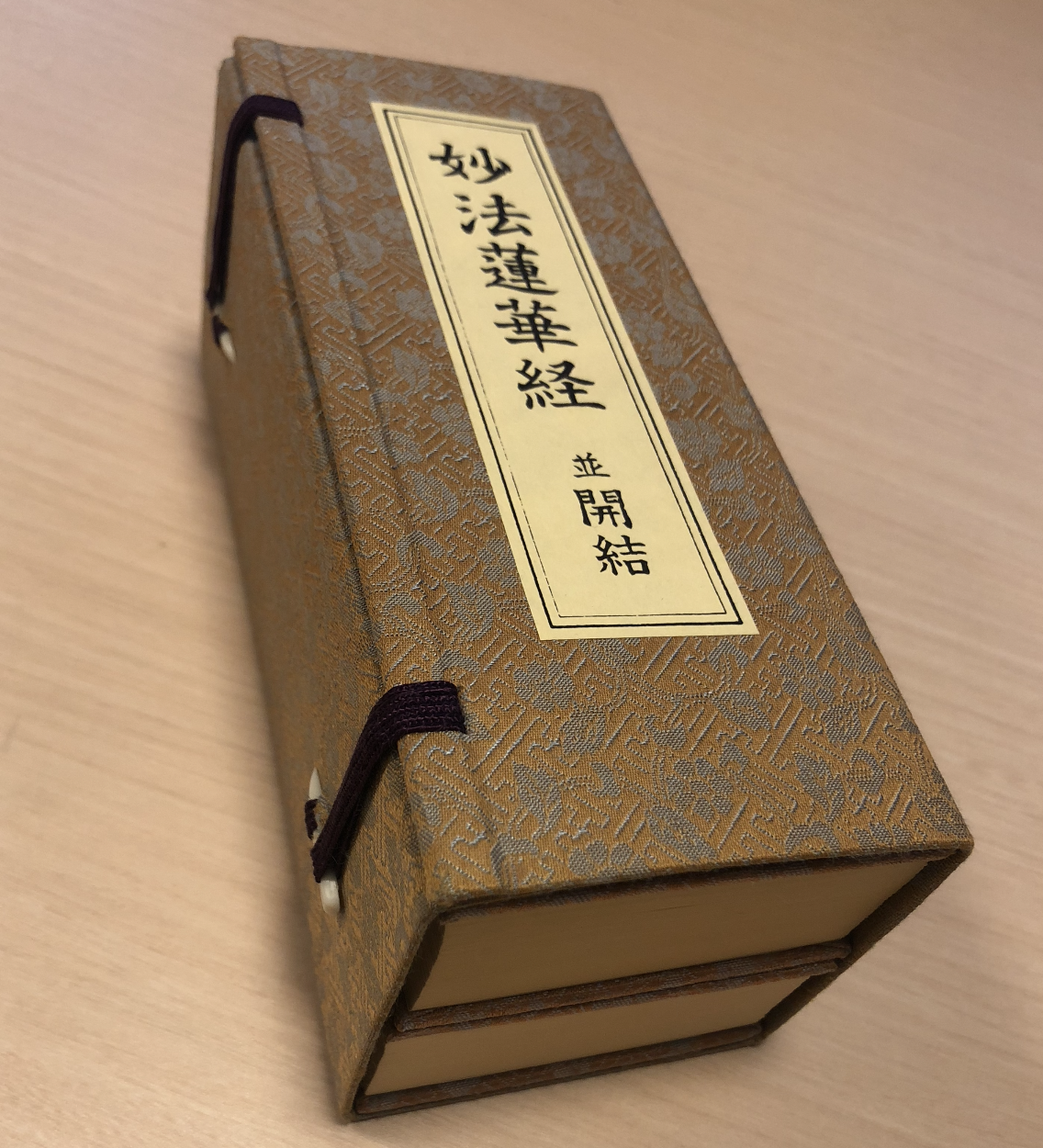
Nikan-bon
If you don’t have the Nikan-Bon, Yohon can be use but the full Lotsu sutra
will be the most powerful.
Eko should be
We humbly hold this ceremony to pray for overcoming illness from the Roku-San
with the chanting of the Lotus Sūtra as a supportive practice and the chanting
of Odaimoku as the primary practice. By this merit we pray that this 〇
year old (in kazoe doshi) named 〇〇〇〇 will recover fromsickness from Roku-San so that they can help spread the Lotus Sūtra far
and wide.
We humbly pray that the Buddha, our founder, the Three Treasures, and all
the heavenly beings, especially Kishimojin, and all others who protect
the practitioners of the Lotus Sūtra ameliorate the sickness in this body
with the power of their sacred dhāranī spells of great compassionate protective
intentions.
May Roku-San fall back immediately and suffering quickly vanish. May the
medicine be well pounded and sifted and the four elements be brought back
into harmony.
May the medicine be efficacious and the vital power be restored as before.
May he/she be protected as the sūtra says, “the patient who hears this
sūtra will be cured of his disease at once. He will not grow old or die.”
The Lotus Sūtra is the wondrous principle and Śākyamuni Buddha’s golden
words. Have faith and be rid of falsehood. Be receptive to the Buddha’s
response and receive his merciful protection.
Namu Myouhou Renge Kyou
Myorinji's original Roku-San-Yoke Ofuda
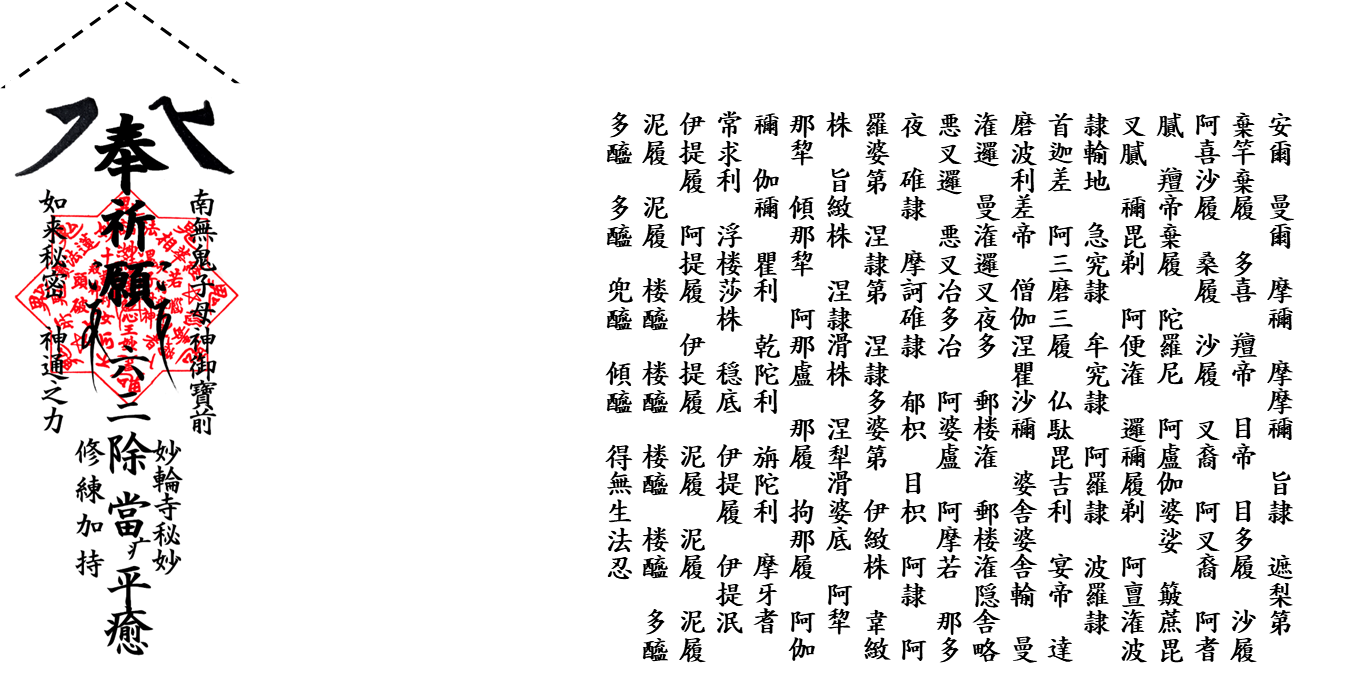
Make the Roku-San-Yoke Ofuda and give it after doing Roku-San-Yoke Blessing.
This Ofuda is a small Ofuda that you always carry around, so make it small
enough to fit in your wallet.
Those who want to get rid of their Roku-San, chant Odaimoku while rubbing
their Roku-San area with this Ofuda. Do this 3 times a day.
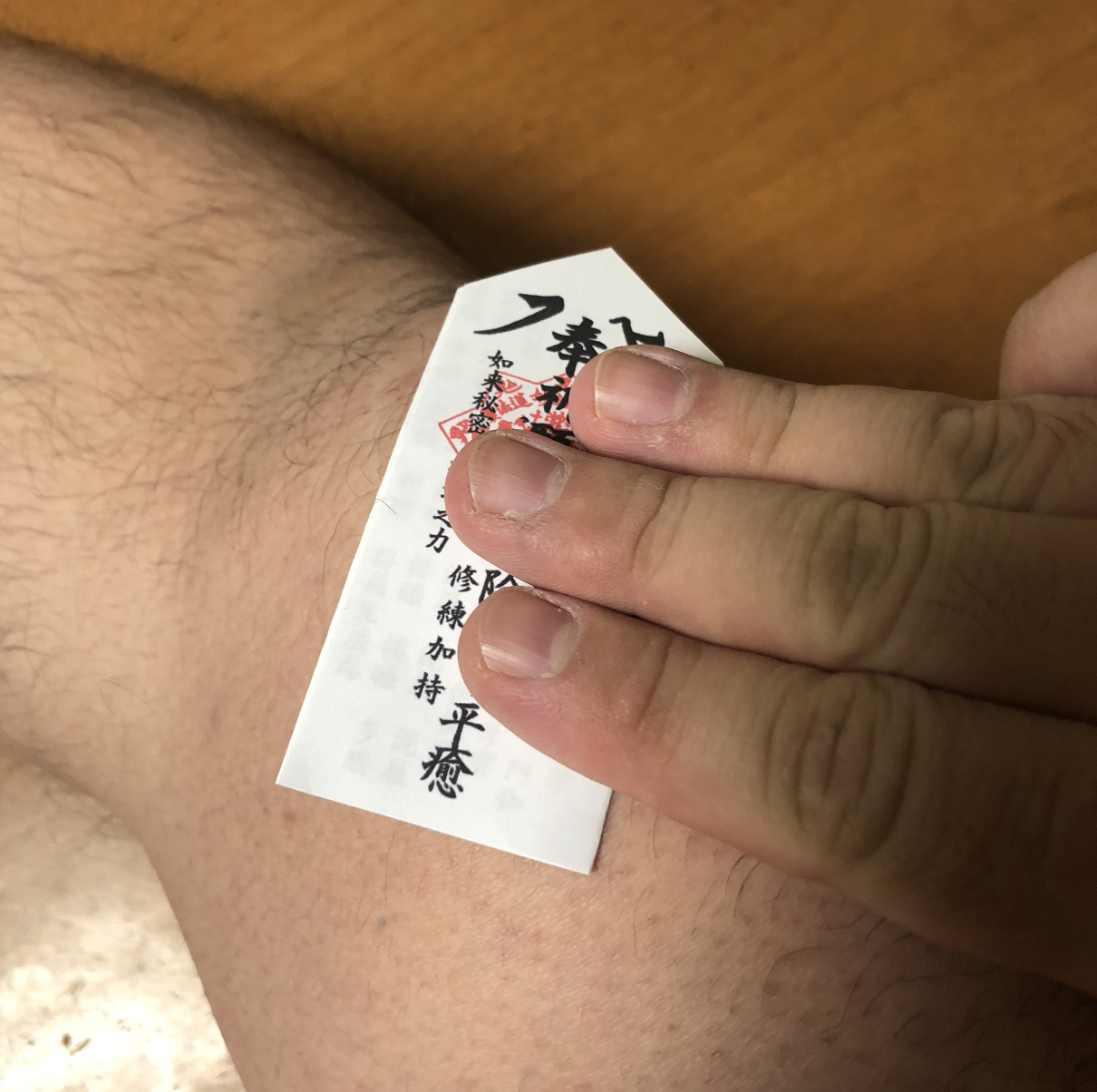
If the Roku-San is your knee, rub it with this Ofuda while you are chanting Odaimoku
Use this Ofuda every day for a year to rub Roku-San area, so you need to
make it very strong so it can't be torn off.
Therefore, it must be with many sheets of paper, not one thin Ofuda.
You should use Washi (Japanese paper) or thick paper to make it.
Write the name of the person who is getting blessed on the back of the
Ofuda.
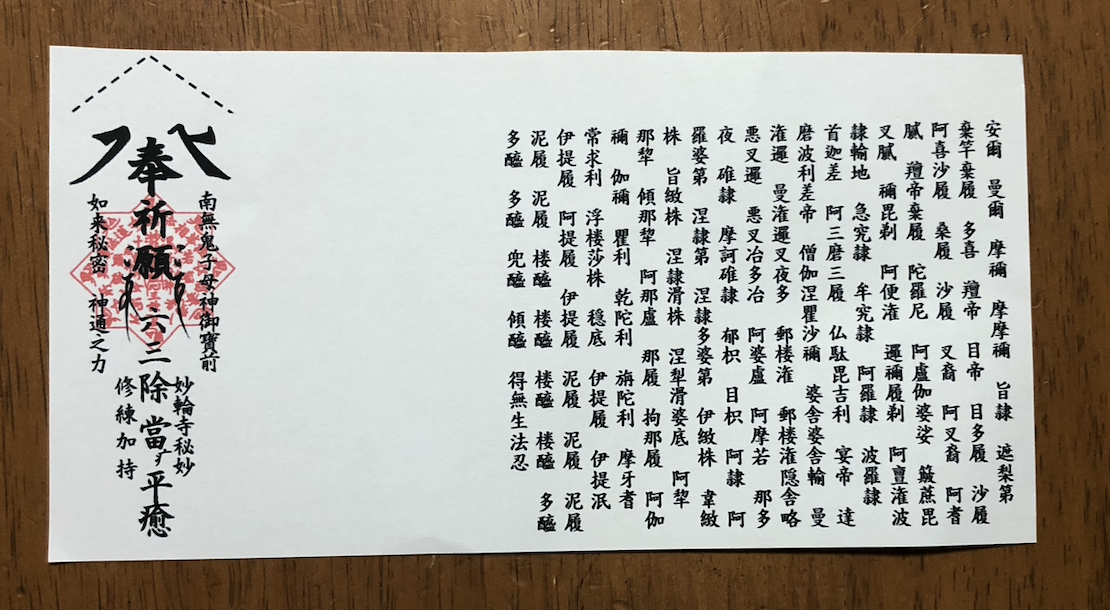
Print it out with Washi or thick papers
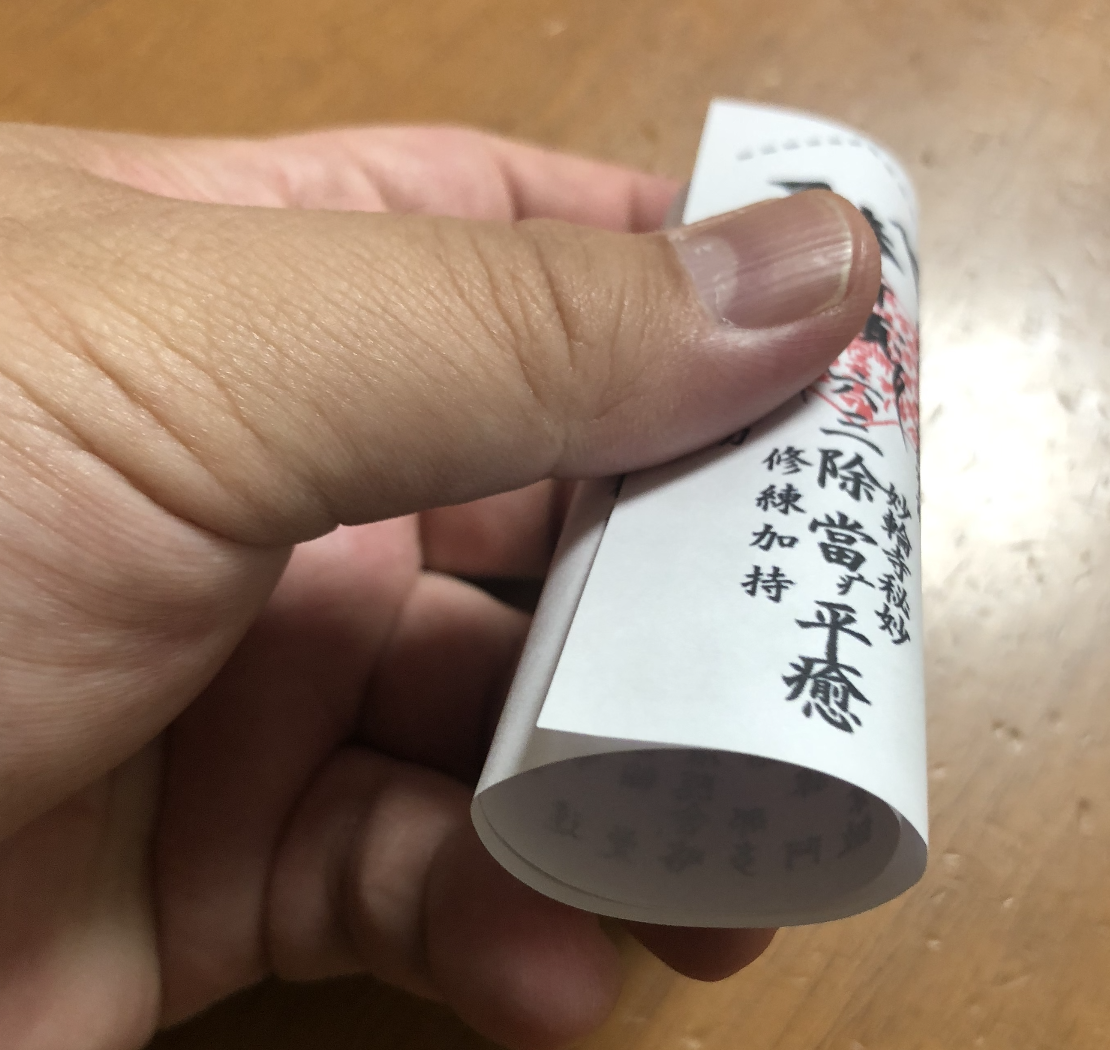
Roll it
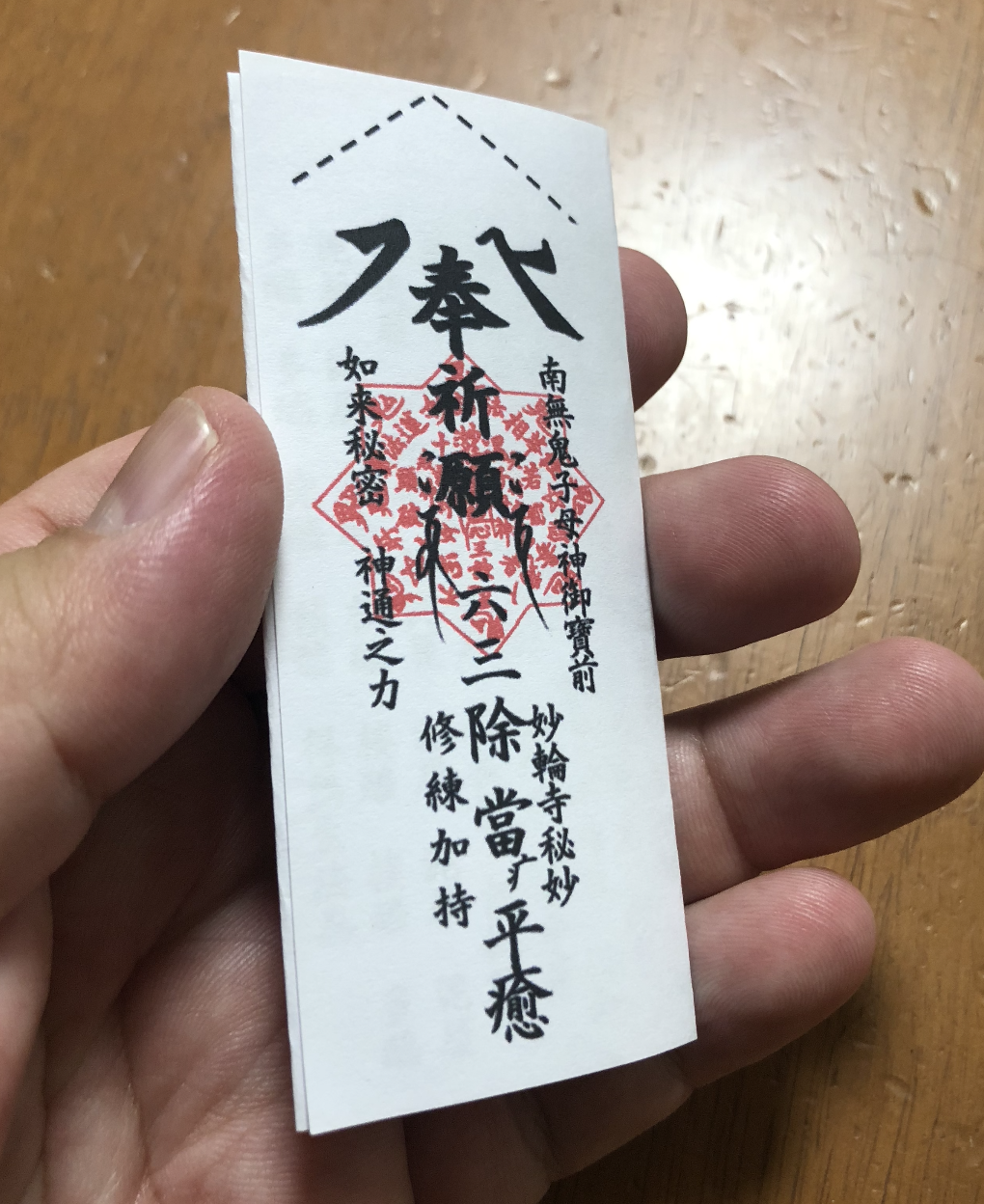
Fold and glue it
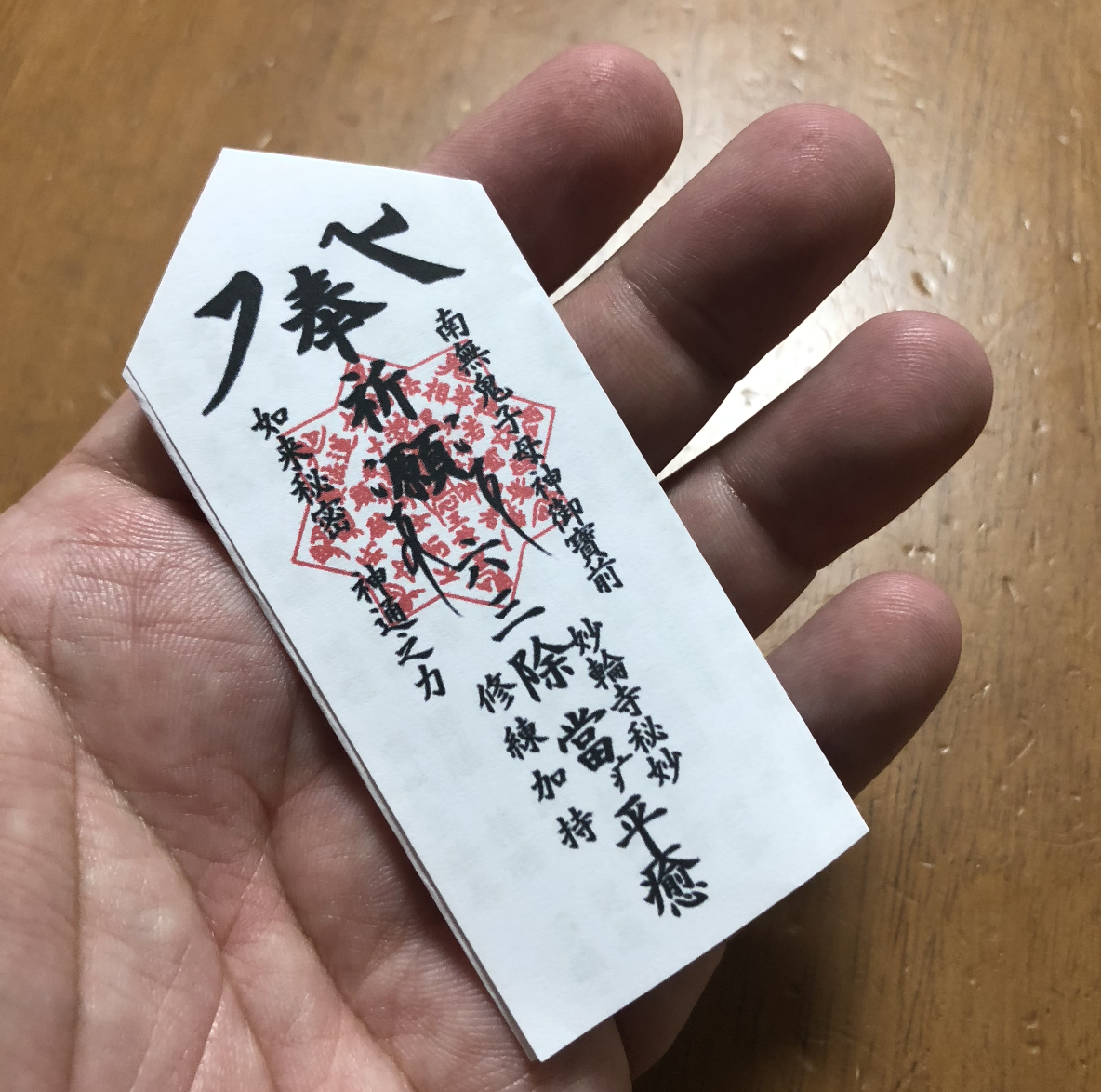
Cut the dotted line with scissors. Be sure to Kaigen Kishimojin it before giving.
▼ Myorinji's blessed purifying salt
As you already know, in Japanese Buddhism, salt is used to purify various
things.
This is originally from Shinto, a traditional Japanese religion.
According to Japanese legend, a god called Izanagi went to the land of
Yomi (underworld where the dead live) to meet his wife who died.
He returned from the underworld, but is said to have used seawater to cleanse
the filth of the underworld.
Therefore, Shinto has a tradition of purifying various things with salt.
This legend has been strongly believed because salt originally has bactericidal
and antiseptic effects.
In ancient Japan, there was a time when Shinto and Buddhism were combined,
and salt purification was also incorporated into Buddhism.
Even today, Japanese people use salt to purify various things.
Many shrines and temples in Japan sell the blessed purifying salt, and many worshipers buy it.
Of course, Myorinji also sells blessed purifying salt, but since the salt at Myorinji is so powerful, worshipers from all over the country come to buy it.
The reason why the blessed purifying salt of Myorinji is so powerful is that the blessed purifying salt is made by the secret blessing method of Myorinji.
It's very difficult to make, but it's very powerful, so please make it and help the members of your temple.
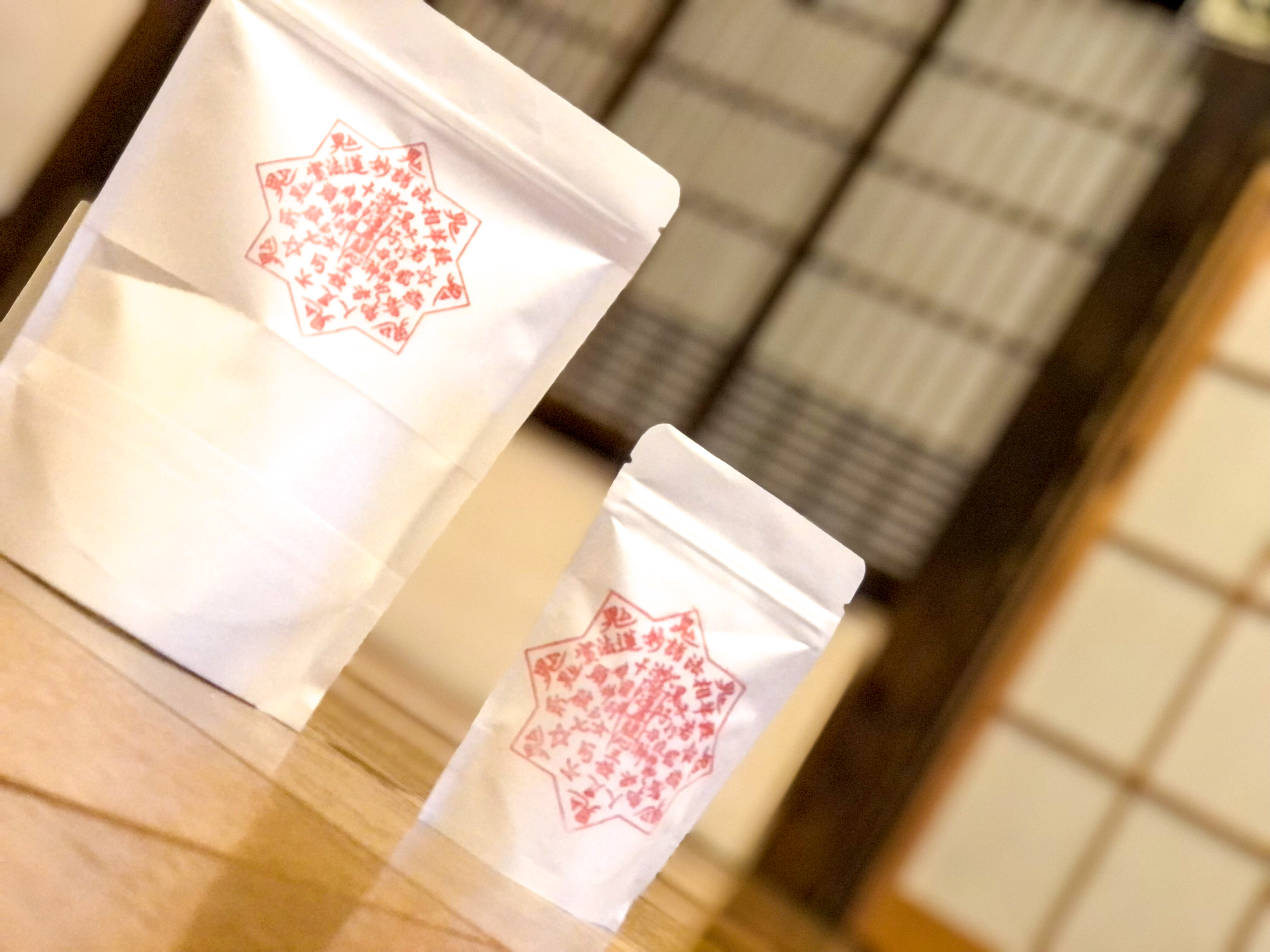
First, prepare salt without impurities.
Next, prepare paper bags of various sizes to store the salt.
A paper bag with a zip lock is suitable to protect the salt from moisture.
Stamp the paper bag with Happou-Yoke.
If you cannot prepare the Happou-yoke stamp, please print it and paste
it on the paper bag.
Put salt in a paper bag and place it on the altar for 100 days to pray
every day.
Daily morning and evening services are not enough, so by chanting "Dhāranī
from chapter 26" every day for the salt, the power of Shoten Zenjin
Sutra dwells in the salt.
For the last 7 days of the 100 days, let the salt "Gekko yoku".
"Gekko yoku" means moonlight bathing.
In Japan, it has been said from ancient times that the moonlight has the
power to purify evil.
For the last seven nights, "Gekko yoku" the salt so that the
moonlight's power goes in it.
Be sure to store the blessed salt in a stamped paper bag.
This stamp not only gives power to salt, but also protects it from evil.
I will explain how to purify with this salt in the video
When you do the blessing service for a member of the temple, you may receive
the evil that the member had.
Therefore, be sure to purify yourself with this salt after the blessing
service.
Download contents
▼ Templates for making ofuda and stamps
Use only in your temple
Sharing to non-members is prohibited
▼ Nichiren shu crest and emblem


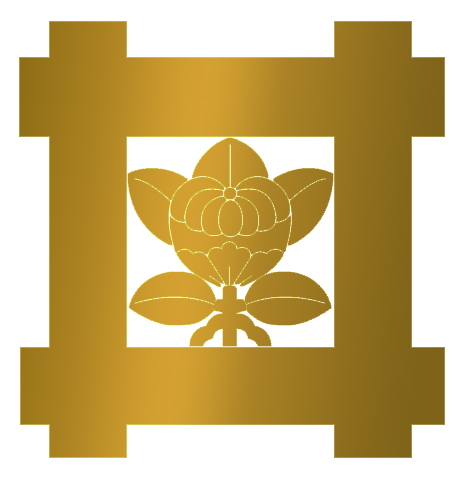
Nichiren shu crest "Igeta ni Tachibana"




Nichiren shu emblem
▼ Round basic mandala
The most basic round mandala.
This mandala crest is widely used as a Goshuin red stamp at Nichiren-shu
temples in Japan.
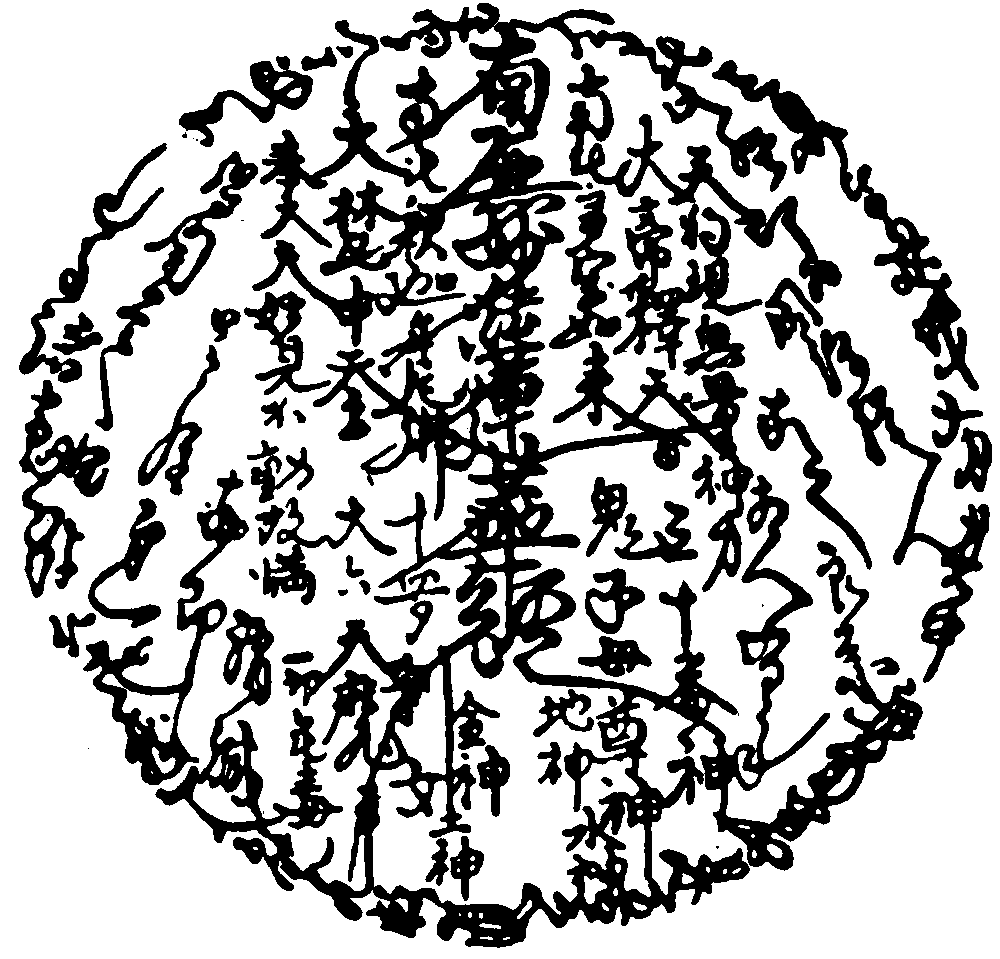
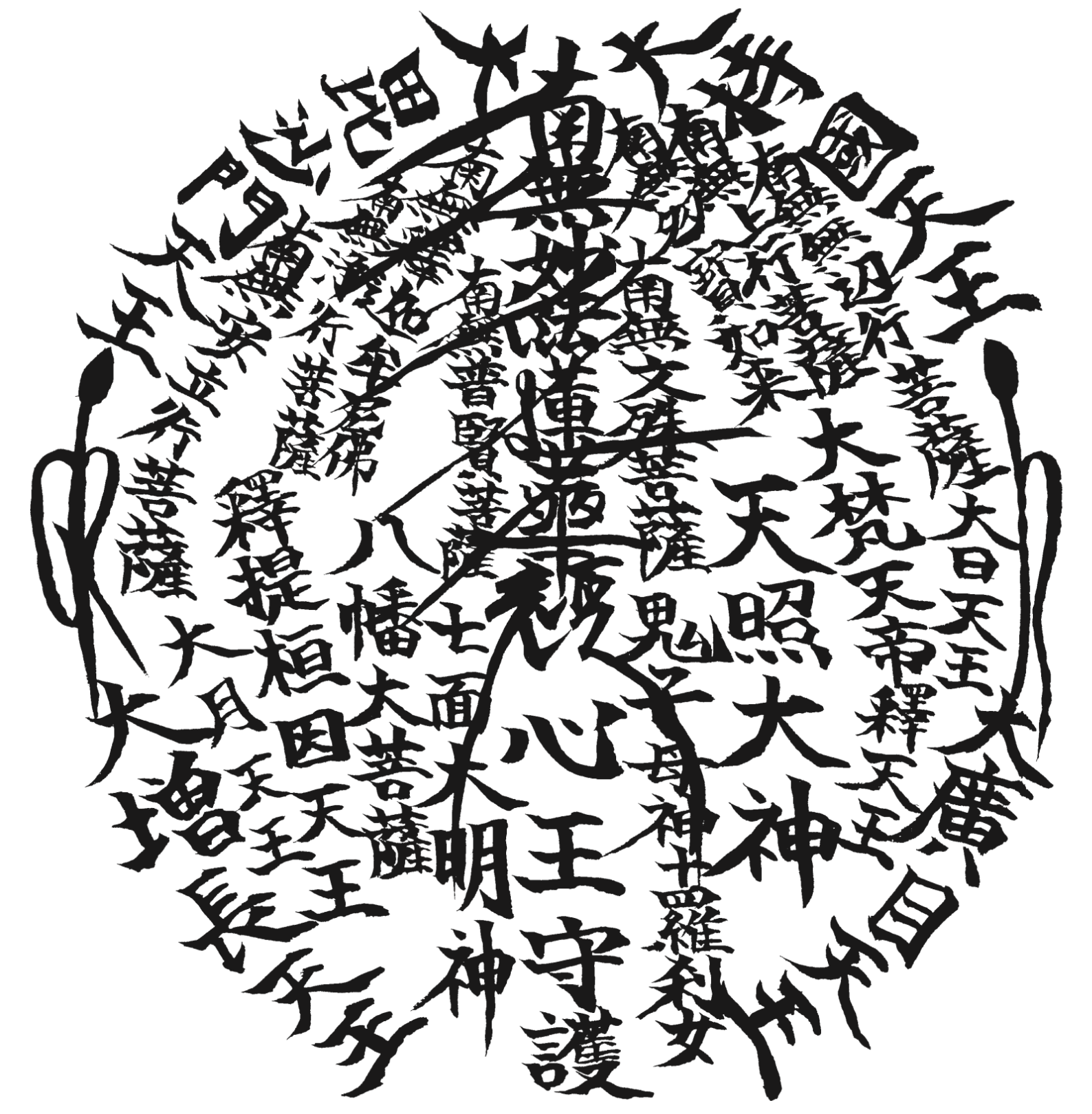
▼ Round Shin'nou mandala
This is the "Shin'nou" protection mandala written by Rev. Riju
Kumazawa.
In the lower middle below the Odaimoku, you will see "Shin'nou Shugo", literally means "Heart king protection".
Shin'nou means "Buddha nature in your heart", so it will be "Protect your Buddha nature".
This mandala will be very powerful ofuda to protect Buddhists.
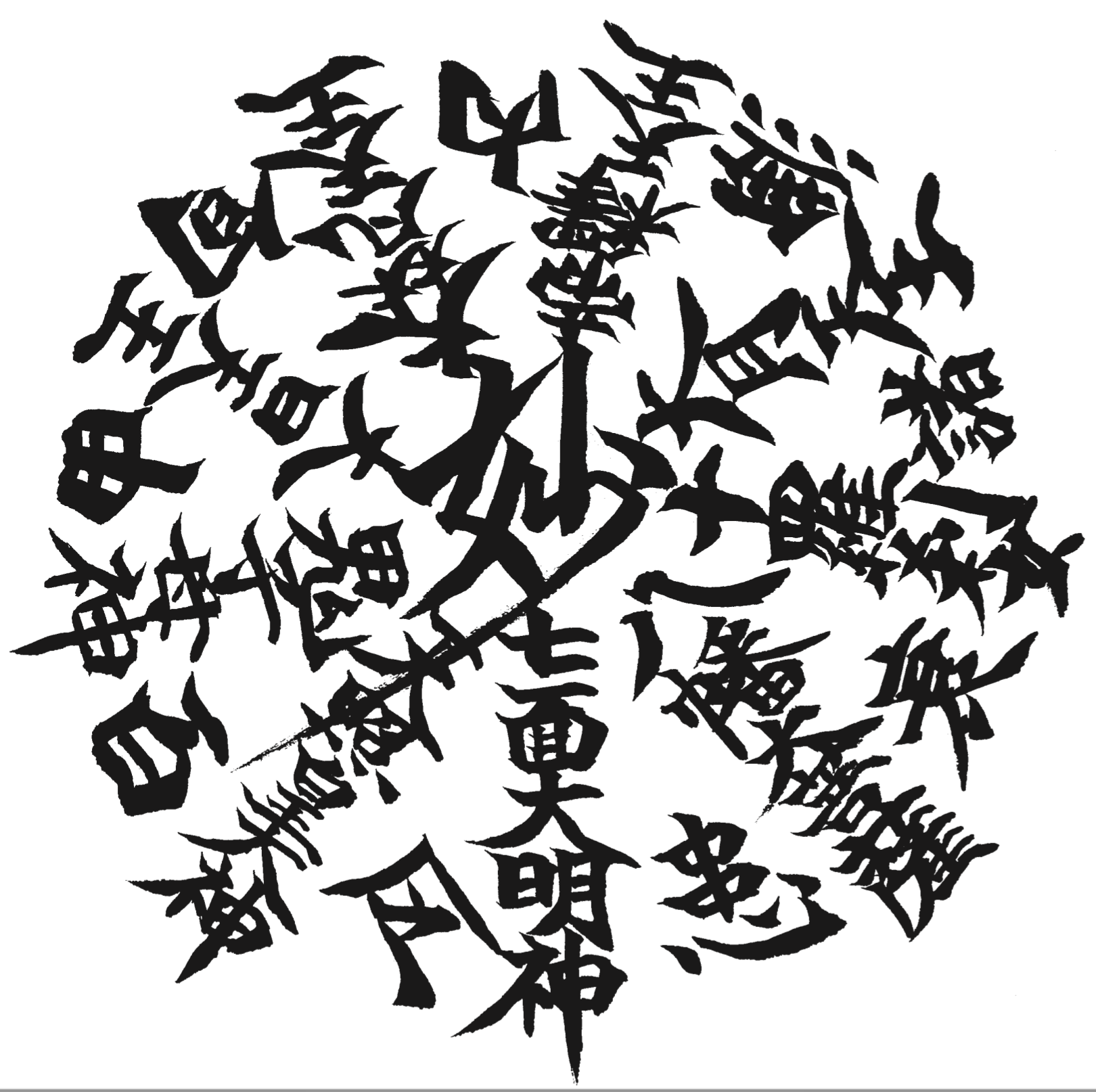
▼ Round 9 Gods mandala
This is a mandala by 9 gods written by Rev. Riju Kumazawa.
>Shichimen-Daimyojin
>Tenshoukou-Daijin
>Kishimo-Jin
>Dainichi-Ten'nou
>Daibon-Ten'nou
>Taishaku-Ten'nou
>Daigatsu-Ten'nou
>Jurasetu-nyo
>Hachiman-Daibosatsu
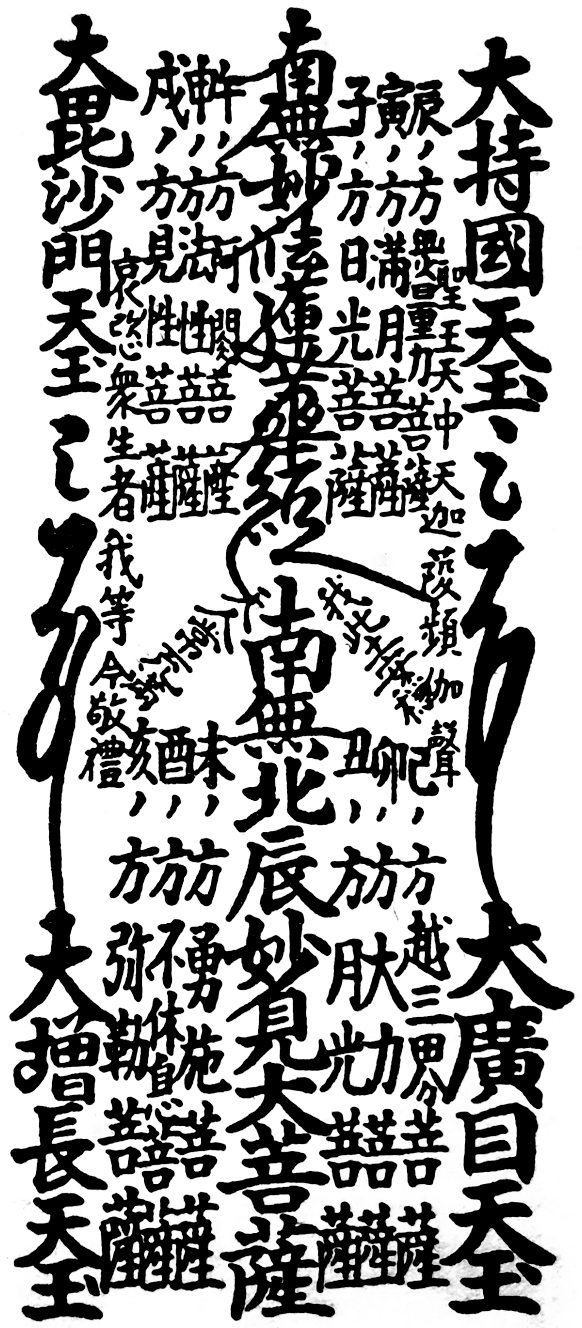
▼ Myoken-bosatsu mandala
The basic type of mandala with "Namu Hokushin Myoken-Daibosatsu" written in the lower middle.
The word "Hokushin" means "Polaris".
Myoken-bosatsu often called "Hokushin-bosatsu" because it is
said that the Polaris became Myoken-bosatsu.
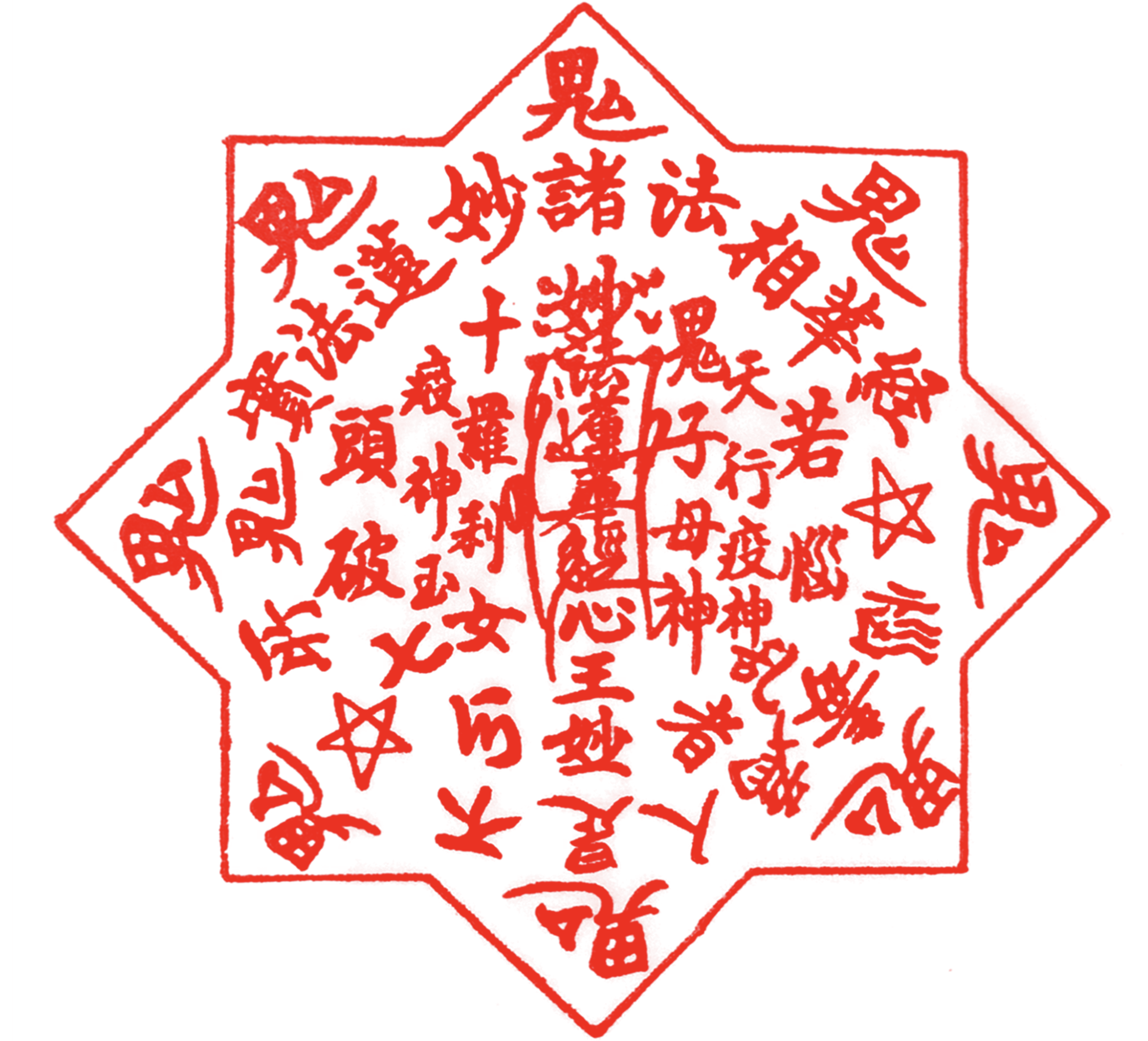
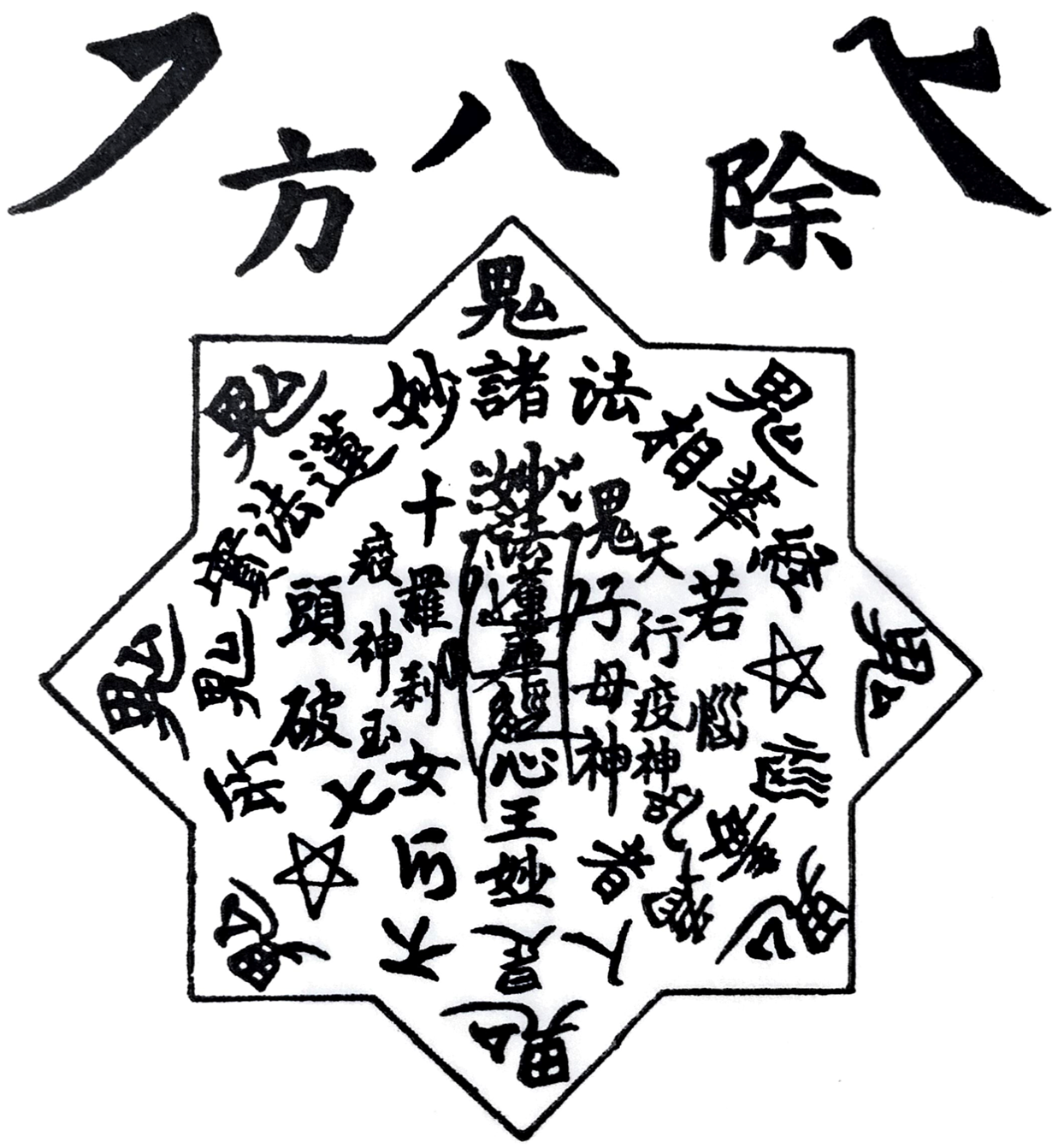
▼ Happou-yoke (Protection from eight directions)
"Happou" meaning the eight directions.
The eight directions are East, West, South, North, Northeast, Northwest, Southeast,and Southwest.
It is called eight directions, but it means protecting from all directions.
"Yoke" meaning "exclude".
Happou-yoke is very common among ofudas, and many of the Japanese ofudas are Happou-yoke.
The marks on the upper left and right are the marks that represent the
Shiten-ou (four heavenly kings).
▼ Saijo Sanjin crest (3 Superior gods crest)
These 3 crests are from Saijo Inari.
Inari needs to pray with Sanmen-Daikokuten and Hachidai-Ryuo.
If you are making Inari ofuda, You should add these 3 crests to it.

Inari crest
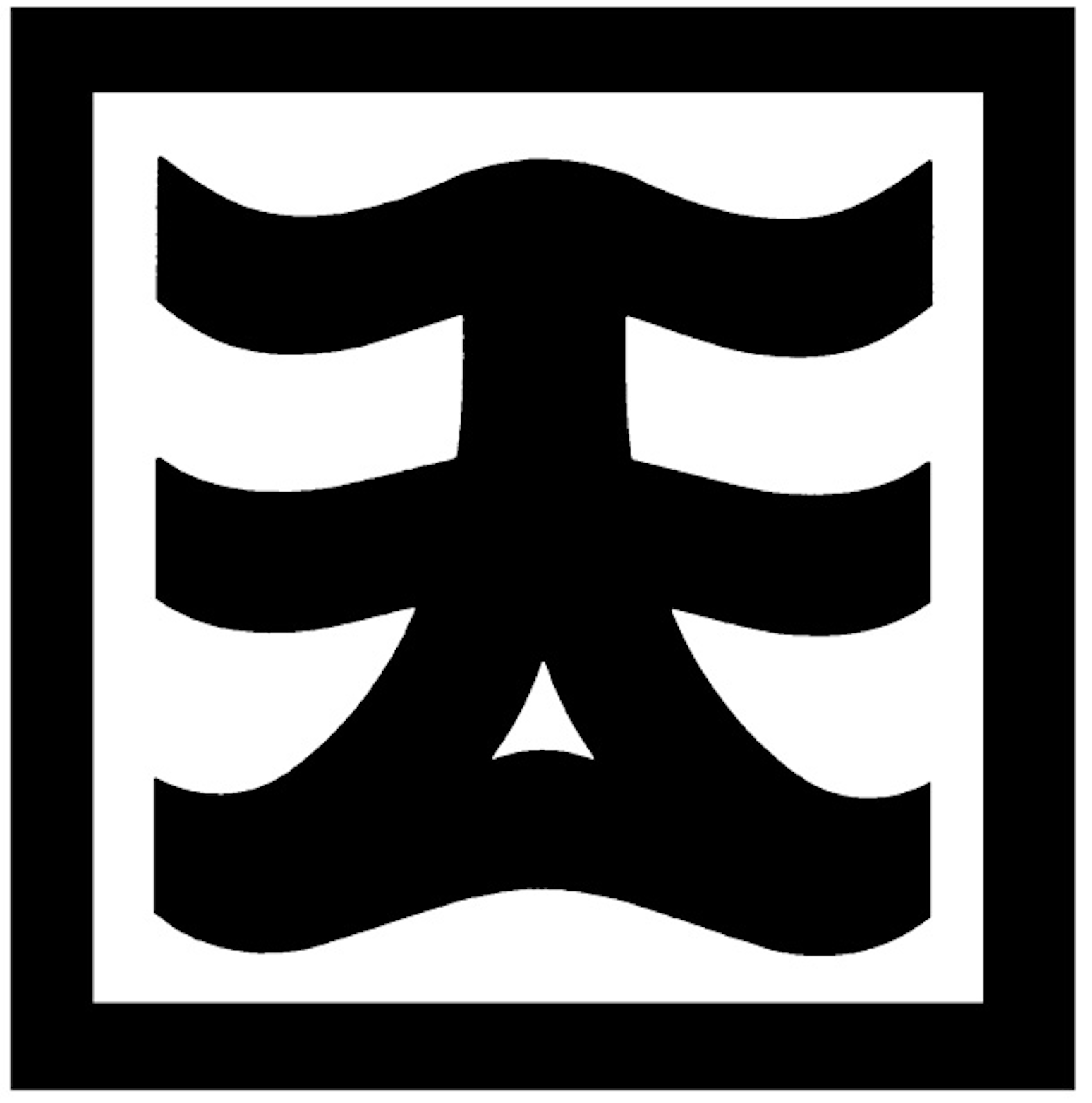
Sanmen-Daikokuten crest
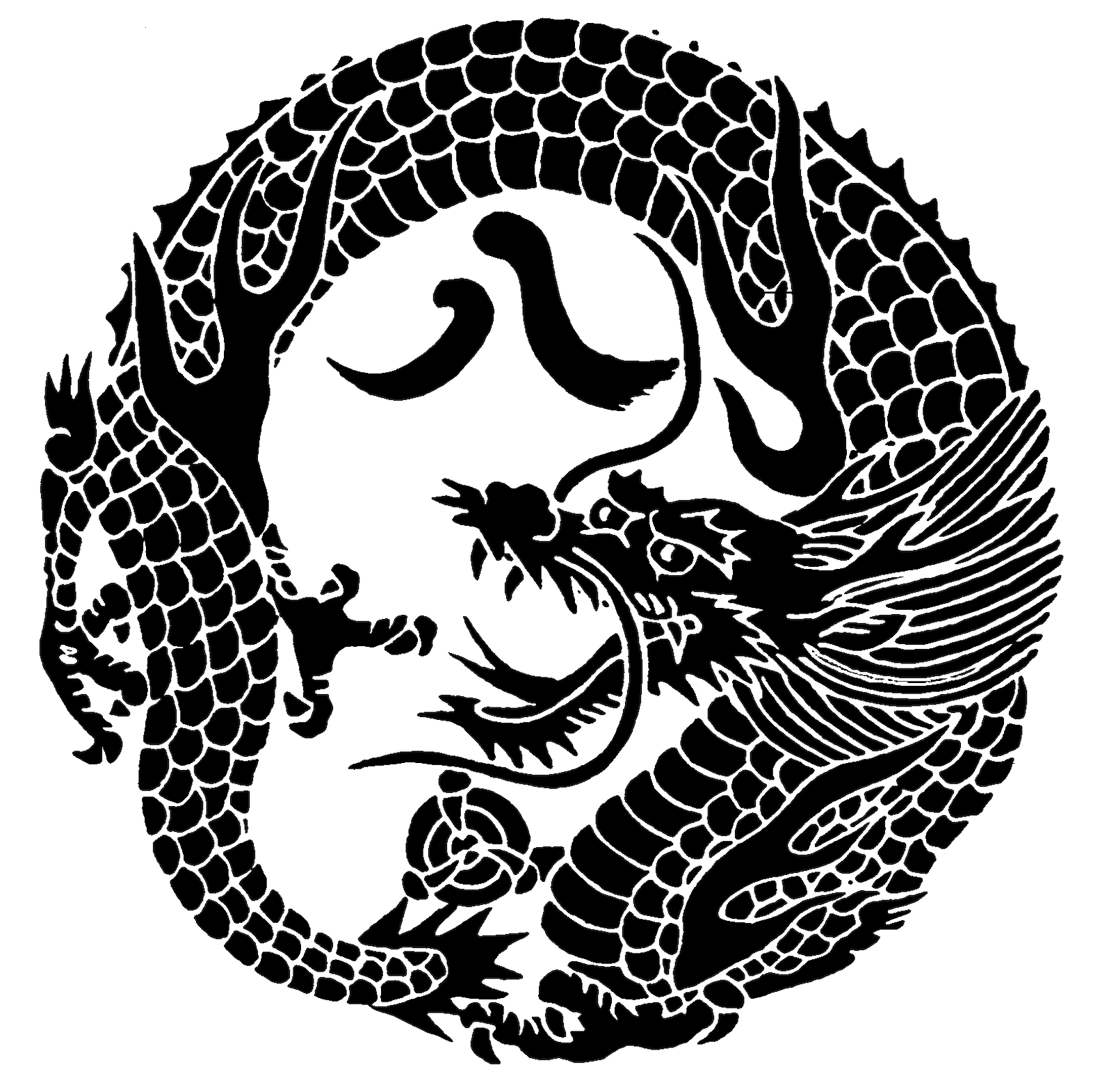
Hachidai-Ryuo"
▼ Inari (Saijoi-Kyouo-Daibosatsu)
There are various types of Inari in Japan.
It is roughly divided into Shinto Inari and Buddhist Inari.
And there are various types of Buddhist Inari.
Inari is actually a nickname, and its identity depends on the sect.
Inari of the Nichiren shu is called "Saijoi-Kyouo-Daibosatsu",
and its identity is the Bodhisattva of the Lotus Sutra.
"Saijoi" meaning "Superior, "Kyouo" meaning "King
of the sutra".
2
These "Hige-daimoku" like Letters are written by Rev. Riju Kumazawa
as Saijoi-Kyouo-Daibosatsu.

▼ Sanbo-in (Three treasure mark)
Sanbo-in represents Three treasures of Nichiren shu. The star and heart
Sanbo-in is Myorinji's original created by Rev. Riju Kumazawa.
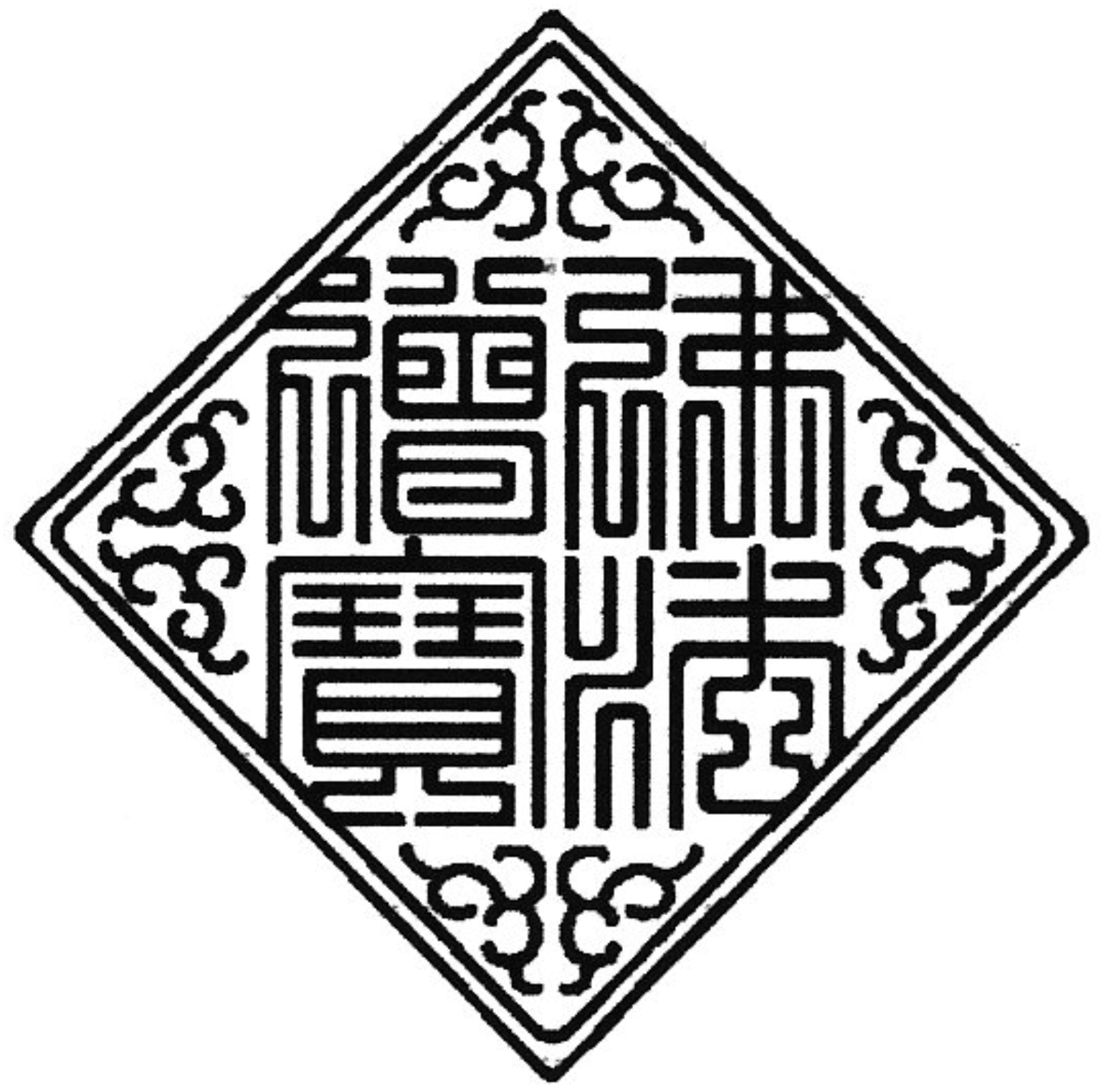
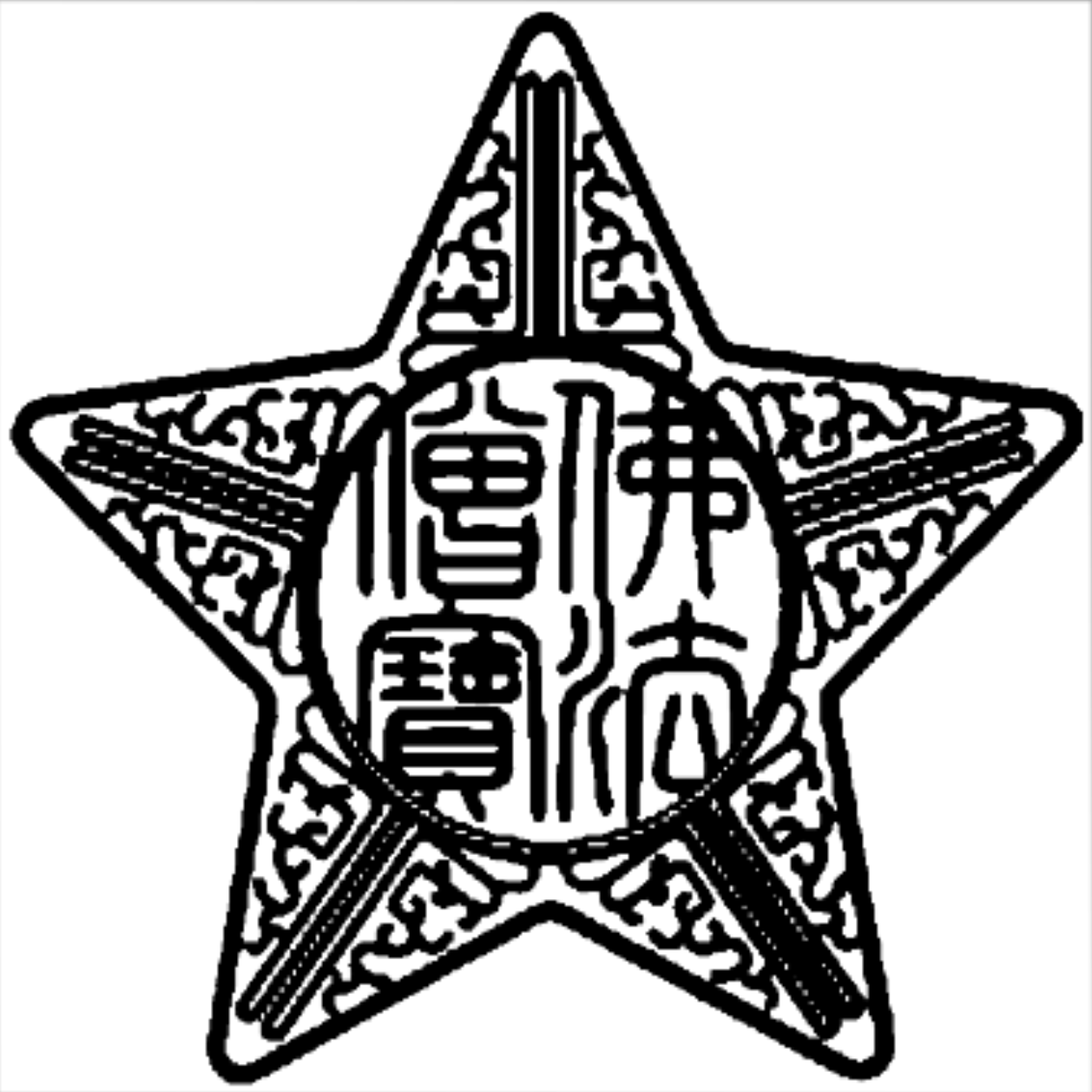

▼ Bon-ji (Sanskrit characters)
Bon-ji (Sanskrit characters) from Daimandara.

Aizen-myo-ou

Fudo-myo-o
▼Roku-San-Yoke
See "Myorinji's original rituals" for more informations about
Roku-San-Yoke.
▼ Shōmyō master lecturers
Rev. Riju Kumazawa
Chief priest of Myorinji
Nichiren shu Shōmyō master
Saijō Inari Kitō blesser
Goshuin Artist
Administrator of the Myorinji International Missionary Network

Rev. Gishin Seita
Deputy chief priest of Honrenji
Nichiren shu shōmyō master
Nichiren shu Shōmyōshi Federation secretariat
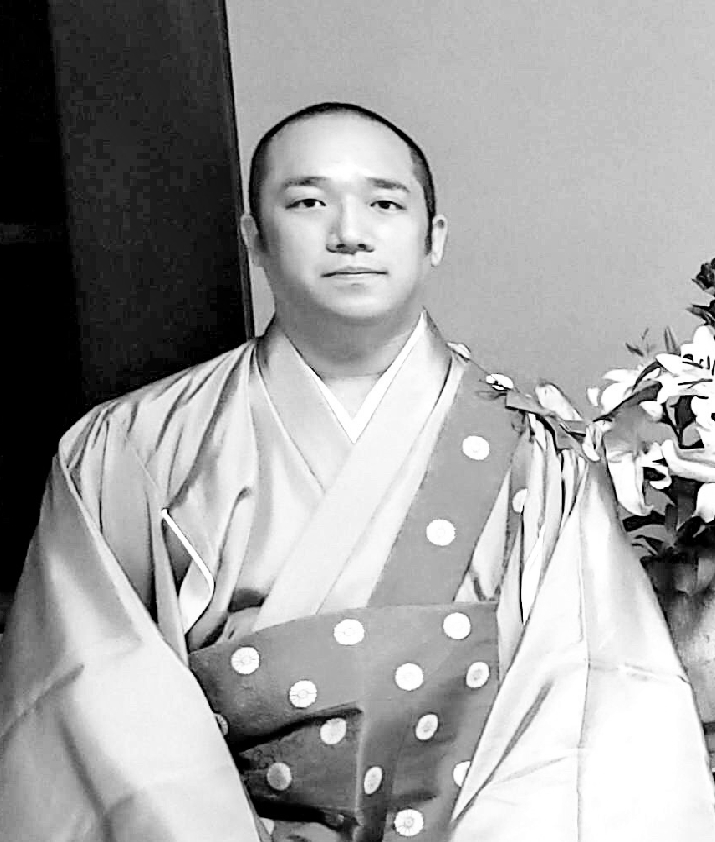
Rev. Shogyo Kobayashi
Deputy chief priest of Daikyuji
Nichiren shu shōmyō master
Nichiren shu Shōmyōshi Federation secretariat